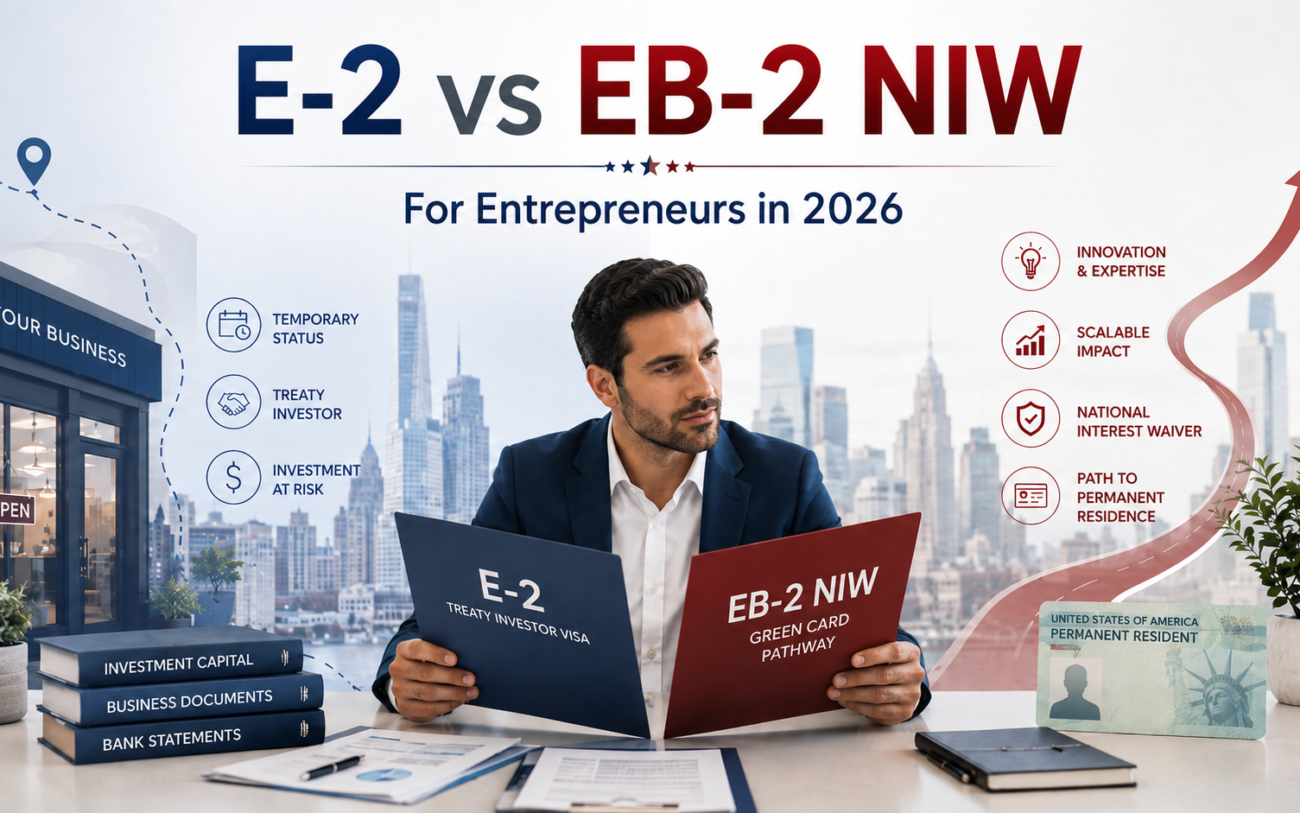
E-2 Visa vs. EB-2 NIW for Entrepreneurs in 2026
Last Updated on July 2, 2026 by Amelia
Written by Emily Carter, Immigration Law Specialist
Reviewed by Jonathan Miller, Esq., Licensed U.S. Immigration Attorney
E-2 Visa vs. EB-2 NIW for Entrepreneurs in 2026: Which U.S. Path Fits Your Business?
Entrepreneurs continue to play a major role in the U.S. economy, especially in technology, healthcare, clean energy, digital services, advanced manufacturing, logistics, education, and professional services. For many foreign founders and business owners, the United States remains attractive because it offers access to capital, customers, research networks, talent, and a large commercial market.
Two immigration options are often discussed by entrepreneurs: the E-2 Treaty Investor visa and the EB-2 National Interest Waiver, also known as EB-2 NIW. Both can support entrepreneurial activity in the United States, but they serve different purposes. The E-2 visa is a temporary, treaty-based investor route. EB-2 NIW is an immigrant petition that may lead to permanent residence if the case is approved and an immigrant visa number is available.
This distinction matters. An entrepreneur who wants to enter the United States quickly to buy, launch, or manage a business may look first at E-2. An entrepreneur whose work has broader national importance and who wants a green card strategy may consider EB-2 NIW. In some cases, both routes may fit different stages of the same long-term plan.
This updated 2026 guide explains the major differences, current policy considerations, evidence expectations, and strategic choices for entrepreneurs comparing E-2 and EB-2 NIW.
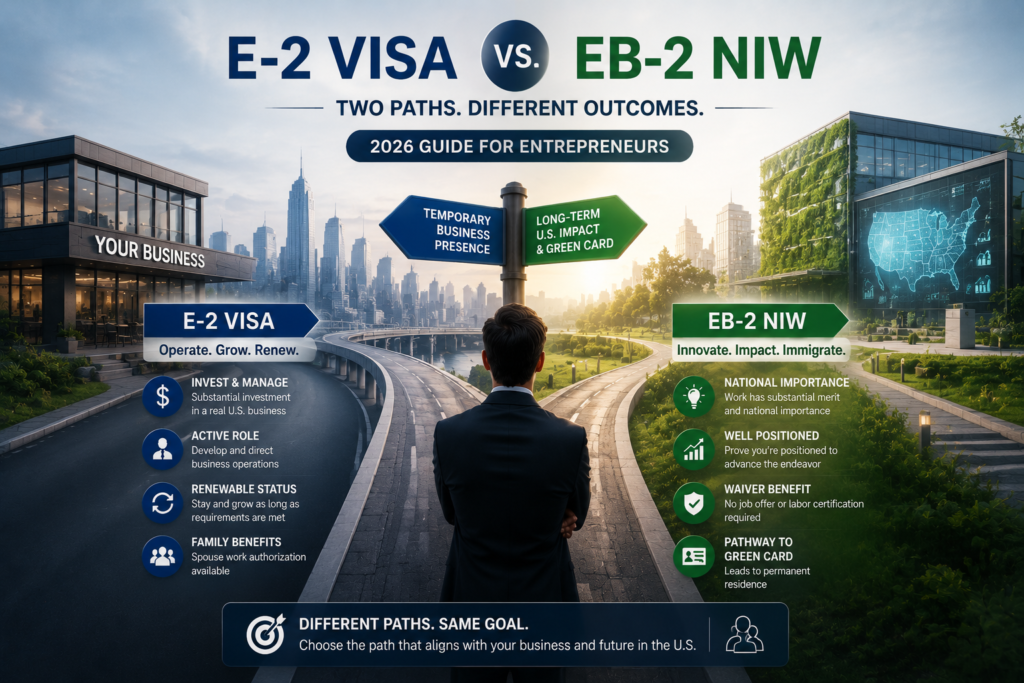
E-2 Visa vs. EB-2 NIW
The E-2 visa is usually better for treaty country entrepreneurs who have already invested, or are actively in the process of investing, substantial capital in a real U.S. business and want to develop and direct that business in the United States.
EB-2 NIW is usually better for entrepreneurs whose work has substantial merit and national importance, who meet the EB-2 advanced-degree or exceptional-ability threshold, and who can show they are well positioned to advance a business or project that benefits the United States beyond private profit alone.
| Question | E-2 Treaty Investor Visa | EB-2 NIW |
| Is it temporary or permanent? | Temporary nonimmigrant visa/status. | Immigrant petition that can support a green card process. |
| Who can apply? | Only nationals of qualifying treaty countries. | All nationalities may qualify if the legal standard is met. |
| Is investment required? | Yes. The investment must be substantial, committed, and tied to a real operating enterprise. | No fixed investment requirement, but business traction and resources can help. |
| Does it directly lead to a green card? | No direct green card path from E-2 itself. | Yes, if the I-140 is approved and the priority date is current. |
| Main legal focus | Treaty nationality, substantial investment, real operating business, non-marginality, and active direction. | EB-2 eligibility, national importance, well-positioned evidence, and the Dhanasar waiver standard. |
| Best for | Founders buying, launching, or operating a U.S. business with committed capital. | Founders with scalable, nationally important, evidence-backed ventures. |
| Main weakness | Nationality restriction and no direct permanent residence path. | Higher documentation burden and Visa Bulletin delays for some countries. |
What Is the E-2 Treaty Investor Visa?
The E-2 visa allows a national of a treaty country to come to the United States to develop and direct the operations of a business in which the person has invested, or is actively in the process of investing, a substantial amount of capital. It may also allow certain executive, supervisory, or essential employees of the treaty enterprise to work for that business.
For entrepreneurs, E-2 is often attractive because it can provide a practical way to enter and operate in the U.S. market. It is commonly used by business owners who want to open a company, purchase an existing business, expand a foreign business into the United States, or operate a U.S. franchise or service company.
Core E-2 Requirements in 2026
- The applicant must be a national of a country that has the required treaty relationship with the United States.
- The U.S. enterprise must have the nationality of the treaty country, generally meaning at least 50 percent ownership by nationals of that treaty country.
- The investment must be substantial and sufficient for the type of business being developed.
- The funds must be committed and at risk. Uncommitted money sitting in a bank account is generally not enough.
- The enterprise must be real, active, and operating, not a passive investment or paper company.
- The business must not be marginal. It should generate more than minimal income for the investor and family, or it should have a significant economic impact.
- The investor must be coming to the United States to develop and direct the enterprise.
- The applicant must intend to depart the United States when E-2 status ends.
Important E-2 Updates and Practical Points
There is no official fixed minimum investment amount for E-2. The correct question is not whether the investor has reached a universal dollar figure. The better question is whether the amount invested is substantial in relation to the total cost of purchasing or establishing that particular business, and whether the business is ready or close to ready for real operations.
Older articles often say that E-2 investments commonly range from $100,000 to $500,000. That may be true in many practical cases, but it should not be presented as a legal requirement. Some businesses may require more capital, while some service or digital businesses may qualify with less if the evidence shows that the investment is sufficient, committed, and credible for the enterprise.
Another important family benefit is spouse work authorization. E-2 spouses are generally employment authorized incident to status when properly documented, such as through an E-2S class of admission on Form I-94. This can make E-2 attractive for families, although children under 21 may accompany and study but do not receive open work authorization as children.
Advantages of the E-2 Visa for Entrepreneurs
- It can be faster than many immigrant visa strategies, especially when processed through a U.S. consulate with efficient E-visa procedures.
- It allows the entrepreneur to actively run a U.S. business.
- It can be renewed as long as the treaty remains in force, the business remains qualifying, and the applicant continues to meet the requirements.
- It does not require PERM labor certification.
- It may work well for entrepreneurs who are not yet ready for a green card filing but need a U.S. operating presence.
- It can support spouses through work authorization, depending on proper status documentation.
Limitations of the E-2 Visa
- It is available only to nationals of E-2 treaty countries. Entrepreneurs from non-treaty countries usually cannot apply unless they hold qualifying nationality through another country and meet all applicable rules.
- It is not a direct green card category. An E-2 investor usually needs a separate immigrant strategy, such as EB-2 NIW, EB-1A, EB-1C, EB-5, family based immigration, or an employer sponsored option.
- The business must remain active and qualifying. If the business fails or no longer meets E-2 standards, the status may be affected.
- The applicant must maintain the required temporary intent and must handle any later immigrant strategy carefully.
- The investor’s work authorization is tied to the E-2 enterprise, not open employment across the U.S. labor market.
What Is EB-2 NIW for Entrepreneurs?
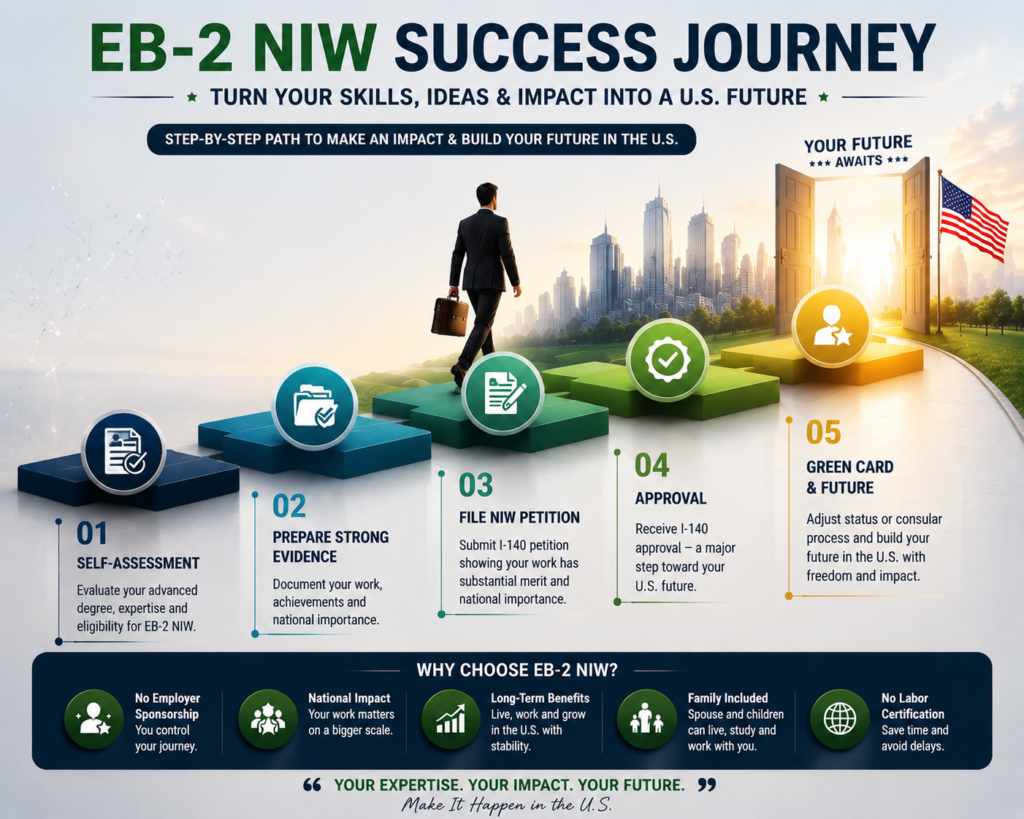
EB-2 NIW is an immigrant petition for people who first qualify under the EB-2 category and then show that the United States should waive the normal job offer and labor certification requirements because the person’s proposed work is in the national interest.
For entrepreneurs, EB-2 NIW can be powerful because it does not require a U.S. employer sponsor and does not require a fixed investment amount. However, it is not simply a “business owner green card.” USCIS looks closely at whether the entrepreneur’s proposed endeavor has national importance and whether the person is well positioned to advance it.
The EB-2 Threshold Requirement
Before USCIS reaches the national-interest analysis, the entrepreneur must first qualify for EB-2. This usually means one of two pathways:
- Advanced degree: The person has an advanced degree or a bachelor’s degree followed by at least five years of progressive post baccalaureate experience in the specialty.
- Exceptional ability: The person has a degree of expertise significantly above that ordinarily encountered in the sciences, arts, or business, supported by regulatory evidence.
For founders, this threshold analysis is important. The applicant’s claimed expertise should connect logically to the proposed endeavor. A person with advanced technical expertise should show how that expertise is being applied in the business or project described in the NIW petition.
The Three Prong NIW Standard
USCIS applies the Matter of Dhanasar framework. The entrepreneur must show:
- The proposed endeavor has substantial merit and national importance.
- The entrepreneur is well positioned to advance the proposed endeavor.
- On balance, it would be beneficial to the United States to waive the job offer and labor certification requirements.
What Changed for Entrepreneur NIW Cases After the 2025 USCIS Guidance?
The 2025 USCIS NIW policy clarification made entrepreneur cases more structured and evidence-focused. The basic Dhanasar test did not disappear, but USCIS now gives more detailed attention to the link between EB-2 eligibility, the proposed endeavor, national importance, and the applicant’s ability to execute the plan.
For entrepreneurs, general claims are risky. A petition should not rely only on statements such as “the business will create jobs,” “the industry is important,” or “the company will help the economy.” Those points may help, but they usually need supporting evidence and a clear explanation of why the impact reaches beyond the private success of the company.
Strong Entrepreneur NIW Evidence May Include
- A specific proposed endeavor tied to a U.S. problem, market gap, technology need, public need, or national priority.
- Evidence of product development, platform development, intellectual property, prototypes, pilots, users, customers, contracts, letters of intent, revenue, grants, accelerators, or investor interest.
- A realistic business or implementation plan with milestones, market evidence, and execution logic.
- Evidence that the business model can scale beyond a narrow local market when national importance is claimed.
- Expert letters explaining the significance of the endeavor and the entrepreneur’s role.
- Evidence of the entrepreneur’s prior record, such as leadership, technical expertise, publications, patents, projects, awards, media coverage, funding, revenue, partnerships, or successful execution.
- Policy or industry evidence connecting the work to U.S. priorities, such as healthcare access, cybersecurity, AI infrastructure, energy transition, manufacturing resilience, supply chain modernization, education, public safety, or environmental resilience.
Advantages of EB-2 NIW for Entrepreneurs
- It can lead to permanent residence if approved and the priority date is current.
- It is open to all nationalities, including entrepreneurs from countries that do not qualify for E-2.
- It does not require a U.S. employer sponsor.
- It does not require PERM labor certification.
- It does not require a specific minimum investment amount.
- It can fit founders whose business is driven by expertise, technology, research, policy relevance, or nationally important innovation.
- It can support a long-term U.S. immigration strategy even where a temporary treaty-investor route is unavailable.
Limitations of EB-2 NIW for Entrepreneurs
- It requires strong documentation and a persuasive legal theory.
- A normal small business, consulting practice, restaurant, retail shop, or local service company may not qualify unless the national-importance argument is carefully supported.
- USCIS may issue a Request for Evidence if the proposed endeavor is vague, overly broad, or unsupported.
- Approval of Form I-140 does not automatically grant a green card. The applicant must still complete adjustment of status or consular processing when a visa number is available.
- Visa Bulletin backlogs can affect the final green card timeline, especially for applicants chargeable to India or China.
- Premium processing speeds up USCIS action on the petition, but it does not make a priority date current and does not guarantee approval.
E-2 vs. EB-2 NIW: Which Path Is Better for Your Business?
| Entrepreneur situation | Usually stronger option | Why |
| You are a national of an E-2 treaty country and have committed substantial funds to a real U.S. business. | E-2 | E-2 is designed for treaty investors who want to develop and direct a qualifying enterprise. |
| You are from a non-treaty country such as India or China and do not hold another qualifying nationality. | EB-2 NIW or another immigrant/nonimmigrant route | E-2 is nationality-limited, while EB-2 NIW is open to all nationalities if the legal standard is met. |
| You need a temporary U.S. operating presence to launch or manage the business. | E-2 | E-2 may be practical for entering the U.S. to run the enterprise. |
| Your business addresses a nationally important issue such as AI, cybersecurity, healthcare, energy, infrastructure, or advanced manufacturing. | EB-2 NIW | The case may fit NIW if the endeavor is specific, credible, and supported by evidence of national importance. |
| Your business is local and primarily supports your own income. | E-2 may be more realistic | A local business can fit E-2 if it is real, operating, substantial, and not marginal; NIW may be harder without broader impact. |
| You want a direct permanent-residence strategy. | EB-2 NIW | E-2 is not a direct green card category. |
| You have capital but limited evidence of national importance or field-level expertise. | E-2 first, possibly NIW later | The business may need traction and impact evidence before an NIW case becomes strong. |
| You have strong expertise, traction, partnerships, or evidence of broader U.S. impact but limited investment capital. | EB-2 NIW | NIW has no fixed investment requirement and focuses on the endeavor and the applicant’s positioning. |
Can E-2 and EB-2 NIW Work Together?
Yes. For some entrepreneurs, E-2 and EB-2 NIW can be part of a staged strategy. E-2 may allow the entrepreneur to enter the United States, operate the business, hire employees, build partnerships, develop products, generate revenue, and collect evidence. That operating history may later support an EB-2 NIW petition if the business can show national importance and the founder can show they are well positioned to advance the endeavor.
However, this must be planned carefully. E-2 is a nonimmigrant category that requires the applicant to intend to depart when status ends. EB-2 NIW is an immigrant petition. Entrepreneurs should obtain case-specific advice before combining temporary and immigrant strategies, especially when applying through a U.S. consulate.
Visa Bulletin Reality for EB-2 NIW in 2026
A major difference between E-2 and EB-2 NIW is visa availability. E-2 is a temporary visa category and is not controlled by the employment-based immigrant Visa Bulletin in the same way as EB-2. EB-2 NIW is part of the employment-based second preference category, so the final green card step depends on priority-date availability.
As of the July 2026 Visa Bulletin, EB-2 remains current for all chargeability areas except those listed, Mexico, and the Philippines, while China-mainland born applicants have a final action date of September 1, 2021, and India EB-2 is unavailable for the remainder of FY 2026. This section should be refreshed monthly because Visa Bulletin dates can move forward, retrogress, or become unavailable depending on demand and annual limits.
Processing and Cost Considerations
E-2 processing depends heavily on whether the applicant applies at a U.S. consulate or files a change or extension of status with USCIS. Consular processes, document formats, and appointment availability vary by post.
EB-2 NIW is filed with USCIS on Form I-140. Premium processing is available for EB-2 NIW, but the premium processing period for NIW is generally longer than many other I-140 categories. Premium processing only requires USCIS to take action within the applicable period; it does not guarantee approval and does not control immigrant visa availability.
As of March 1, 2026, DHS increased the premium processing fee for all Form I-140 petitioners requesting premium processing to $2,965. Entrepreneurs should always verify the current USCIS fee schedule before filing because fees and forms can change.
Practical Examples
Example 1: Treaty country restaurant investor
A French national buys and actively manages a well-capitalized restaurant in Florida. The business has signed lease documents, purchased equipment, hired staff, and has a credible operating plan. The business is mainly local. E-2 may be a more practical first route than EB-2 NIW because the case is built around investment and active management, not national importance.
Example 2: AI healthcare founder
An Indian founder develops an AI-enabled patient triage platform for rural clinics. The founder has a master’s degree, prior healthcare technology experience, pilot letters, technical documentation, institutional interest, and evidence connecting the platform to healthcare-access gaps in the United States. E-2 may not be available because of nationality, but EB-2 NIW may be worth evaluating if the national-importance and well-positioned evidence is strong.
Example 3: E-2 first, NIW later
A Turkish entrepreneur launches a cybersecurity compliance platform through E-2. After two years, the company has U.S. customers, documented revenue, enterprise pilots, expert validation, industry coverage, and measurable cybersecurity outcomes. The entrepreneur may later consider EB-2 NIW if the evidence supports a nationally important proposed endeavor and shows that the founder is well positioned to expand it.
Common Mistakes Entrepreneurs Should Avoid
- Treating E-2 as a guaranteed green card path. It is not.
- Assuming any business can qualify for EB-2 NIW just because entrepreneurship helps the economy.
- Using a generic business plan without evidence of traction, national importance, or execution capacity.
- Claiming national importance based only on job creation without supporting market, policy, industry, or public interest evidence.
- Ignoring treaty country rules for E-2 ownership and nationality.
- Leaving investment funds uncommitted and expecting a bank balance to prove E-2 eligibility.
- Ignoring Visa Bulletin delays after EB-2 NIW approval.
- Filing a weak NIW petition too early before the entrepreneur has enough evidence of positioning and impact.
- Using copied recommendation letters that praise the applicant but do not explain the significance of the venture.
- Choosing a visa strategy based only on speed, without considering long-term immigration goals.
How Immignis Can Help Entrepreneurs
Immignis helps entrepreneurs evaluate whether E-2, EB-2 NIW, or another U.S. immigration strategy better fits their business model, nationality, evidence, timeline, and long-term goals.
For E-2, this may include business document review, investment readiness planning, ownership structure review, business plan preparation, and coordination of evidence showing a real, active, non marginal enterprise.
For EB-2 NIW, this may include proposed endeavor development, national importance analysis, evidence mapping, expert letter planning, business plan alignment, profile building recommendations, and petition support documentation.
The strongest strategy is not the one that sounds fastest. It is the one that matches the entrepreneur’s actual nationality, capital, achievements, business evidence, and immigration goal.
Conclusion
E-2 and EB-2 NIW are both valuable options for entrepreneurs, but they solve different problems. E-2 is often a practical temporary route for treaty country investors who have committed substantial capital to a real U.S. business and want to develop and direct that enterprise. It can be flexible, renewable, and useful for entrepreneurs who need to enter the U.S. market quickly, but it does not directly lead to a green card.
EB-2 NIW is a permanent-residence strategy for entrepreneurs whose work has substantial merit and national importance and who can show they are well positioned to advance that work. It does not require a treaty nationality or fixed investment amount, but it demands a stronger legal and evidentiary case.
For some entrepreneurs, E-2 is the right first step. For others, EB-2 NIW may be the better long-term strategy. For many, the best answer comes from a careful profile review, business review, country of chargeability analysis, and evidence based immigration plan.
Is E-2 better than EB-2 NIW for entrepreneurs?
E-2 may be better for treaty country nationals who have invested substantial capital in a real U.S. business and want to operate it. EB-2 NIW may be better for entrepreneurs seeking permanent residence through a nationally important proposed endeavor.
Does the E-2 visa lead to a green card?
No. E-2 is a temporary nonimmigrant category. An E-2 investor who wants a green card usually needs a separate immigrant strategy, such as EB-2 NIW, EB-1A, EB-1C, EB-5, employer sponsorship, or a family-based route.
Can Indian entrepreneurs apply for E-2?
Generally, Indian nationals do not qualify for E-2 based on Indian nationality because India is not an E-2 treaty country. Some entrepreneurs may explore whether they have another qualifying nationality, but this requires careful analysis.
Does EB-2 NIW require investment?
No fixed investment amount is required for EB-2 NIW. However, funding, traction, product development, contracts, pilots, customers, or other business evidence can help show that the entrepreneur is well positioned.
Can a small business qualify for EB-2 NIW?
Possibly, but it is harder if the business impact is only local or personal. The case must show substantial merit, national importance, and evidence that the entrepreneur is well positioned to advance the proposed endeavor.
Can I run a business while my EB-2 NIW is pending?
This depends on your current U.S. status and work authorization. An approved or pending NIW petition by itself does not automatically authorize employment in the United States.
Is premium processing available for EB-2 NIW?
Yes. Premium processing is available for EB-2 NIW Form I-140 petitions. It speeds up USCIS action on the petition but does not guarantee approval or solve Visa Bulletin delays.
Can E-2 and EB-2 NIW be used together?
Yes, in some cases. An entrepreneur may use E-2 to operate a business and later file EB-2 NIW if the business and the founder’s evidence support the NIW standard. This should be planned carefully because E-2 is temporary and NIW is immigrant.
Which is faster, E-2 or EB-2 NIW?
E-2 may be faster for entering the United States to run a business, depending on the consulate or USCIS process. EB-2 NIW can take longer and also depends on immigrant visa availability after approval.
What is the main difference between E-2 and EB-2 NIW?
E-2 focuses on treaty nationality, substantial investment, and active management of a real U.S. business. EB-2 NIW focuses on an immigrant petition based on advanced degree or exceptional ability, national importance, well positioned evidence, and the benefit of waiving labor certification.