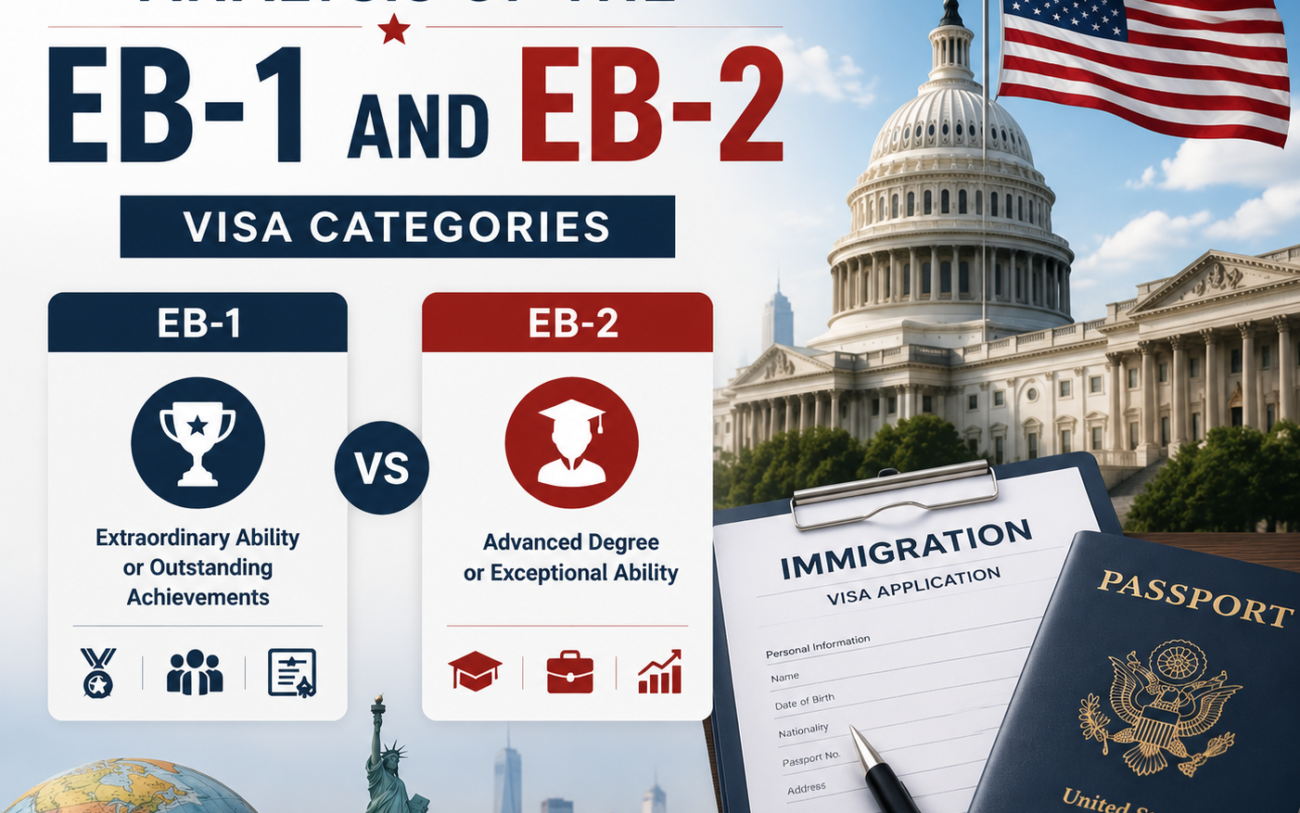
Analysis of the EB-1 and EB-2 Visa Categories
Last Updated on July 9, 2026 by Amelia
Written by Emily Carter, Immigration-Law Specialist
Reviewed by Jonathan Miller, Esq., Licensed U.S. Immigration Attorney
Employment-based immigrant visa categories EB-1 vs EB-2 Visa are two of the most important U.S. green card pathways for high-achieving professionals, researchers, entrepreneurs, executives, managers, physicians, engineers, scientists, academics, artists, and other skilled workers. Both categories can lead to permanent residence in the United States, but they are designed for different profiles and require different evidence.
The original version of this article treated EB-1 vs EB-2 Visa mainly as a simple comparison. In 2026, that approach is no longer enough. USCIS policy guidance has become more detailed, premium processing rules vary by subcategory, and the Visa Bulletin has shown that even preferred categories can face retrogression or unavailability for certain countries. Applicants should therefore understand not only which category sounds attractive, but which category fits their evidence, sponsorship situation, country of chargeability, and long-term immigration goal.
This updated guide explains the EB-1 vs EB-2 categories in practical terms, including subcategories, eligibility standards, sponsorship requirements, labor certification rules, evidence expectations, processing considerations, family benefits, and strategic differences.
What Is the Main Difference Between EB-1 vs EB-2?
EB-1 is the first employment-based preference category. It is generally reserved for individuals with extraordinary ability, outstanding professors or researchers, and multinational executives or managers. EB-1 usually has higher eligibility standards but can be strategically valuable where visa availability is better than EB-2.
EB-2 is the second employment-based preference category. It is generally for professionals with advanced degrees or individuals with exceptional ability. Most EB-2 cases require a job offer and PERM labor certification, but EB-2 NIW can waive those requirements if the applicant proves that the waiver is in the national interest.
| Issue | EB-1 | EB-2 |
| Core focus | High-level achievement, recognition, outstanding research standing, or multinational executive/managerial role. | Advanced degree, exceptional ability, or a proposed endeavor that qualifies for a national interest waiver. |
| Common self-petition route | EB-1A only. | EB-2 NIW only. |
| Labor certification | Not required for EB-1A, EB-1B, or EB-1C. | Usually required, except EB-2 NIW. |
| Typical evidentiary theme | Sustained acclaim, field-level recognition, distinguished academic standing, or qualifying multinational executive/manager history. | Education, expertise, job offer/PERM, exceptional ability, or national importance and ability to advance a proposed endeavor. |
| Strategic caution | High standard; simply meeting three EB-1A evidence categories is not enough without final merits strength. | Broader eligibility, but NIW requires more than a strong resume or a generally important field. |
Understanding the EB-1 Category
EB-1 is divided into three subcategories. Each serves a different type of applicant, and each has its own evidence requirements.
| EB-1 subcategory | Who it is for | Self-petition? | Labor certification |
| EB-1A Extraordinary Ability | Individuals with extraordinary ability in the sciences, arts, education, business, or athletics. | Yes. Employer sponsor is not required. | No PERM labor certification. |
| EB-1B Outstanding Professor or Researcher | Professors or researchers who are internationally recognized as outstanding in a specific academic field. | No self-petition. A qualifying U.S. employer must file. | No PERM labor certification. |
| EB-1C Multinational Executive or Manager | Executives or managers transferring from a qualifying foreign company to a related U.S. company. | No self-petition. A qualifying U.S. employer must file. | No PERM labor certification. |
EB-1A: Extraordinary Ability
EB-1A is for individuals who can show extraordinary ability through sustained national or international acclaim. The applicant must show that their achievements have been recognized in the field through extensive documentation, that they intend to continue working in the area of extraordinary ability, and that their entry will substantially benefit the United States.
A major advantage of EB-1A is that it allows self-petitioning. No U.S. employer is required. However, the evidentiary standard is high. USCIS uses a two-step review: first, whether the evidence meets the regulatory criteria; second, whether the totality of the evidence proves that the person is among the small percentage at the very top of the field. This final merits stage is where many cases are won or lost.
EB-1B: Outstanding Professors and Researchers
EB-1B is for professors and researchers who are internationally recognized as outstanding in a specific academic field. This category is not a self-petition route. A qualifying U.S. employer must file the petition, and the position must generally be tenured, tenure-track, or a comparable research position. EB-1B can be strong for academics and institutional researchers whose recognition is significant but may not fit the self-petition EB-1A model.
EB-1C: Multinational Executives and Managers
EB-1C is designed for multinational executives and managers who have worked abroad in a qualifying managerial or executive capacity for a related foreign company and are being transferred to a qualifying U.S. entity. It is often used by multinational businesses, founders, senior managers, and executives, but the petition is filed by the U.S. employer. The case must document the qualifying relationship between the foreign and U.S. companies and the executive or managerial nature of the role.
Understanding the EB-2 Category
EB-2 is generally available to two groups: professionals holding advanced degrees and individuals with exceptional ability in the sciences, arts, or business. EB-2 also includes the National Interest Waiver, which is not a separate preference category but a waiver of the job offer and labor certification requirements within EB-2.
| EB-2 route | Who it is for | Job offer | Labor certification |
| EB-2 Advanced Degree | A professional role requiring an advanced degree or equivalent, with the applicant meeting the required education and experience. | Usually required. | Usually required. |
| EB-2 Exceptional Ability | A person with a degree of expertise significantly above that ordinarily encountered in the sciences, arts, or business. | Usually required. | Usually required. |
| EB-2 National Interest Waiver | An advanced-degree professional or exceptional-ability applicant whose proposed endeavor meets the Dhanasar national interest standard. | No job offer required if waiver is granted. | No PERM required if waiver is granted. |
EB-2 Advanced Degree
The advanced degree route is commonly used for professionals whose offered U.S. job requires a master’s degree, Ph.D., or a foreign equivalent. In some situations, a bachelor’s degree plus at least five years of progressive post-baccalaureate experience can be treated as the equivalent of an advanced degree. In the regular EB-2 route, the employer typically completes the PERM labor certification process before filing Form I-140.
EB-2 Exceptional Ability
Exceptional ability means a degree of expertise significantly above that ordinarily encountered in the sciences, arts, or business. Evidence may include academic records, experience letters, professional licenses, high salary, memberships, and recognition for achievements. USCIS evaluates not only the quantity of evidence but also its quality and connection to the occupation or proposed work.
EB-2 National Interest Waiver
EB-2 NIW is the major self-petition route within EB-2. It allows the applicant to ask USCIS to waive the job offer and labor certification requirements. However, the applicant must first qualify for EB-2 as either an advanced-degree professional or a person of exceptional ability. Only after that threshold is met does USCIS evaluate whether the national interest waiver should be granted.
USCIS evaluates NIW cases under the three-prong Matter of Dhanasar framework: the proposed endeavor must have substantial merit and national importance; the applicant must be well positioned to advance the proposed endeavor; and, on balance, it must be beneficial to the United States to waive the job offer and labor certification requirements.
EB-1 vs EB-2: Detailed Comparison
| Aspect | EB-1 | EB-2 |
| Target applicants | Extraordinary ability individuals, outstanding professors/researchers, and multinational executives/managers. | Advanced-degree professionals, exceptional-ability professionals, and NIW applicants. |
| Main legal focus | Recognition, acclaim, outstanding academic standing, or qualifying multinational executive/managerial role. | Education, exceptional ability, job offer/PERM, or national-interest waiver showing. |
| Self-petition options | EB-1A only. | EB-2 NIW only. |
| Employer sponsorship | Required for EB-1B and EB-1C; not required for EB-1A. | Required for regular EB-2; not required for NIW. |
| PERM labor certification | Not required for EB-1 subcategories. | Usually required unless NIW is granted. |
| Evidence burden | High, especially EB-1A final merits and EB-1B international recognition. | Moderate to high depending on route; NIW requires a persuasive proposed endeavor and national-interest argument. |
| Priority-date sensitivity | Can still retrogress for high-demand countries. | Often more backlogged for India and China; availability changes monthly. |
| Best suited for | Top recognized professionals, internationally recognized researchers, or multinational executives/managers. | Professionals with strong education, job offers, exceptional ability, or nationally important work. |
| Common mistake | Assuming three EB-1A criteria automatically means approval. | Assuming an advanced degree or important occupation automatically qualifies for NIW. |
Visa Bulletin Reality in 2026
Older articles often describe EB-1 as generally faster and EB-2 as generally slower. That can be directionally true in some situations, but it is incomplete. Visa availability depends on the monthly Visa Bulletin, the applicant’s country of chargeability, annual limits, demand, and whether the applicant is using adjustment of status or consular processing.
The July 2026 Visa Bulletin shows why applicants should avoid oversimplified timelines. EB-1 India retrogressed because of high demand and number use, and the Department of State warned that further retrogression or unavailability could become necessary. India EB-2 became unavailable for the remainder of fiscal year 2026, and the Visa Bulletin also warned that China EB-2 demand could require retrogression or unavailability later in the fiscal year.
For applicants from countries with heavy demand, category selection is therefore not only a legal issue; it is also a priority-date and visa-availability strategy. EB-1 may provide a better opportunity in some cases, but only if the evidence truly supports EB-1 eligibility.
Processing Time and Premium Processing
Both EB-1 and EB-2 cases are generally filed using Form I-140. Premium processing may be available for many I-140 classifications, but it does not guarantee approval. It only requires USCIS to take action within the applicable premium processing period, such as approval, denial, Request for Evidence, or Notice of Intent to Deny.
Applicants should also separate three timelines: the I-140 adjudication timeline, the priority-date wait under the Visa Bulletin, and the later adjustment of status or immigrant visa process. A fast I-140 approval does not mean a green card is immediately available if the priority date is not current.
Family Members and Work Authorization
In both EB-1 and EB-2 green card pathways, the principal applicant’s spouse and unmarried children under 21 may usually apply as derivative beneficiaries when an immigrant visa is available or when adjustment of status is properly filed. A common misunderstanding is that the spouse automatically receives work authorization after the I-140 is approved. In most adjustment cases, work authorization is connected to a pending Form I-485 and related employment authorization application, not merely to I-140 approval by itself.
Which Category Is Better for Your Profile?
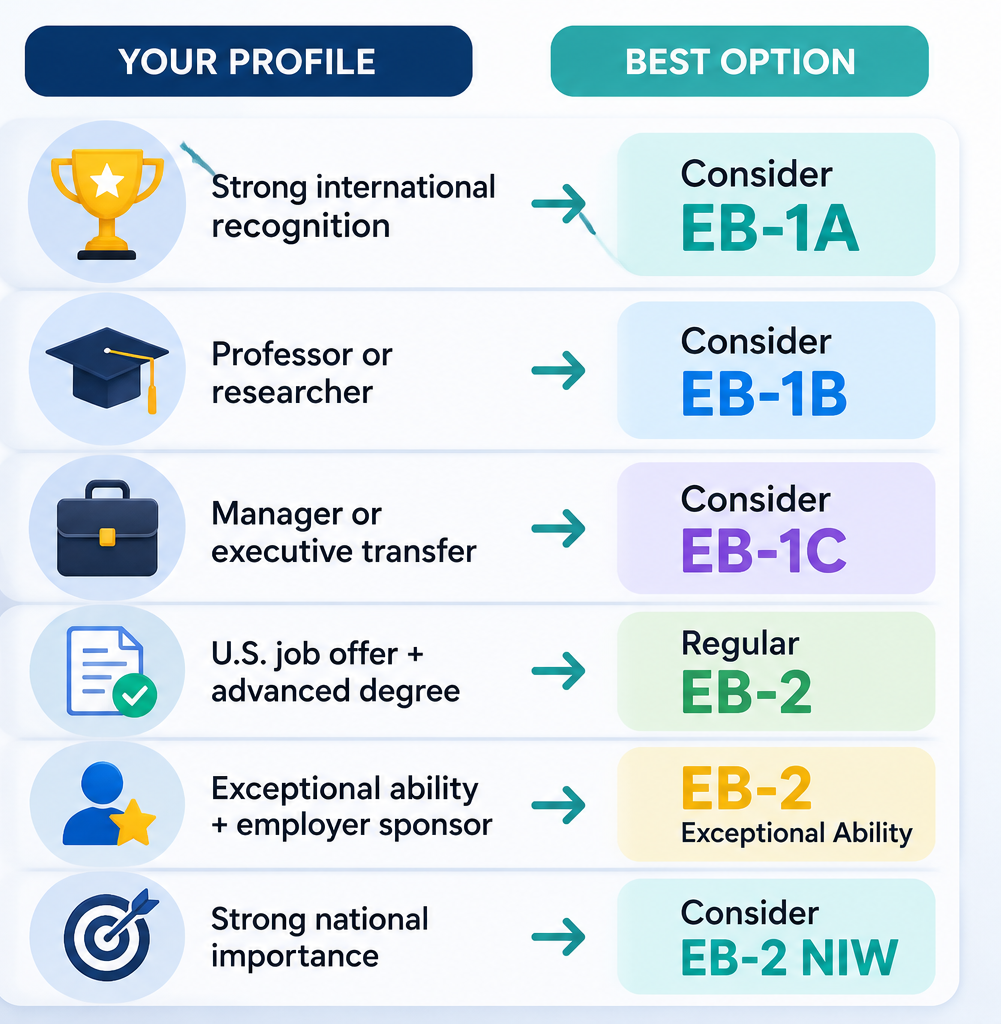
| Profile situation | Possible strategy |
| You have strong international recognition, major awards, high citations, media, judging, or original contributions with field-level impact. | Consider EB-1A, but evaluate final merits strength before filing. |
| You are a professor or researcher with international recognition and a qualifying U.S. academic or research employer. | Consider EB-1B. |
| You are a senior manager or executive transferring from a foreign company to a related U.S. company. | Consider EB-1C. |
| You have a strong U.S. job offer requiring an advanced degree and the employer can complete PERM. | Consider regular EB-2 advanced degree route. |
| You have exceptional ability and a qualifying employer willing to sponsor through PERM. | Consider regular EB-2 exceptional ability route. |
| You have a strong proposed endeavor with national importance and can show you are well positioned to advance it. | Consider EB-2 NIW. |
| You are from a high-demand country and your EB-2 priority date may face long delays. | Evaluate whether EB-1 evidence can be developed, but do not file a weak EB-1 case only for speed. |
Evidence Strategy: What USCIS Wants to See
The strongest EB-1 and EB-2 petitions do not simply attach documents. They explain why each document matters under the legal standard. USCIS officers evaluate whether the record proves the classification by a preponderance of the evidence. For EB-1A, the record must support both regulatory criteria and final merits. For EB-2 NIW, the record must show threshold EB-2 eligibility and the three Dhanasar prongs.
| Category | Evidence examples | How the evidence should be framed |
| EB-1A | Awards, media about the applicant, judging, memberships, scholarly articles, citations, original contributions, high salary, leading roles, commercial success, comparable evidence. | Show sustained acclaim and that the applicant is among the small percentage at the top of the field. |
| EB-1B | Publications, citations, peer review, awards, major research role, expert letters, international recognition, employer documentation. | Show international recognition as outstanding in a specific academic area. |
| EB-1C | Corporate structure evidence, foreign employment records, U.S. job description, managerial/executive authority, staffing charts, business operations. | Show qualifying multinational relationship and executive or managerial capacity. |
| Regular EB-2 | Academic credentials, experience letters, PERM documentation, employer offer, licenses, recognition evidence where relevant. | Show the applicant qualifies for the offered EB-2 position and the employer completed required steps. |
| EB-2 NIW | Defined proposed endeavor, evidence of national importance, applicant’s track record, implementation plan, expert letters, funding, projects, publications, patents, business evidence, policy/industry need. | Show the endeavor matters nationally, the applicant is well positioned, and waiver benefits the United States. |
Common Mistakes to Avoid
- Treating EB-1vs EB-2 as simple “fast versus slow” categories without checking the Visa Bulletin.
- Assuming EB-1A approval is likely because the applicant can list three regulatory criteria.
- Assuming EB-2 NIW approval is likely because the applicant has a master’s degree or works in an important industry.
- Using generic recommendation letters that praise the applicant but do not explain field-level significance or national importance.
- Failing to separate the applicant’s occupation from the proposed endeavor in NIW cases.
- Ignoring country-specific backlogs and filing strategy.
- Submitting large volumes of evidence without a clear legal narrative.
- Using outdated statements such as “EB-1 has no backlog” or “EB-2 NIW is easy for anyone with an advanced degree.”
Practical Decision Framework
Before choosing EB-1 or EB-2, applicants should answer five questions:
- Do I need employer sponsorship, or do I need a self-petition route?
- Is my strongest evidence recognition/acclaim, employer sponsorship, multinational management, or national importance?
- Does my country of chargeability face EB-1 or EB-2 backlog pressure?
- Is my evidence strong enough to file now, or should I build the profile first?
- Does premium processing meaningfully help my situation, or is my real delay visa availability?
For many applicants, the best answer is not simply EB-1 vs EB-2. The best answer may be a staged strategy: file the strongest available petition now, preserve the priority date where possible, and build the profile for a stronger future category if needed.
How Immignis Can Help
Immignis helps professionals, entrepreneurs, researchers, executives, and skilled workers evaluate the right employment-based green card strategy. The goal is to match the applicant’s evidence with the correct legal category and avoid weak filings based on incomplete comparisons.
Our work may include EB-1A evidence mapping, EB-2 NIW proposed endeavor development, petition-letter strategy, expert-letter planning, RFE response support, long-term profile-building strategy, and category comparison for applicants deciding between EB-1 vs EB-2 routes.
Conclusion
EB-1 and EB-2 are both valuable employment-based green card pathways, but they serve different profiles. EB-1 is generally built around extraordinary ability, outstanding academic recognition, or multinational executive and managerial roles. EB-2 is generally built around advanced education, exceptional ability, employer sponsorship, or a national interest waiver.
In 2026, applicants should not rely on outdated assumptions about speed, backlogs, or evidence. A strong strategy must consider the applicant’s evidence, the correct subcategory, USCIS policy guidance, Visa Bulletin movement, and long-term immigration goals. The best category is the one that fits the record and can be supported with clear, credible, and well-organized evidence.
Frequently Asked Questions
Is EB-1 better than EB-2?
EB-1 can be better for applicants who truly meet the higher EB-1 standards and whose country of chargeability has better EB-1 visa availability. EB-2 may be better for applicants with advanced degrees, exceptional ability, or strong national-interest work but less extraordinary ability evidence.
Can I self-petition under EB-1 or EB-2?
Yes, but only through specific routes. EB-1A allows self-petitioning. EB-2 NIW also allows self-petitioning if the national interest waiver is granted. EB-1B, EB-1C, and most regular EB-2 cases require employer sponsorship.
Does EB-1 require PERM labor certification?
No. EB-1A, EB-1B, and EB-1C do not require PERM labor certification.
Does EB-2 require PERM labor certification?
Regular EB-2 usually requires PERM labor certification. EB-2 NIW waives the job offer and labor certification requirements if USCIS agrees that the waiver is in the national interest.
Is EB-1A easier than EB-2 NIW?
No. EB-1A has a higher extraordinary ability standard. EB-2 NIW may be more accessible for many professionals, but it still requires a strong proposed endeavor, national importance, and proof that the applicant is well positioned.
Can an EB-2 NIW applicant later file EB-1A?
Yes. Some applicants first file EB-2 NIW and later file EB-1A after building stronger evidence of recognition, citations, awards, judging, media, leadership, or original contributions. NIW approval does not automatically prove EB-1A eligibility.
Does premium processing make the green card faster?
Premium processing can speed up USCIS action on the I-140 petition, but it does not make the priority date current and does not speed up the Visa Bulletin.
Can my spouse work after my EB-1 or EB-2 approval?
A spouse may generally apply for work authorization in connection with a pending adjustment of status application when eligible. I-140 approval alone usually does not give the spouse work authorization.
Which category is best for Indian or Chinese applicants?
It depends on the evidence and current Visa Bulletin conditions. EB-1 may be strategically valuable if the evidence is strong, but EB-1 can also retrogress. Applicants should evaluate both legal eligibility and visa availability.
What is the biggest mistake in choosing EB-1 or EB-2?
The biggest mistake is choosing a category based only on speed or online success stories instead of matching the legal standard to the actual evidence.