EB-1A High Salary Criterion: How to Prove It and When It Backfires
The EB-1A high salary criterion is one of the most immediately documentable of the ten extraordinary ability criteria the underlying compensation either exists or it doesn’t, and unlike judging history or media coverage, it cannot be built from scratch. But the gap between having above average compensation and satisfying this criterion in a way that survives adjudication scrutiny is wider than most petitioners expect. The standard is specific, the comparison must be precise, and several common documentation approaches generate RFEs even when the underlying compensation is genuinely exceptional.
This guide explains what the criterion actually requires, how to build a benchmark comparison that holds up under review, how non-traditional compensation is handled, and the specific patterns that cause an otherwise strong criterion to backfire.
What the High Salary Criterion Requires
The regulatory language requires evidence that the petitioner commands a high salary or other significantly high remuneration for services relative to others in the same field. Four elements in that phrase matter.
“Significantly high” is not defined by a fixed dollar threshold. USCIS evaluates compensation against a relevant peer group, and practitioners consistently observe that compensation needs to reach the upper end of the distribution the top 10 to 15 percent to register as ‘significantly high’ in adjudication. Below that level, an RFE asking for clarification of why the compensation qualifies is common.
“Or other significantly high remuneration” is a deliberate broadening of the standard beyond base salary. USCIS evaluates the full compensation picture, and for professionals whose compensation includes substantial variable elements bonuses, equity, profit sharing relying on base salary alone typically understates actual economic standing. The total package is what matters.
“Relative to others” is the comparison requirement. A specific salary figure says nothing without establishing what the relevant peer group earns. The benchmark comparison is not optional documentation; it is the evidentiary substance of this criterion.
“In the same field” introduces the subspecialty challenge. The right comparison group is not all practitioners in a broad occupational category. It is practitioners at the same seniority level, in the same geographic market, in the same specific professional subspecialty. Getting this comparison group wrong is one of the most common single causes of salary criterion RFEs.
What Counts as Remuneration
USCIS evaluates total compensation, not just the W-2 base salary figure. For professionals whose economic standing includes significant variable or equity components, documenting only base salary is a strategic error that understates the criterion and invites scrutiny.
Components that count toward total remuneration:
- Base salary always use gross (pre-tax) figures for comparison to government wage data, which is reported gross
- Performance bonuses and incentive pay documented via W-2, offer letters, or employer confirmation
- Equity based compensation RSUs, stock options, and similar instruments. These must be translated into documented economic value; a grant agreement alone is insufficient without evidence of the underlying equity’s value
- Profit sharing and revenue based compensation documented via Schedule K-1, employer records, or business financial statements
- Retention packages documented via offer or retention letter
An important matching requirement: the comparison data used in the benchmark must measure the same remuneration components being claimed. Comparing total compensation (base + bonus + equity) against a survey that measures only base salary creates an apples to oranges problem that officers will identify and flag. If total compensation is the claim, the benchmark must cover total compensation.
The Benchmark Comparison: Why Getting This Right Is Everything
The benchmark comparison is not a supporting exhibit. It is the evidentiary core of the criterion. Without a specific, well-supported, and appropriately scoped comparison showing where the petitioner’s compensation falls in the relevant distribution, there is no criterion there is only a salary figure with no context.
The Apples to Apples Requirement
USCIS officers consistently identify mismatched comparisons as a basis for RFEs and denials. The comparison group must match the petitioner on three dimensions simultaneously:
- Seniority level: A senior or principal-level professional should not be compared against a broad occupational category that includes entry-level practitioners in the same field. An entry-level developer and a principal architect may share the same SOC code while having entirely different compensation distributions. The comparison must isolate the relevant seniority tier.
Geographic market: National averages are the wrong benchmark for professionals in high cost of living metropolitan areas. A compensation level that places a professional in the 80th percentile nationally may place them at the 60th percentile in San Francisco or New York. The geographic comparison must match where the work is performed ideally at the Metropolitan Statistical Area (MSA) level.
- Professional subspecialty: A data scientist and a business intelligence analyst share overlapping skills but have different compensation distributions. A fintech software engineer and a general software engineer at the same seniority level have different compensation norms. The comparison must identify a peer group in the right subspecialty, not just the right broad field.
Failing any one of these three matching requirements gives an officer grounds to question whether the comparison is meaningful. Failing two or three of them is frequently the sole reason a strong salary becomes a thin criterion.
The Benchmark Source Hierarchy
| Source Type | Examples | USCIS Weight | Best Used For |
| Federal government wage data | BLS Occupational Employment Statistics (OES), O*NET OnLine, DOL CareerOneStop | Primary most credible | Foundation benchmark filter by MSA for geographic precision provides percentile ranges by SOC code |
| Major industry compensation surveys | Mercer, Radford/Aon, Robert Half | Primary highly credible | Specialized roles where BLS categories are too broad; provides seniority-level and subspecialty data |
| Field-specific surveys | Levels.fyi (tech), academic association salary surveys, clinical specialty reports | Primary for the field | Technology compensation including equity; academic salaries; clinical specialty benchmarking |
| Commercial self-report sites | Glassdoor, Payscale, Salary.com | Supplemental only | Geographic precision and seniority filtering; not standalone — use alongside government and industry data |
| Expert declarations | Economist or industry professional letter analyzing compensation | Highly valuable for context | Non-standard compensation, equity valuation, foreign income, or cases where standard data does not capture the role |
| Employer letters with compensation context | Detailed employer letter explaining pay benchmarks and where petitioner stands relative to peers | Valuable corroboration | Connecting compensation to demonstrated extraordinary ability; organizational justification for above-market pay |
No single source is typically sufficient. A well-constructed salary benchmark uses government data as the foundation, supplements it with industry or field-specific survey data that captures seniority and subspecialty detail the government data lacks, and adds commercial site data where geographic precision is needed. The combination demonstrates that the high compensation is consistent across multiple independent sources, not an artifact of a single cherry-picked dataset.
Geographic Precision: Why National Averages Fail
The geographic mismatch problem is the most common single error in salary criterion documentation. Government wage data at the national level aggregates compensation across markets with dramatically different cost and compensation norms. For professionals in major technology, finance, healthcare, or business hubs, national data systematically understates where they stand relative to local peers.
BLS Occupational Employment Statistics allows filtering at the Metropolitan Statistical Area level a feature that many petitioners never use. O*NET provides state and zip-code-level data. These tools are available, free, and specifically designed to produce the localized comparison that the criterion requires.
The practical consequence of geographic mismatch:
Wrong approach: A senior machine learning engineer in San Francisco with $320K total compensation compares against the national BLS median for Software Developers. The national figure shows their compensation as being above average. It does not show whether it is significantly high relative to their actual peer group.
Right approach: The same engineer uses BLS OES data filtered to the San Francisco-Oakland-Hayward MSA, supplemented by Levels.fyi data for senior ML engineers at major technology companies in the Bay Area. The localized data shows their total compensation sits in the upper distribution for that specific peer group in that specific market. For professionals in rural or lower-cost markets, geographic precision works in the opposite direction. A compensation level that appears unremarkable against national figures may represent genuine upper-distribution standing in the local labor market where the work is performed. The comparison must reflect the actual market and the argument must be that the petitioner’s compensation stands out relative to that market’s norms.
Defining the Right Subspecialty
The subspecialty definition challenge deserves dedicated attention because it is the step where both overbroadness and excessive narrowness create problems.
The Overbroadness Problem
Using a broad SOC code that encompasses a wide range of seniority levels is the most common subspecialty error. A category that spans from entry level to senior practitioners has a compressed wage distribution where the upper end reflects what the most senior practitioners earn a much lower bar than the distribution for senior practitioners alone. The comparison must isolate the relevant tier.
For specialized roles where the BLS SOC structure does not reflect the actual subspecialty accurately Data Scientists versus “Business Intelligence Analysts”, “Quantitative Analysts” versus general Financial Analysts the petition should acknowledge that the BLS data provides a conservative floor level benchmark and supplement it with survey data from sources that capture the specific role.
When Salary Exceeds BLS Caps
BLS OES data caps reported wages at a maximum figure across all wage tables. For highly specialized or senior professionals whose compensation significantly exceeds this cap, the BLS data confirms that their compensation is above the highest reported level for their occupational category which is itself strong evidence of above-distribution standing.
When compensation exceeds BLS caps, the comparison strategy shifts from percentile position to comparative standing. The combination of: (a) exceeding the BLS-reported maximum for the occupational category, (b) industry survey data that captures the specific niche and shows upper distribution positioning, and (c) an expert declaration contextualizing what this compensation level reflects in the field, typically produces a complete and credible argument.
the actual market and the argument must be that the petitioner’s compensation stands out relative to that market’s norms.
Defining the Right Subspecialty
The subspecialty definition challenge deserves dedicated attention because it is the step where both overbroadness and excessive narrowness create problems.
The Overbroadness Problem
Using a broad SOC code that encompasses a wide range of seniority levels is the most common subspecialty error. A category that spans from entry-level to senior practitioners has a compressed wage distribution where the upper end reflects what the most senior practitioners earn a much lower bar than the distribution for senior practitioners alone. The comparison must isolate the relevant tier.
For specialized roles where the BLS SOC structure does not reflect the actual subspecialty accurately Data Scientists versus “Business Intelligence Analysts”, “Quantitative Analysts” versus general Financial Analysts the petition should acknowledge that the BLS data provides a conservative floor-level benchmark and supplement it with survey data from sources that capture the specific role.
When Salary Exceeds BLS Caps
BLS OES data caps reported wages at a maximum figure across all wage tables. For highly specialized or senior professionals whose compensation significantly exceeds this cap, the BLS data confirms that their compensation is above the highest reported level for their occupational category which is itself strong evidence of above-distribution standing.
When compensation exceeds BLS caps, the comparison strategy shifts from percentile position to comparative standing. The combination of: (a) exceeding the BLS-reported maximum for the occupational category, (b) industry survey data that captures the specific niche and shows upper-distribution positioning, and (c) an expert declaration contextualizing what this compensation level reflects in the field, typically produces a complete and credible argument.
Organizational Justification
When compensation is exceptionally high above what even specialized surveys reflect as upper-distribution an organizational justification letter from the employer adds important context. The letter should explain the internal benchmarks used to set the compensation, why the petitioner’s specific contributions justify compensation at this level, and where the compensation stands relative to peers inside the organization and the broader industry.
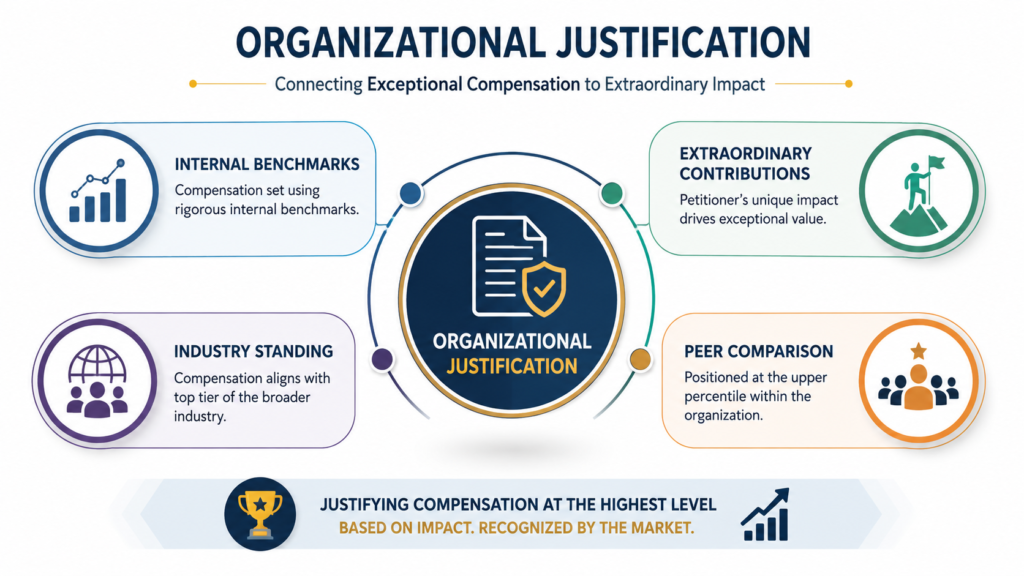
This is not just a corroborating document. For compensation at the extreme upper end of a field, the organizational justification is the argument that connects the compensation level to independent market recognition of extraordinary ability which is ultimately what the criterion is measuring.
Non Standard Compensation: Founders, Self Employed, and Foreign Income
Startup Founders and Equity Based Compensation
For startup founders, base salary is often not the primary economic indicator of compensation standing. USCIS explicitly recognizes that highly valued equity holdings can serve as comparable evidence of high remuneration for founders but the valuation must be established through credible, independently validated economic documentation.
A company valuation alone is not sufficient. The evidence must establish: the company’s current valuation (from a recent funding round, third-party professional valuation, or investment documents), the petitioner’s ownership percentage (from capitalization tables), and the resulting dollar value of that ownership stake. These three elements together produce a documentable remuneration figure comparable to a salary.
Venture capital funding serves a secondary function: it validates the credibility of the valuation. When recognized institutional investors have assigned a value to the company through an arm’s-length transaction, that transaction establishes an independently validated benchmark for what the company is worth and by extension, what the founder’s equity stake is worth.
An economist or expert declaration is typically needed to bridge the equity documentation to the high remuneration argument. The letter explains how the equity value, translated to annual economic terms, places the petitioner in the relevant compensation distribution relative to employees in comparable roles at comparable organizations.
Self-Employed Consultants and Independent Professionals
For self-employed professionals and consultants, remuneration is documented through business income records rather than W-2 wage statements. Relevant documentation includes Schedule C or corporate returns showing business income, profit and loss statements, bank statements documenting transfers from business to personal accounts, and contracts or 1099 records establishing the rate structure.
The comparison benchmark for self-employed professionals should reflect the consultant or independent practitioner market in the relevant field, not the employee market. Hourly or project rates for independent specialists in a field are typically higher than the equivalent employee compensation for the same work, and the comparison sources must reflect independent practitioner rates rather than employee compensation surveys.
Foreign Income
When the high salary claim is based on compensation earned outside the United States, USCIS evaluates the income relative to the labor market where it was earned not by converting to U.S. dollars and comparing against U.S. benchmarks. A salary that appears modest in absolute U.S. dollar terms may represent upper-distribution standing within its local market.
Documentation for foreign income follows the same structure as domestic documentation: the primary compensation records (foreign equivalents of W-2 or employment contracts), and comparison data specific to the same profession, seniority level, and geographic market in the country where the work was performed. A local expert declaration is particularly valuable for foreign income, as it contextualizes the significance of the salary within the specific economic environment.
When the High Salary Criterion Backfires
Several patterns cause a salary that genuinely represents exceptional compensation to fail as petition evidence.
Mismatched Comparison Groups
The most common failure: comparing total compensation against surveys that measure only base salary, or comparing against a broad national average for a wide occupational category, or comparing a senior professional’s compensation against data that includes entry-level practitioners. Each of these produces a comparison that appears to show lower relative standing than reality, and all three are addressable with more precise data.
Total Compensation vs Base Only Mismatch
A specific version of the mismatch problem: claiming total compensation as the relevant figure while using a comparison source that measures base salary only. A professional earning $400K total $200K base, $100K bonus, $100K equity who compares against a base salary survey is comparing their total to others’ partial. The resulting comparison is not evidence of exceptional standing; it is evidence of a methodology problem that officers will identify.
Relying on Commercial Sites Alone
Petitions that use only Glassdoor, Payscale, or Salary.com data as their benchmark regularly receive RFEs questioning the credibility of the comparison. These sites provide useful geographic precision and seniority-level filtering, but their self-reported data structure makes them less credible as standalone evidence. Used alongside BLS data and industry survey data, they add geographic and seniority specificity. Used alone, they invite questions about sample size, data quality, and whether the comparison is appropriate.
No Nexus Between Pay and Individual Contribution
A salary comparison demonstrates what a professional earns. The final merits argument requires establishing why they earn it what about their specific expertise and contributions commands this compensation level. When the salary evidence floats independently from the rest of the petition’s narrative about the petitioner’s specific standing in the field, the criterion satisfies the threshold without advancing the final merits case.
The organizational justification letter and expert declaration together provide this connection. They explain the salary not just as a data point but as the market’s assessment of this professional’s specific expertise which is the argument the final merits determination requires.
The Exhibit Table: How to Present Salary Evidence Clearly
A common practical failure in salary criterion documentation is submitting the raw data without organizing it in a way that makes the comparison immediately legible to an officer. A structured exhibit table presenting all benchmark sources in one place, with explicit percentile positions, prevents an officer from needing to calculate or infer the comparison from disparate exhibits.
The table below illustrates the format:
| Source | Comparison Group | Geography | 90th Pctile Figure | Why This Group |
| BLS OES | Software Dev., Systems Software (SOC 15-1252) | San Francisco-Oakland-Hayward MSA | [Figure from BLS] | Most precise government SOC match for role and location |
| Radford / Aon | Senior Software Engineer, L6 equivalent, fintech | San Francisco Bay Area | [Figure from survey] | Captures seniority level and industry segment not reflected in BLS broad category |
| Levels.fyi | Senior SWE total compensation, FAANG and equivalent | San Francisco Bay Area | [Figure from site] | Equity-inclusive total compensation benchmark for tech sector at this seniority |
This format makes several things immediately clear: the comparison is multi-source (not cherry-picked), each source is specifically matched to the petitioner’s role and geography, and the percentile position is explicitly stated rather than implied. An officer reviewing this table can see the full comparison in one place before reviewing the underlying source documentation.
How Salary Evidence Contributes to Final Merits

The high salary criterion’s contribution to the final merits determination is specific and distinct from other criteria. Salary evidence documents something that most other criteria cannot: a quantifiable, market-determined assessment of the petitioner’s economic standing relative to peers.
When an independent market an employer, a client, or an investor compensates a professional at significantly above the field median, that compensation is itself a form of external recognition. The market is saying that this professional’s specific expertise is worth more than most practitioners in the same field. That is, at its core, an extraordinary ability signal: above-average standing recognized by external parties with no stake in the immigration outcome.
This is why the organizational nexus matters for final merits. The argument is not just “this professional earns above the 90th percentile.” The argument is: “this professional’s compensation reflects the market’s independent assessment that their specific contributions and expertise are significantly more valuable than most practitioners in their field. That market assessment corroborates the extraordinary standing demonstrated by the other criteria.”
When salary evidence is combined with judging evidence and critical role evidence, the three criteria reinforce each other in final merits: the market compensates them above peers (Criterion 9), external organizations trust them to evaluate peer work (Criterion 4), and their organization’s outcomes are specifically dependent on their contribution (Criterion 8). The coherence of that argument is what final merits approvals require.
Not sure whether your compensation documentation is structured for the comparison USCIS expects? Get a free EB-1A profile audit from Immignis for an evidence-level assessment of your salary criterion.
Frequently Asked Questions
What counts as high salary for EB-1A?
There is no fixed dollar threshold. USCIS evaluates compensation relative to others in the same field at the same seniority level and in the same geographic market. Compensation needs to be significantly higher than peers practitioners consistently observe that upper-distribution standing, roughly the top 10 to 15 percent of the relevant peer group, is what the criterion requires.
Does USCIS consider just base salary or total compensation?
Total compensation, including base salary, bonuses, equity-based compensation (RSUs, stock options), profit-sharing, and retention packages. For professionals with significant variable or equity components, documenting only base salary understates economic standing. The comparison benchmark must measure the same components being claimed.
What is the most important thing to get right in salary documentation?
The comparison group. The benchmark must match the petitioner on seniority level, geographic market, and professional subspecialty simultaneously. Using national averages for a high-cost-of-living market, comparing senior compensation against a category that includes entry-level practitioners, or using broad occupational codes for specialized roles are the most common RFE triggers.
Can startup founders use the high salary criterion without a traditional salary?
Yes. USCIS allows highly valued equity holdings as comparable evidence of high remuneration for founders. The equity value must be established through documented company valuation (from funding rounds, professional valuations, or investment documents), the petitioner's ownership percentage from capitalization tables, and expert analysis connecting the resulting economic value to the remuneration distribution.
Can prospective job offers count toward the high salary criterion?
Yes. USCIS accepts prospective offer letters as evidence that the petitioner commands a high salary. The offer must be from a credible employer with demonstrated ability to pay, and should be supplemented by an employer letter explaining the compensation benchmarks used and where the offer stands relative to the relevant market.
When does the high salary criterion backfire?
Common backfire patterns: comparing total compensation against base-salary-only surveys; using national averages for professionals in high-cost markets; comparing against broad categories that include entry-level workers; relying solely on commercial self-report sites; and failing to connect the salary to the petitioner's specific contributions in the final merits argument.
Are Glassdoor and Payscale accepted by USCIS?
As supplemental evidence alongside government and industry data, yes. As standalone evidence, they are typically insufficient their self-reported data structure makes them less credible on their own. They add geographic precision and seniority filtering that government data sometimes lacks, but they should be one component of a multi-source benchmark, not the primary evidence.
How do I handle foreign income for the salary criterion?
USCIS evaluates foreign income relative to the labor market where it was earned, not by converting to U.S. dollars for comparison against U.S. norms. Documentation should include the primary income records, comparison data specific to the same profession and region in the country of employment, and typically an expert declaration contextualizing the salary's significance within that economic environment.
What is an organizational justification letter?
A detailed letter from the employer explaining the internal benchmarks used to set the petitioner's compensation, why their specific contributions justify this level, and how their pay compares to peers inside the organization and the broader market. It is most valuable when compensation significantly exceeds standard survey data or when connecting the salary level to the petitioner's specific extraordinary contributions.
How does salary evidence help the final merits determination?
Salary evidence provides a quantifiable, market-determined signal of extraordinary standing: an independent employer or market has compensated this professional significantly above peers. Combined with the organizational nexus argument explaining why the compensation reflects the market's assessment of this specific expertise salary evidence reinforces the coherent final merits narrative alongside judging and critical role evidence.
The high salary criterion is documentable, but documenting it correctly requires precision at every level the right comparison group, the right geographic market, the right remuneration components, and a clear argument connecting the compensation to the petitioner’s specific extraordinary standing. Book a strategic EB-1A consultation with Immignis to evaluate your compensation evidence and identify any gaps in the benchmark comparison before filing.