EB-2 NIW Approval Rate 2026: What the Numbers Actually Tell You
Last Updated on August 18, 2026 by Amelia
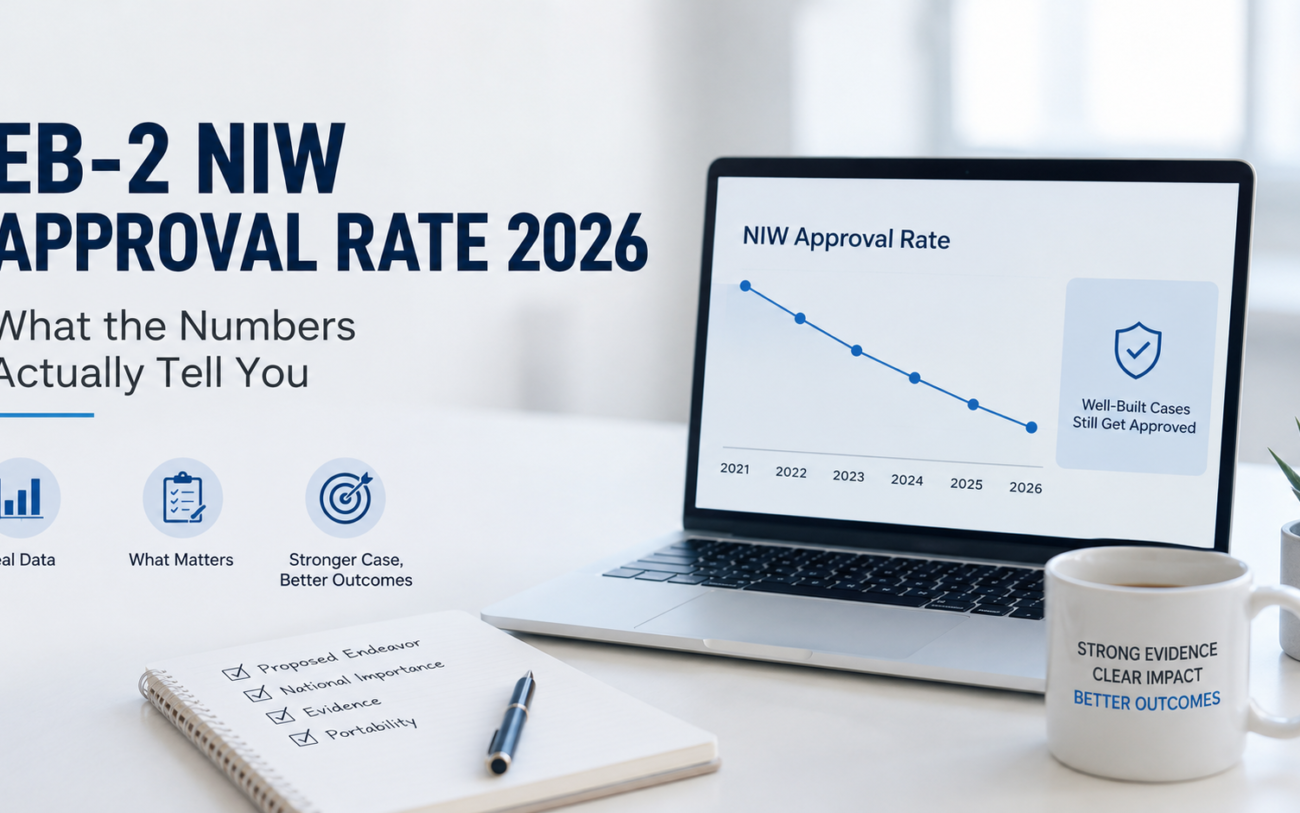
The question most applicants ask first is the one that answers the least when evaluating EB-2 NIW approval factors: “What is the EB-2 NIW approval rate in 2026?” Third-party trackers following USCIS adjudication data have documented a significant tightening over the past several years aggregate approval rates that once hovered in the low-to-mid nineties have come down considerably, with some quarters showing denial rates that surprised even experienced practitioners.
But the aggregate approval rate is one of the least useful numbers for evaluating your own case. USCIS does not adjudicate categories it adjudicates individual petitions. The rate at which petitions across the pool are approved or denied reflects the pool’s composition as much as it reflects policy. A wave of thin filings drives the aggregate rate down. A well-constructed petition does not become weaker because adjacent filings were poorly built.
This article explains what the data actually shows, why aggregate statistics mislead more than they inform, and more usefully what the factors are that correlate with approval outcomes at the individual petition level.
What the Approval Data Actually Shows
Third-party tracking of USCIS I-140 adjudication data shows that NIW approval rates have declined meaningfully from the peak of the 2021-2022 period. In those years, aggregate NIW approval rates were exceptionally high by historical standards. The subsequent tightening reflects multiple compounding factors: a surge in filings during and after the pandemic, a shift in USCIS scrutiny toward the national importance prong, and a notable increase in RFE issuance as a tool for controlling case quality.
What trackers observed through 2025 was a gradual decline that accelerated in later quarters, with some service centers showing particularly low approval rates during specific review periods. The pattern was not uniform across service centers, processing types, or fields.
A few things worth noting about what the data can and cannot establish:
- USCIS does not publish NIW specific approval rates. The figures circulating come from third-party analysis of publicly available I-140 adjudication records, which have methodological limitations.
- Aggregate rates blend cases of very different quality. A pool that includes a large share of underprepared petitions will show a lower aggregate approval rate even if strong petitions continue to perform well.
- Rates vary significantly by service center and processing type. Cases processed at different USCIS service centers, or through premium versus standard processing, have shown divergent patterns in tracked data.
- The trend matters more than any single quarter. A single low-approval quarter does not establish a permanent policy shift. The meaningful signal is the multi-year direction, which indicates genuinely tightened scrutiny particularly on Prong 1.
The honest takeaway: adjudication has become more demanding, particularly around the national importance argument. The cases most affected are those with vague endeavor statements, field level national importance claims, and evidence that does not demonstrate portability beyond a single employer. Well constructed cases have not stopped being approved.
Why Aggregate Approval Rates Mislead
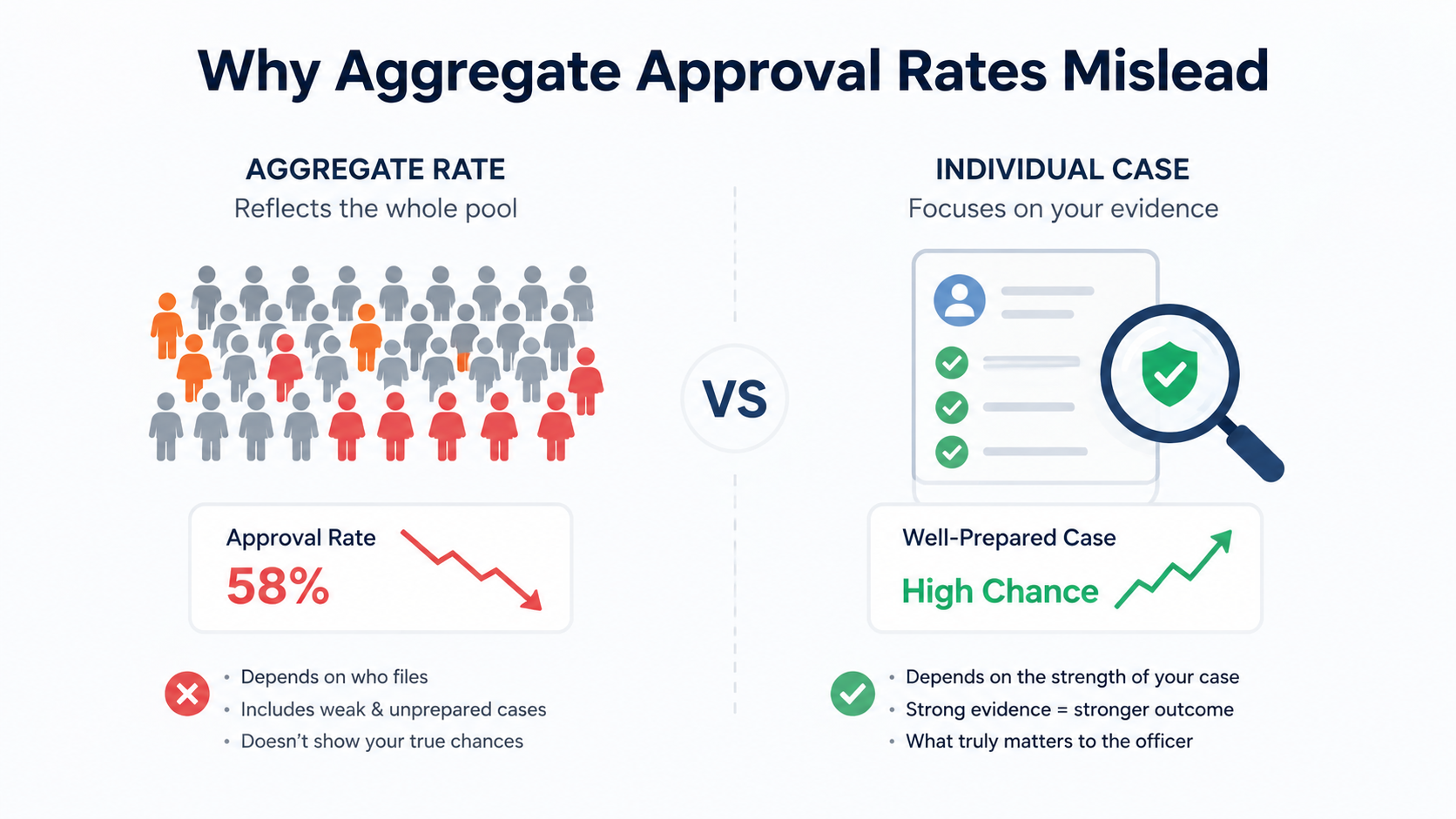
The approval rate for any immigration category reflects the population filing into it not the probability of any individual outcome. When a category becomes well publicized and accessible, the volume of filings increases, and the composition of that pool shifts toward less prepared applicants. The aggregate rate falls not because officers started rejecting previously approvable cases, but because more cases at the margin entered the pool.
This effect is documented across immigration categories over time. When NIW became more widely discussed in the tech community, filing volumes increased substantially. Not all of those new filers had records that credibly supported a national interest argument.
For any individual petitioner, the relevant question is not “what percentage of the pool was approved?” It is “does my petition satisfy the Dhanasar standard with evidence that an officer can evaluate and credit?” Those are structurally different questions.
Three numbers the aggregate rate cannot tell you:
- What percentage of well constructed petitions with strong evidence were approved
- What the approval rate is for your specific field, service center, and processing type
- How much of the decline is attributable to a change in policy versus a change in filing population composition
Practitioners who monitor case-level outcomes consistently report that petitions with strong proposed endeavors, specific independent letters, and genuine portability evidence continue to achieve favorable outcomes even in adjudication cycles where the aggregate numbers looked poor.
The Factors That Actually Predict Individual Outcomes
If approval rate is the wrong question, the right question is: what differentiates petitions that get approved from those that receive RFEs or denials? The patterns are consistent across adjudication cycles.
Proposed Endeavor Precision
The single variable most consistently associated with strong outcomes is how precisely the proposed endeavor is defined. Petitions where the endeavor is specific, bounded, and tied to a documentable national priority almost always survive Prong 1 review. Petitions where the endeavor reads as a continuation of existing employment or a general description of a field rarely do.
Officers evaluating petitions at volume develop fast pattern recognition for vague endeavors. When the first page does not establish clearly what the petitioner will do, what outputs they will produce, and who will benefit, the petition rarely recovers.
Evidence of National Importance with Portability
The second consistent differentiator is whether the petition demonstrates portability that the work’s benefit extends beyond the petitioner’s current employer. This is the most common Prong 1 failure mode in recent adjudication: work that is genuinely valuable to a single organization, framed as nationally important without a mechanism showing how that value reaches beyond the single employer.
Strong portability evidence includes: frameworks adopted by peer organizations, methodologies referenced in industry standards, federal agency citations of the work, replication of approaches by other institutions, or documented use of the petitioner’s tools across sectors.
Recommendation Letter Independence and Specificity
Letters from genuinely independent experts who describe specific contributions with field level context consistently outperform letters from colleagues, supervisors, or professional contacts who offer general praise. Officers are trained to assess letter credibility and weight accordingly.
The two dimensions that matter most: independence (no financial or professional stake in the petitioner’s outcome) and specificity (concrete description of particular contributions and their measurable influence at a level above the petitioner’s immediate organization).
Prong 3 Argumentation
The third prong whether it benefits the United States to waive the labor certification requirement is the most frequently underdeveloped section in denied petitions. It is not sufficient to establish Prong 1 and Prong 2 and then assume Prong 3 follows automatically. The petition must make an explicit argument for why, in this petitioner’s specific case, requiring a job offer or labor certification would be contrary to the national interest or impractical.
Common Prong 3 angles: the petitioner is an entrepreneur for whom a traditional job offer is structurally impossible, the work is time sensitive and a multi-year certification process would compromise execution, or the petitioner’s specific expertise and established networks cannot be replicated through a standard recruitment process.
Internal Coherence Across All Layers
Petitions where the proposed endeavor, the petition letter, the supporting evidence, and the recommendation letters all describe the same person doing the same work generate a coherent signal. Petitions where these layers describe slightly different careers where the endeavor mentions one field but the letters emphasize another, or where the evidence does not connect to the stated endeavor create inconsistencies that undermine the whole.
A Petition Quality Framework
The table below illustrates how the same petition dimensions appear across strong, average, and weak filings. Approval outcomes correlate strongly with which column the petition most closely resembles.
| Factor | Strong Case | Average Case | Weak Case |
| Proposed endeavor definition | Specific, bounded, measurable | General but coherent | Vague or job-like |
| National importance anchor | Explicit federal document cited | Broad field-level claim | No anchor |
| Portability evidence | Cross-org adoption shown | Implied but unsubstantiated | Absent |
| Recommendation letters | Independent, specific, field-bridging | Peer-level, somewhat specific | Generic praise |
| Prong 3 argument | Urgency or impracticality shown | Briefly addressed | Treated as afterthought |
| Evidence consistency | All layers align to one argument | Minor misalignments | Letter contradicts endeavor |
Most petitions sit in the middle column across several dimensions. Moving consistently toward the left column is the practical task of petition preparation.
STEM vs. Non-STEM Approval Patterns
Available tracking data consistently shows that STEM-field petitions perform better in aggregate than non-STEM petitions. The structural reason is straightforward: STEM endeavors map more easily onto federally designated priority sectors, and the national importance argument is often shorter to construct because the federal anchor is widely documented.
Non-STEM petitions do not face a categorical disadvantage in the regulations, but they do face a practical evidence construction gap. The petitioner must do more deliberate work to build the federal anchor and demonstrate portability than their STEM-field counterparts, who often have agency reports, legislative frameworks, and published strategic priorities directly naming their field.
The practical implication for non-STEM applicants is not discouragement it is planning. Non-STEM cases that fail typically fail because the petitioner applied a STEM evidence template to a non-STEM career. Non-STEM cases that succeed typically do so because the petitioner built a different kind of evidence architecture: adoption records, cross-organizational influence signals, policy anchored endeavor framing, and independent expert letters that bridge the technical work to federal priorities.
For both categories, the most important performance driver is petition quality not the field designation.
RFE Trends and What They Signal
RFE rates have increased across the NIW category in recent years, and RFE issuance has become more common than it was during the high-approval period of 2021-2022. The pattern reflects two things: USCIS using RFEs to request evidence that should have been in the initial filing, and a stricter standard for what constitutes adequate Prong 1 documentation.
An RFE is not a denial. It is a signal that the officer reviewing the case found the evidence insufficient to approve or deny without additional information. A well-prepared response can address an RFE effectively but avoiding the RFE in the first place is substantially more efficient.
The most common RFE triggers in current adjudication:
- Vague or insufficiently specific proposed endeavor definitions
- National importance claims that assert field importance without demonstrating the petitioner’s specific contribution
- Absence of portability evidence no mechanism showing how the work extends beyond one employer
- Recommendation letters that describe general excellence without specific innovations or field-level influence
- Underdeveloped Prong 3 arguments that treat the waiver justification as an afterthought
Petitions that address all five of these proactively in the initial filing avoid the majority of the RFE triggers visible in current adjudication patterns.
Want a realistic assessment of where your petition stands? Get a free USCIS style case evaluation from Immignis before you file.
Why Strong Professionals Still Get Denied
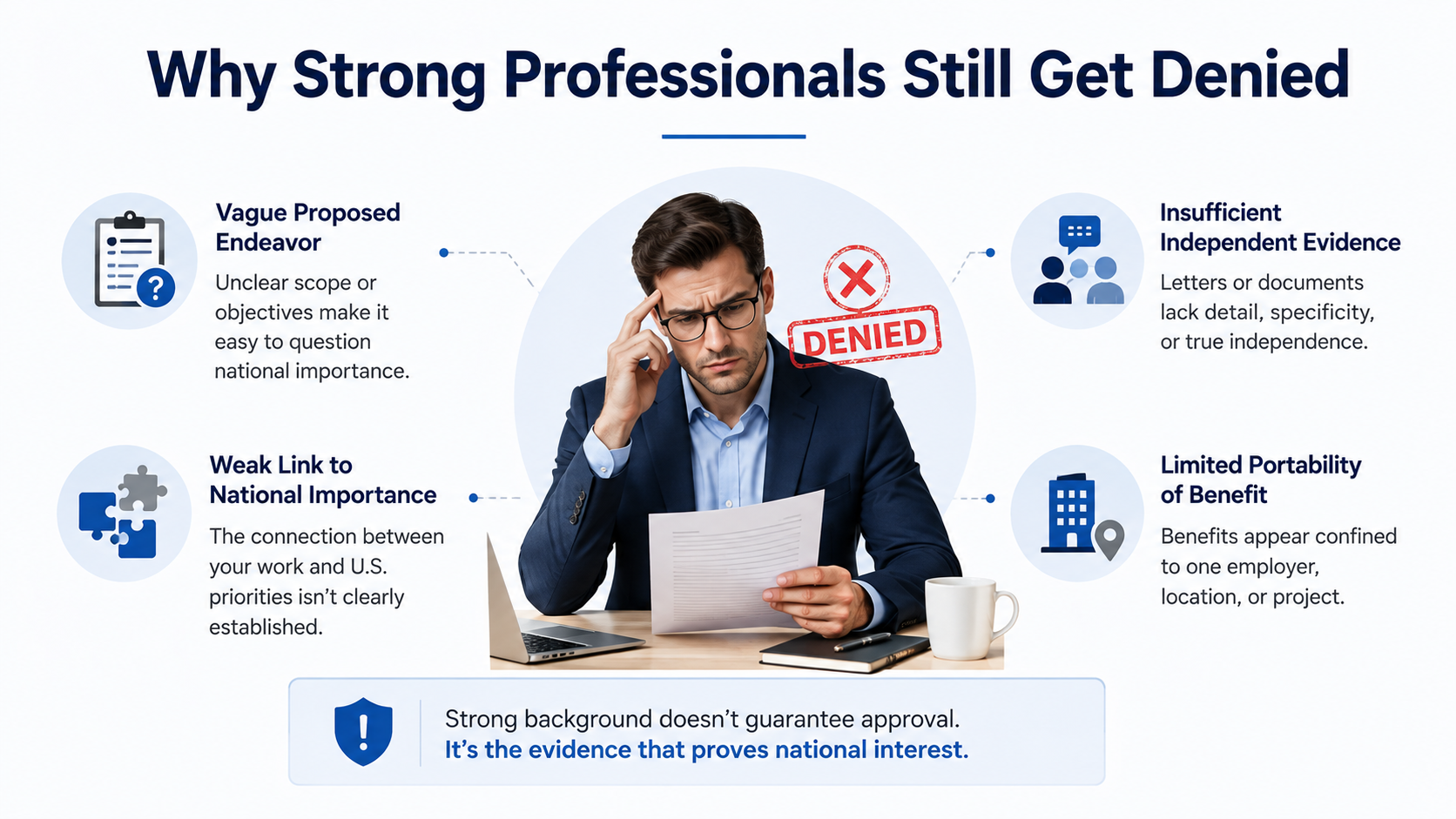
One of the more counterintuitive patterns in NIW adjudication is that strong credentials alone do not produce approvals. Applicants with PhDs from leading institutions, publication records in high-impact journals, and demonstrably excellent professional records have received denials and RFEs in recent cycles.
The explanation is consistent with the structure of the Dhanasar test: it is a future benefit standard, not an achievement standard. What matters is whether the proposed endeavor will benefit the United States at the national level not whether the petitioner has accomplished impressive things in the past. Past accomplishments support Prong 2 (well-positioned). They do not establish Prong 1.
The petitions that fail despite strong credentials typically share one or more of these characteristics:
- The proposed endeavor is stated at a high level of abstraction “continuing my research in X” or “advancing the field of Y” that cannot be evaluated against the national importance standard.
- The national importance argument is implicit rather than explicit the petition assumes the officer will infer importance from the prestige of the applicant’s institution or the visibility of the field.
- The evidence package is credential heavy and impact light strong on publications and awards, thin on documentation of what changed in the field, who adopted the work, or what the U.S. level benefit specifically is.
- Prong 3 is absent or formulaic the petition assumes the waiver is self-evidently appropriate for a qualified applicant rather than arguing it explicitly.
The structural correction is the same regardless of credential level: build the petition around the proposed endeavor and its national level benefit, use credentials to establish Prong 2 positioning, and argue all three prongs as distinct analytical claims.
How Filing Timing Relates to Approval Outcomes
For applicants from countries with EB-2 visa backlogs, approval rate is only one dimension of the strategic picture. The priority date captured at I-140 filing determines position in the visa queue which can mean a difference of years in when adjustment of status or consular processing becomes available.
This creates a specific strategic consideration: a well-constructed petition filed early is almost always preferable to a stronger petition filed later, because the priority date travels with the approved I-140 regardless of subsequent job changes or career shifts (within limits). The cost of waiting to build a stronger case is measured in priority date movement not just in the time it takes to prepare the petition.
For applicants not subject to backlog pressure, the timing calculation is simpler: file when the case is credibly prepared, not before.
What a Genuinely Approvable Petition Looks Like
Drawing together the patterns above, a petition that consistently avoids the failure modes associated with RFEs and denials shares several characteristics.
It opens with a precisely defined proposed endeavor that a non-specialist officer can read, understand, and evaluate. The endeavor is specific enough to permit assessment: what work, what method, what output, what national level benefit.
It establishes substantial merit and national importance as two separate arguments. Substantial merit is grounded in evidence of the work’s value within its field. National importance is grounded in a documented federal priority anchor and a portability mechanism that extends the work’s benefit beyond one employer.
It provides expert letters from genuinely independent voices who describe specific contributions and bridge those contributions to national level significance, rather than offering general endorsements of the petitioner’s qualities.
It argues Prong 3 explicitly, identifying the specific reasons why waiving the labor certification requirement serves the national interest in this petitioner’s particular circumstances.
And it maintains coherence across all layers. The endeavor defined on page one is the same endeavor being supported by the evidence on page forty. Nothing in the letter, the evidence, or the letters should require the officer to reconcile inconsistencies.
Frequently Asked Questions
What is the EB-2 NIW approval rate in 2026?
Third-party trackers following USCIS I-140 adjudication data have documented a significant decline in aggregate NIW approval rates from the 2021–2022 period, with tightened scrutiny particularly around national importance arguments. USCIS does not publish NIW-specific rates. The aggregate figures reflect pool composition as well as adjudication policy, making them poor predictors of individual outcomes.
Is EB-2 NIW getting harder to approve?
Adjudication has become more demanding, particularly around Prong 1 national importance arguments and Prong 3 waiver justification. The bar for what constitutes a sufficient endeavor definition and portability evidence has risen. Well-constructed petitions with strong evidence continue to achieve approvals; the cases most affected are thin or vague filings.
What increases NIW approval chances?
A precisely defined proposed endeavor, an explicit federal priority anchor, portability evidence showing impact beyond one employer, independent and specific recommendation letters, and a developed Prong 3 argument. These factors consistently differentiate approved petitions from those that receive RFEs or denials across all adjudication cycles.
What are the most common causes of NIW denial?
Vague proposed endeavors, field-level national importance claims that don’t demonstrate the petitioner’s specific contribution, single employer impact framing without portability, generic recommendation letters, and underdeveloped Prong 3 arguments. Most denials are not credential related they are petition structure related.
Why do strong professionals sometimes still get denied?
Because Dhanasar is a future benefit standard, not an achievement standard. Strong credentials support Prong 2, but they do not establish Prong 1. Petitions that lead with credentials and treat the national importance argument as implicit rather than explicitly building it fail regardless of how impressive the applicant’s record is.
What causes EB-2 NIW RFEs?
The most common triggers are vague proposed endeavors, national importance claims that assert field importance without demonstrating the petitioner’s specific contribution, absence of portability evidence, generic recommendation letters, and underdeveloped Prong 3 arguments. All five are preventable in initial filing.
Is NIW approval easier for STEM professionals?
STEM petitions perform better in aggregate because STEM endeavors map more easily onto federally designated priority sectors. The advantage is practical, not regulatory the legal standard is the same. Non-STEM petitions succeed when they build equivalent evidence through adoption records, policy anchored framing, and cross-organizational influence.
Does premium processing improve approval odds?
Premium processing does not change the legal standard applied or improve the substantive quality of the petition. It guarantees a USCIS action within 45 business days for the I-140, which can be valuable for timeline planning. Approval probability is determined by petition quality, not processing type.
Should I file now or wait to strengthen my profile?
It depends on whether the current case is credible under Dhanasar and, for backlogged country applicants, how much priority date capture matters to the overall strategy. A credible case should generally be filed when ready. For applicants with meaningful backlogs, capturing an early priority date through a viable petition often outweighs the marginal benefit of additional delay.
How long does NIW adjudication take in 2026?
Standard I-140 processing for NIW petitions currently takes many months at USCIS, with timelines varying by service center and filing volume. Premium processing offers an I-140 adjudication decision within 45 business days but does not accelerate the subsequent visa bulletin queue or adjustment of status processing.
If you want an honest assessment of where your case sits relative to current adjudication standards not the aggregate rate, but your specific petition’s strengths and vulnerabilities book a strategic EB-2 NIW petition consultation with Immignis and get a structured evaluation before you file.