
Understanding the Current EB-2 NIW Approval Rate Around the World
Last Updated on July 2, 2026 by Amelia
2026 Update: Global Trends, USCIS Scrutiny, Visa Bulletin Backlogs, and Stronger Petition Strategy
Written by Emily Carter, Immigration-Law Specialist
Reviewed by Jonathan Miller, Esq., Licensed U.S. Immigration Attorney
The EB-2 National Interest Waiver, commonly called EB-2 NIW, remains one of the most important U.S. green card options for qualified professionals, researchers, entrepreneurs, physicians, engineers, scientists, academics, technology specialists, and other high-skilled individuals whose work can benefit the United States.
The attraction is clear. A qualified EB-2 NIW applicant can self-petition without a permanent job offer and without the PERM labor certification process. This makes the category especially valuable for professionals whose work is independent, research-based, entrepreneurial, cross-institutional, or not limited to one U.S. employer.
However, EB-2 NIW Approval Rate environment has changed. Older articles often described EB-2 NIW as having very high approval rates, sometimes in the 70% to 90% range. That description is no longer safe as a general 2026 statement. Current USCIS adjudication trends show that EB-2 NIW remains a strong pathway for well-prepared applicants, but the category is now more competitive and more evidence-sensitive than it was several years ago.
This article explains what the current approval-rate data means, why country of birth affects timing but not the legal standard, and what applicants can do to build a stronger EB-2 NIW petition in the current environment.
| Quick answer: EB-2 NIW is still a valuable green card strategy in 2026, but applicants should not rely on old approval-rate assumptions. Recent USCIS Form I-140 data summarized from USCIS reports shows a clear decline in NIW approval rates from earlier years, with FY2025 reported at about 55.2% overall and a much lower fourth quarter. The main reason is not that NIW disappeared as an option; it is that USCIS is applying the Dhanasar framework and the January 2025 NIW guidance with greater attention to the proposed endeavor, national importance, and independent evidence. |
First, Understand What ‘Acceptance Rate’ Really Means
The phrase ‘acceptance rate’ can be misleading in immigration writing. USCIS may accept a filing for processing if the forms, signatures, and fees are correct. That is not the same as approving the petition.
For EB-2 NIW, the more useful term is I-140 approval rate. This refers to whether USCIS approves the Form I-140 immigrant petition after reviewing the applicant’s EB-2 eligibility and National Interest Waiver evidence.
Even after an I-140 is approved, the applicant still needs an available immigrant visa number before receiving permanent residence. This is where the Visa Bulletin becomes important, especially for applicants chargeable to India and China.
| Term | Meaning | Why it matters |
| Filing acceptance | USCIS accepts the package for processing. | This only means the filing passed basic intake checks. |
| I-140 approval | USCIS approves the EB-2 NIW immigrant petition. | This is the core NIW case result. |
| Visa availability | The priority date is current under the Visa Bulletin. | This determines when the applicant may complete adjustment of status or consular processing. |
| Green card approval | The applicant receives permanent residence after I-485 approval or immigrant visa admission. | This is the final immigration benefit. |
What the Latest EB-2 NIW Approval-Rate Trend Shows
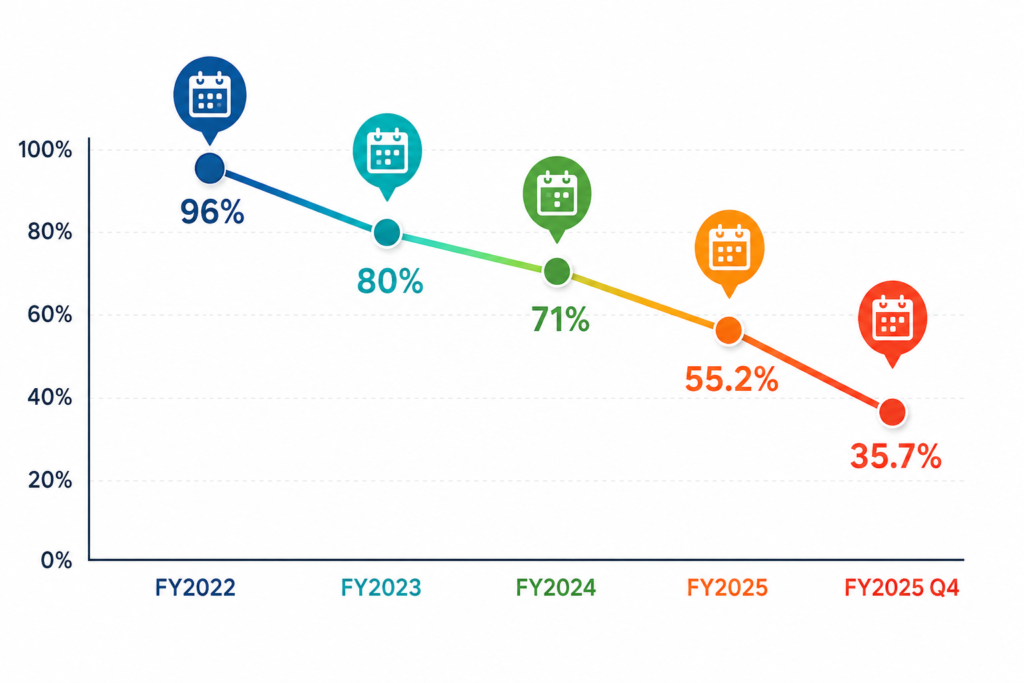
USCIS publishes immigration and citizenship data, including Form I-140 adjudication data. Recent legal-industry analysis of USCIS Form I-140 data shows that EB-2 NIW approval rates have declined from the unusually high levels seen during earlier years. One 2026 analysis of USCIS data reported approximate EB-2 NIW approval rates of 96% in FY2022, 80% in FY2023, 71% in FY2024, and 55.2% in FY2025, with the fourth quarter of FY2025 reported at about 35.7%.
These figures should be understood carefully. They are not a personal prediction for any individual applicant. They do not mean that every field, country, or petition type has the same chance. They also do not replace a legal evaluation of a specific profile. They show a broader trend: USCIS is now reviewing EB-2 NIW petitions more carefully, and weak or broadly framed cases face greater risk.
| Period | Reported EB-2 NIW approval trend | Practical meaning for applicants |
| FY2022 | About 96% | Earlier filings faced a more favorable approval environment and lower filing volume. |
| FY2023 | About 80% | The category remained strong but demand was rising. |
| FY2024 | About 71% | USCIS scrutiny and case volume increased. |
| FY2025 | About 55.2% | The category became meaningfully more competitive. |
| FY2025 Q4 | About 35.7% | Recent data suggests sharper scrutiny and a higher denial risk for weaker petitions. |
Does This Mean EB-2 NIW Is No Longer Worth Filing?
No. EB-2 NIW is still a strong option for the right applicant. The current trend does not mean that qualified professionals should avoid the category. It means the petition must be built with more care, more specificity, and stronger independent evidence.
A well-prepared NIW petition should not present the applicant as generally talented or generally useful. It should show a defined proposed endeavor, explain why that endeavor has substantial merit and national importance, prove that the applicant is well positioned to advance it, and explain why waiving the job offer and labor certification benefits the United States.
The petitions most at risk are those built on broad claims, generic recommendation letters, weak connection between the applicant’s background and future plan, or unsupported statements that the field itself is important.
How EB-2 NIW Trends Differ Around the World
USCIS applies the same EB-2 NIW legal standard regardless of nationality. A petitioner from India, China, Pakistan, Nigeria, Brazil, Germany, Canada, or any other country must satisfy the same EB-2 threshold and the same National Interest Waiver standard. However, country of chargeability can strongly affect timing after I-140 approval. This is because employment-based immigrant visas are subject to annual limits and per-country limits. As a result, applicants from countries with very high demand may wait longer for a visa number even after a strong I-140 approval.
| Applicant group | Main 2026 issue | What it means |
| India | Severe EB-2 visa-number pressure | The Department of State announced that all available EB-2 visas for India in FY2026 had been used, and the July 2026 Visa Bulletin made EB-2 India unavailable for the remainder of FY2026. |
| China | Continuing EB-2 demand pressure | The July 2026 Visa Bulletin warned that EB-2 China may need retrogression or unavailability if demand requires it. |
| Rest of World | Often better visa availability than India and China, but not guaranteed | I-140 quality remains the key approval issue; visa timing still depends on the monthly Visa Bulletin. |
| Europe, Canada, Australia, and similar lower-demand chargeability areas | Usually fewer EB-2 visa-number delays than India and China | Applicants still need a strong NIW petition; location does not reduce the legal burden. |
| Africa, Latin America, Middle East, and South Asia outside India | Case quality and endeavor framing are usually more important than visa-number pressure | Strong cases can succeed when the work is tied to a credible U.S. benefit and supported by evidence. |
Why EB-2 NIW Approval Has Become More Competitive
Several factors explain the more competitive EB-2 NIW environment.
- More people are filing EB-2 NIW petitions because self-petitioning is attractive and does not require a sponsoring employer.
- USCIS is reviewing the proposed endeavor more closely and expects the endeavor to be specific, credible, and nationally important.
- USCIS now places more attention on whether the applicant’s EB-2 eligibility connects to the proposed endeavor.
- Generic expert letters carry less weight if they do not explain specific achievements, measurable impact, or why the applicant is well positioned.
- Entrepreneurial and commercial cases need stronger proof that the endeavor has broader U.S. importance beyond private business success.
- Visa Bulletin pressure has made applicants more strategic, increasing the number and quality of filings in self-petition categories.
The Legal Standard: Matter of Dhanasar and the 2025 USCIS NIW Guidance
The core EB-2 NIW test comes from Matter of Dhanasar. USCIS may grant a National Interest Waiver when the petitioner proves three elements: the proposed endeavor has substantial merit and national importance; the petitioner is well positioned to advance the endeavor; and, on balance, it would benefit the United States to waive the job-offer and labor-certification requirements.
The 2025 USCIS policy guidance made this analysis more detailed. USCIS now gives closer attention to threshold EB-2 eligibility, the relationship between the applicant’s claimed expertise and the proposed endeavor, the national importance of the endeavor, and the quality of evidence such as support letters and business plans.
| Dhanasar prong | What USCIS wants to see | Weak version | Stronger version |
| Prong 1: substantial merit and national importance | A proposed endeavor that matters beyond a private employer or narrow local benefit. | My field is important. | My defined project addresses a documented U.S. need, with evidence from policy, industry, data, or implementation. |
| Prong 2: well positioned | A credible record showing the applicant can advance the endeavor. | I have education and experience. | My past projects, publications, patents, leadership, funding, adoption, or expert support show I can execute the plan. |
| Prong 3: waiver beneficial to the U.S. | A reason why the U.S. benefits from waiving job offer and PERM. | I want to work independently. | The endeavor requires flexibility, speed, cross-institutional work, entrepreneurship, or work not tied to one labor-certified job. |
What Factors Most Influence EB-2 NIW Approval in 2026?
- A clearly defined proposed endeavor, not only a job title.
- Evidence that the endeavor has national importance, not only personal or employer-level benefit.
- A direct connection between the applicant’s education, experience, and proposed work.
- Independent evidence of past impact, such as adoption, citations, implementation, revenue impact, cost savings, clinical use, technical deployment, policy relevance, patents, or industry recognition.
- Specific expert letters that explain what the applicant did and why it matters.
- A realistic future plan showing how the applicant will advance the endeavor in the United States.
- Evidence that the work aligns with U.S. priorities such as public health, cybersecurity, artificial intelligence, infrastructure, energy resilience, education, workforce development, supply chain security, advanced manufacturing, environmental protection, or economic competitiveness.
- A petition letter that ties every claim to the Dhanasar framework.
Fields That Can Still Build Strong EB-2 NIW Cases
EB-2 NIW is not limited to STEM or academia. However, the proposed endeavor must be framed in a way that shows broader U.S. importance. The strongest cases usually connect professional expertise to a documented national need.
| Field | Possible national-interest framing | Evidence that may help |
| Healthcare and public health | Improving access, quality, disease prevention, healthcare operations, clinical innovation, or health-data systems. | Clinical outcomes, research, implementation, public-health projects, hospital adoption, expert letters. |
| Artificial intelligence and data science | Improving cybersecurity, healthcare analytics, infrastructure, education, logistics, fraud detection, or advanced industry productivity. | Models, deployments, patents, publications, system performance data, industry use. |
| Cybersecurity | Protecting critical infrastructure, financial systems, healthcare systems, software supply chains, or public-sector digital systems. | Security frameworks, incident prevention, technical reports, certifications, implementation evidence. |
| Energy and climate | Supporting grid resilience, renewable energy, emissions reduction, energy efficiency, or environmental monitoring. | Project results, patents, field deployment, cost savings, policy alignment. |
| Business and entrepreneurship | Creating scalable products or services that address documented market or public needs beyond one small business. | Traction, customers, funding, partnerships, job creation data, market validation. |
| Education and workforce development | Addressing skill gaps, improving access, training workers in national-priority sectors, or building measurable learning systems. | Program outcomes, institutional adoption, curriculum impact, workforce data. |
Common Misunderstandings About EB-2 NIW Approval by Country
| Misunderstanding | Correct position |
| Applicants from India or China are denied more often because of nationality. | USCIS applies the same legal standard to every petitioner. India and China mainly face longer visa-number waits after approval because of high demand and per-country limits. |
| Applicants from Europe or Canada automatically have better approval chances. | They may face shorter Visa Bulletin waits, but USCIS still reviews the I-140 evidence under the same legal standard. |
| Applicants from Africa, Latin America, or the Middle East cannot succeed without U.S. publications. | Publications can help, but strong projects, patents, implementation evidence, expert letters, and credible national-importance framing can also support NIW cases. |
| A high global approval rate means my case is safe. | Approval depends on the specific record. Current trends show that weak or generic petitions are much riskier than before. |
How to Improve EB-2 NIW Approval Chances in the Current Environment
- Start with the proposed endeavor. Define what the applicant will actually do in the United States and why it matters.
- Prove threshold EB-2 eligibility. Show that the applicant qualifies as an advanced-degree professional or a person of exceptional ability, and connect that eligibility to the proposed endeavor.
- Use objective evidence. Avoid relying only on personal statements or general praise.
- Show national importance with facts. Use government priorities, industry reports, public need, market evidence, health data, technical adoption, or measurable outcomes.
- Build strong expert letters. Letters should be specific, independent where possible, and tied to the applicant’s contributions.
- Address all three Dhanasar prongs separately. Do not assume one strong section will cover the entire case.
- Prepare for RFE risks before filing. A good petition should answer likely questions about national importance, well-positioned status, and the waiver benefit in the initial filing.
- Track the Visa Bulletin separately from I-140 approval. Approval of the petition and availability of the green card are different steps.
Examples of Stronger EB-2 NIW Case Framing
The following examples are simplified illustrations. They are not guarantees and should not be copied without adapting the facts to the applicant’s actual record.
| Applicant type | Weak framing | Stronger framing |
| Software engineer | I work in artificial intelligence. | I develop AI-based anomaly detection methods that help U.S. healthcare organizations detect system failures and reduce operational risk in patient-facing digital infrastructure. |
| Public-health researcher | I have published research papers. | My research identifies undercoverage in population-health datasets and supports more accurate public-health planning for underserved communities. |
| Entrepreneur | My startup will create jobs. | My platform addresses a documented U.S. workforce shortage through measurable training, employer partnerships, and scalable placement infrastructure. |
| Energy engineer | Renewable energy is important. | My battery-control and energy-efficiency methods have been tested in field conditions and can support U.S. grid resilience and cost reduction. |
Common Mistakes That Lower EB-2 NIW Approval Chances
- Using old approval-rate claims as if they still reflect the current adjudication environment.
- Describing the applicant’s occupation instead of a specific proposed endeavor.
- Claiming national importance only because the field is important.
- Submitting recommendation letters that only praise the applicant without explaining specific impact.
- Failing to connect the applicant’s past achievements to the future U.S. endeavor.
- Relying on business plans without proof of traction, expertise, feasibility, or broader benefit.
- Ignoring Visa Bulletin delays after I-140 approval.
- Assuming that an advanced degree alone is enough for NIW approval.
How Immignis Can Help
Immignis helps professionals, researchers, entrepreneurs, and highly skilled applicants evaluate whether EB-2 NIW is a realistic pathway under current USCIS standards. The goal is not to rely on general approval-rate statistics, but to assess the applicant’s actual evidence and build a petition that fits the current legal framework.
Our EB-2 NIW strategy work may include proposed endeavor development, evidence mapping, expert-letter planning, petition-letter drafting, policy-alignment analysis, RFE risk review, and long-term profile-building where the applicant needs stronger proof before filing.
In the current environment, the strongest petitions are specific, evidence-based, and honest about both strengths and gaps. That is the standard applicants should expect before filing.
Frequently Asked Questions
What is the current EB-2 NIW approval rate?
Recent analysis of USCIS Form I-140 data reported the FY2025 EB-2 NIW approval rate at about 55.2%, with a much lower fourth quarter. Applicants should treat this as a broad trend, not a prediction for any individual case.
Does USCIS publish EB-2 NIW approval rates by nationality?
USCIS does not provide a simple public approval-rate chart by nationality for EB-2 NIW applicants. Country of chargeability mainly affects visa availability after approval, not the legal standard used to decide the I-140 petition.
Is EB-2 NIW harder now than before?
Yes, the category appears more competitive than in earlier years. USCIS is giving closer attention to the proposed endeavor, national importance, well-positioned evidence, and whether the waiver truly benefits the United States.
Can Indian applicants still file EB-2 NIW?
Yes. Indian applicants can still file EB-2 NIW petitions, but EB-2 visa-number availability for India is a separate issue. In FY2026, the State Department announced that India EB-2 numbers had been used for the fiscal year, which affects final green card timing after petition approval.
Can Chinese applicants still file EB-2 NIW?
Yes. Chinese applicants can file EB-2 NIW petitions, but the Visa Bulletin should be monitored closely because EB-2 China can face retrogression or limited visa availability when demand is high.
Do STEM professionals have better EB-2 NIW chances?
STEM professionals may have strong cases when the proposed endeavor connects to U.S. national priorities, but STEM status alone is not enough. The petition still needs specific evidence of national importance and the applicant’s ability to advance the work.
Do entrepreneurs qualify for EB-2 NIW?
Entrepreneurs can qualify, but business cases require careful evidence. USCIS will look for a credible proposed endeavor, proof of the applicant’s ability to execute it, and evidence that the benefit extends beyond ordinary private business success.
Does EB-2 NIW require publications?
No. Publications can help, especially in research fields, but they are not mandatory in every case. Other evidence such as patents, implementation records, contracts, adoption, expert letters, technical reports, funding, or measurable project results can also support a petition.
Does a high approval rate mean my EB-2 NIW case will be approved?
No. Approval-rate data shows general trends only. USCIS decides each petition on its own evidence.
What is the best way to improve approval chances?
Build the petition around a defined proposed endeavor, strong independent evidence, clear Dhanasar analysis, and proof that the applicant is well positioned to advance work of national importance.



Comments
EB-2 NIW Approval Factors 2026: What Actually Predicts Success
August 18, 2026 - 12:07 pm[…] first is the one that answers the least when evaluating EB-2 NIW approval factors: “What is the EB-2 NIW approval rate in 2026?” Third-party trackers following USCIS adjudication data have documented a significant tightening […]
EB-2 NIW Processing Time 2026: Avoid Costly Delays
August 21, 2026 - 10:30 am[…] by USCIS workload and petition quality. The priority date clock is controlled by visa supply, country of birth, and monthly Visa Bulletin movement. The adjustment of status clock begins only when the first two […]