Forms and Fees for the EB-2 NIW Application in 2026
Last Updated on July 2, 2026 by Amelia
EB-2 NIW Forms and Fees in 2026: What Applicants Should Know Before Filing
The EB-2 National Interest Waiver, commonly called EB-2 NIW, is one of the most valuable U.S. green card pathways for professionals whose work can serve the national interest of the United States. It is especially attractive because a qualified applicant may self-petition, avoid PERM labor certification, and apply without a permanent job offer from a U.S. employer.
However, the EB-2 NIW filing process is technical. A strong case can still be rejected at intake if the wrong form edition is used, the wrong fee is paid, the Asylum Program Fee is missing, or required form questions are left blank. Since the USCIS fee changes that took effect in 2024 and the later premium-processing fee adjustment reflected in 2026 regulations, applicants should verify every amount before mailing a petition.
This guide explains the main forms and fees for an EB-2 NIW case in 2026, the most common filing mistakes, and the difference between the first stage of the case, Form I-140, and the later green card stage through adjustment of status or consular processing.
| Quick Answer: For a typical EB-2 NIW self-petition filed in 2026, the core USCIS petition package usually includes Form I-140, the $715 I-140 filing fee, and the Asylum Program Fee. Many individual self-petitioners commonly fall under the $300 small-employer/individual category for the Asylum Program Fee, while regular petitioners pay $600 and qualifying nonprofits pay $0. Premium processing is optional and currently listed at $2,965 for EB-2 NIW, with a 45-business-day premium-processing timeframe. ETA-9089 labor certification is not required for EB-2 NIW. |
Current EB-2 NIW Form and Fee Snapshot
| Form / Item | When It Is Used | 2026 Fee / Cost Point |
| Form G-1145 | Optional e-notification request for paper filings accepted at USCIS lockbox locations. | No USCIS filing fee. |
| Form G-28 | Used if an attorney or accredited representative is entering an appearance. | No USCIS filing fee. |
| Form I-140 | The main immigrant petition for EB-2 NIW classification. | $715 USCIS filing fee. |
| Asylum Program Fee | Required with most Form I-140 filings unless the petitioner qualifies for a reduced or exempt category. | $600 regular petitioner; $300 small employer or qualifying individual self-petitioner; $0 qualifying nonprofit. |
| Form I-907 | Optional premium-processing request for Form I-140. | $2,965; EB-2 NIW premium-processing timeframe is 45 business days. |
| Form I-485 | Used for adjustment of status if the applicant is physically in the United States and the priority date is eligible for filing under the USCIS filing chart for that month. | $1,440 for most applicants age 14 or older; $950 for certain children under 14 filing with a parent. |
| Form I-765 | Optional employment authorization request while Form I-485 is pending. | $260 for applicants who filed Form I-485 with a fee after April 1, 2024 and whose I-485 remains pending; other categories may differ. |
| Form I-131 | Optional travel document / advance parole request while Form I-485 is pending. | $630 for advance parole, reentry permit, and many other travel-document requests. |
| Form I-693 | Medical examination report for adjustment of status. | No USCIS form filing fee, but civil surgeon medical exam costs are paid separately. |
Important: USCIS fees can change. Before filing, always verify the latest USCIS Fee Schedule, Form G-1055, and the filing instructions for each form.
What Is EB-2 NIW?
EB-2 NIW is part of the employment-based second preference immigrant visa category. The applicant must first qualify for EB-2 as either a professional with an advanced degree or a person with exceptional ability in the sciences, arts, or business. After meeting that threshold requirement, the applicant must show that the job-offer and labor-certification requirements should be waived because the proposed work is in the national interest of the United States.
Under the current USCIS policy trend, officers look closely at the connection between the applicant’s qualifications, the proposed endeavor, national importance, and the applicant’s ability to advance the work. The filing package should therefore include more than forms and fees. It should include a complete legal and evidence-based petition.
Stage One: The Form I-140 EB-2 NIW Petition
The first formal filing step in most EB-2 NIW cases is Form I-140, Immigrant Petition for Alien Workers. For NIW cases, the applicant may self-petition. This means a U.S. employer sponsor is not required, and the petition can be filed by the applicant directly.
Form I-140 is not only an administrative form. It identifies the requested immigrant classification, petitioner information, beneficiary information, filing basis, and key eligibility details. Errors on this form can cause rejection or delay, especially where the fee questions and petitioner-type questions are incomplete or inconsistent.
Form G-1145: Electronic Notification of Acceptance
Form G-1145 is optional. It allows the applicant to request an email or text notification when USCIS accepts the paper filing at a lockbox location. It does not replace the official USCIS receipt notice, but it can help the applicant learn faster that the filing has been accepted.
Because it has no filing fee and can help with tracking, it is commonly placed at the front of the petition package.
Form G-28: Attorney or Accredited Representative Appearance
Form G-28 is used only if an attorney or accredited representative represents the petitioner. It tells USCIS who is authorized to receive notices and communicate about the case. Applicants filing without a representative do not include Form G-28.
Form I-140: The Main EB-2 NIW Form
Form I-140 is mandatory for the EB-2 NIW petition. As of the current USCIS fee schedule, the Form I-140 filing fee is $715.
For a self-petitioned EB-2 NIW case, the I-140 package should normally include the completed form, the correct fee payments, an attorney appearance form if applicable, the petition letter or legal brief, evidence of EB-2 eligibility, evidence supporting the three Dhanasar prongs, and the applicant’s supporting exhibits.
Important Correction: ETA-9089 Is Not Required for EB-2 NIW
The regular EB-2 PERM route normally involves a labor certification process through the U.S. Department of Labor. EB-2 NIW is different. The purpose of the National Interest Waiver is to request a waiver of the job-offer and labor-certification requirements. Therefore, a typical EB-2 NIW self-petition does not require a certified ETA-9089 labor certification from the Department of Labor.
Applicants should not confuse EB-2 NIW with regular employer-sponsored EB-2 PERM cases. Including the wrong forms, describing the case as PERM-based, or treating ETA-9089 as mandatory for NIW can create confusion and may weaken the filing strategy.
The Asylum Program Fee: A Major 2026 Filing Issue
The Asylum Program Fee is one of the most common causes of I-140 filing rejection. USCIS requires the correct Asylum Program Fee with Form I-140 unless the petitioner qualifies for a reduced or exempt category. The amount depends on the petitioner type.
For many EB-2 NIW individual self-petitioners, the practical total for the initial I-140 stage is often $715 plus a $300 Asylum Program Fee, for a total of $1,015 before premium processing. However, the correct fee should always be confirmed using the current Form I-140 questions, the USCIS fee schedule, and the petitioner’s exact status.
| Petitioner Type | Asylum Program Fee | Practical Filing Note |
| Regular petitioner | $600 | Often applies to larger employer petitioners. |
| Small employer / qualifying individual self-petitioner | $300 | Commonly relevant for EB-2 NIW self-petitioners, depending on how the Form I-140 petitioner-type questions are answered. |
| Qualifying nonprofit | $0 | Applies only if the petitioner meets the nonprofit definition and completes the relevant form questions correctly. |
USCIS has warned that missing or incorrect Asylum Program Fee payments, or leaving required Form I-140 questions blank, may cause rejection at intake. For paper filings, applicants should also pay close attention to whether USCIS requires separate payments for different fee items.
Form I-907: Premium Processing for EB-2 NIW
Premium processing is optional. It is requested on Form I-907. For EB-2 NIW, premium processing does not mean that USCIS will approve the petition within the premium period. It means USCIS must take an action within the stated timeframe, such as approval, denial, Request for Evidence, or Notice of Intent to Deny.
Under the current fee schedule, premium processing for EB-2 NIW is listed at $2,965. The premium-processing timeframe for EB-2 NIW is 45 business days. The premium-processing fee is separate from the Form I-140 filing fee and the Asylum Program Fee.
Typical EB-2 NIW Filing Cost Scenarios
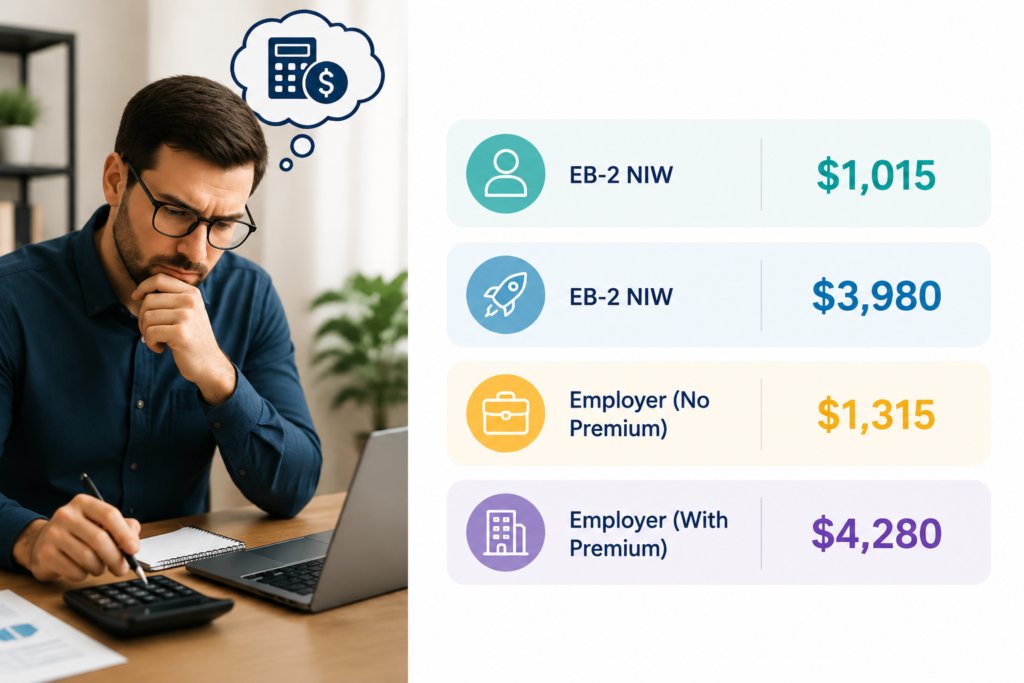
| Scenario | Forms / Fees Included | Estimated USCIS Fee Total |
| I-140 EB-2 NIW self-petition without premium processing | Form I-140 filing fee + likely reduced Asylum Program Fee for qualifying individual self-petitioner. | $715 + $300 = $1,015 |
| I-140 EB-2 NIW self-petition with premium processing | Form I-140 filing fee + likely reduced Asylum Program Fee + Form I-907 premium processing. | $715 + $300 + $2,965 = $3,980 |
| I-140 filed by regular employer petitioner without premium processing | Form I-140 filing fee + full Asylum Program Fee. | $715 + $600 = $1,315 |
| I-140 filed by regular employer petitioner with premium processing | Form I-140 filing fee + full Asylum Program Fee + Form I-907 premium processing. | $715 + $600 + $2,965 = $4,280 |
These examples do not include attorney fees, translation costs, credential evaluations, mailing costs, expert letters, civil surgeon costs, or later adjustment-of-status or consular-processing fees.
What Evidence Should Be Filed With the EB-2 NIW I-140?
The forms and fees only start the case. The main strength of an EB-2 NIW filing comes from the petition letter and supporting evidence. A strong EB-2 NIW package should prove both threshold EB-2 eligibility and the National Interest Waiver standard.
| Evidence Category | Purpose |
| Advanced degree evidence | Diplomas, transcripts, evaluations, or evidence of a bachelor’s degree plus at least five years of progressive post-bachelor’s experience where applicable. |
| Exceptional ability evidence | Evidence such as academic records, ten years of experience, license or certification, salary evidence, memberships, and recognition where the applicant relies on exceptional ability. |
| Proposed endeavor statement | Explains exactly what the applicant plans to do in the United States and why it matters. |
| National importance evidence | Shows broader U.S. significance through policy, industry, economic, scientific, technological, healthcare, infrastructure, or public-interest evidence. |
| Well-positioned evidence | Shows education, experience, achievements, funding, publications, patents, projects, implementation, letters, or other proof that the applicant can advance the endeavor. |
| Balancing-test evidence | Explains why the U.S. benefits from waiving the job offer and labor certification requirement. |
Stage Two: Adjustment of Status After I-140 Filing or Approval
Form I-140 approval does not automatically grant a green card. The applicant must still complete the immigrant visa stage. If the applicant is physically in the United States and otherwise eligible, this may be done through Form I-485, Application to Register Permanent Residence or Adjust Status. If the applicant is outside the United States, the case usually proceeds through consular processing.
For adjustment of status, the priority date must be eligible under the monthly USCIS filing chart. This is especially important for applicants from countries affected by EB-2 backlogs. For example, the July 2026 Visa Bulletin made EB-2 unavailable for India for the remainder of FY 2026, showing why applicants must check visa availability before planning I-485 filing.
| Adjustment Form | Purpose | Current Fee Point |
| Form I-485 | Main green card application filed inside the United States when eligible. | $1,440 for most applicants age 14 or older; $950 for certain children under 14 filing with a parent. |
| Form I-765 | Optional work authorization while I-485 is pending. | $260 for many I-485-based applicants who filed I-485 with a fee after April 1, 2024. |
| Form I-131 | Optional advance parole/travel document while I-485 is pending. | $630 for advance parole, reentry permit, and many other travel-document requests. |
| Form I-693 | Medical examination report. | No USCIS form fee, but the civil surgeon charges separately. |
Each family member applying for adjustment of status generally files their own Form I-485 and pays the applicable filing fee. Spouses and unmarried children under 21 may be included as derivative beneficiaries, but they still need their own adjustment filings if they are applying inside the United States.
Consular Processing: When the Applicant Is Outside the United States
If the applicant is outside the United States, the case may move to the National Visa Center and then to a U.S. embassy or consulate after I-140 approval and visa availability. The applicant generally completes Form DS-260, submits civil documents, pays applicable Department of State fees, completes a medical exam with an authorized physician, and attends an immigrant visa interview if required.
Consular-processing fees are paid through the Department of State system, not as part of the USCIS I-140 filing. Because consular fees and procedures can change, applicants should verify the current National Visa Center and Department of State instructions at the time of processing.
How to Pay USCIS Fees Correctly
USCIS fee payments must be made in U.S. dollars and from a bank or financial institution located in the United States, unless USCIS instructions for a specific filing location provide otherwise. Common payment methods include personal check, cashier’s check, money order, and credit card using Form G-1450 where accepted.
If paying by check or money order, it should be payable to “U.S. Department of Homeland Security.” Do not abbreviate the payee as “USDHS” or “DHS.” Always follow the latest USCIS form instructions and lockbox instructions because payment-combination rules can change.
Common EB-2 NIW Forms and Fees Mistakes to Avoid
- Listing ETA-9089 as a required NIW form. EB-2 NIW waives the labor-certification requirement and does not require a certified PERM ETA-9089.
- Forgetting the Asylum Program Fee when filing Form I-140.
- Using the wrong Asylum Program Fee amount for the petitioner type.
- Leaving Form I-140 petitioner-type questions blank, especially questions that determine the Asylum Program Fee.
- Combining payments when USCIS instructions require separate payments.
- Assuming premium processing guarantees approval. It guarantees faster USCIS action, not a favorable decision.
- Filing Form I-485 when the priority date is not eligible under the monthly USCIS filing chart.
- Assuming Form I-765 and Form I-131 are still free with all I-485 filings. After April 1, 2024, many adjustment applicants must pay separate fees for these forms.
- Not checking for updated form editions before filing.
- Forgetting that each derivative family member usually needs separate adjustment forms and fees
Frequently Asked Questions About EB-2 NIW Forms and Fees
What is the main form for EB-2 NIW?
The main form is Form I-140, Immigrant Petition for Alien Workers. EB-2 NIW applicants may generally self-petition, which means a U.S. employer sponsor is not required.
How much is the Form I-140 filing fee in 2026?
The current Form I-140 filing fee listed in the USCIS fee schedule is $715.
Does EB-2 NIW require the Asylum Program Fee?
Yes, most Form I-140 filings require the Asylum Program Fee unless the petitioner qualifies for a reduced or exempt category. Many individual NIW self-petitioners commonly use the $300 reduced fee category, while regular petitioners pay $600 and qualifying nonprofits pay $0.
Does EB-2 NIW require ETA-9089 labor certification?
No. A typical EB-2 NIW self-petition does not require PERM labor certification or a certified ETA-9089 from the Department of Labor.
How much is premium processing for EB-2 NIW?
The current premium-processing fee for EB-2 NIW is listed at $2,965, and the premium-processing timeframe is 45 business days.
Can I file Form I-485 with my EB-2 NIW I-140?
Only if you are otherwise eligible to adjust status and your priority date is eligible under the USCIS filing chart for that month. Visa Bulletin movement can affect this decision.
Are Form I-765 and Form I-131 free with Form I-485?
Not generally for new filings after April 1, 2024. Many I-485-based applicants must pay separate fees, including $260 for Form I-765 and $630 for Form I-131, depending on the category and filing history.
Do dependents pay separate fees?
Yes. A spouse or unmarried child under 21 may be included as a derivative beneficiary, but each person usually files their own adjustment forms and pays applicable fees if applying for adjustment of status.
Are USCIS filing fees refundable if the case is denied?
USCIS filing fees are generally non-refundable once accepted, even if the case is denied or withdrawn.
Conclusion
The EB-2 NIW application process is not just about completing forms. It requires the correct USCIS filing package, the correct fees, and a persuasive evidence record showing that the applicant qualifies for EB-2 classification and deserves a waiver of the job-offer and labor-certification requirements.
For 2026 filings, applicants should pay special attention to the Form I-140 filing fee, the Asylum Program Fee, premium-processing costs, and the separate fees that may apply later for adjustment of status, employment authorization, and advance parole. Filing with outdated fees or incorrect forms can cause rejection before USCIS even reviews the merits of the case.
Immignis helps professionals, entrepreneurs, researchers, and skilled applicants evaluate EB-2 NIW eligibility, organize evidence, prepare petition strategies, and avoid filing mistakes that can delay or weaken an otherwise strong case.