EB-2 NIW India 2026: Backlog Reality, Priority Dates, and How to Navigate the Wait
For Indian-born professionals pursuing an employment based green card, the EB-2 NIW India backlog in 2026 represents one of the most structurally challenging situations in U.S. immigration. The wait is not a bureaucratic inconvenience it is a multi-decade queue driven by a hard legal cap, and it affects every major life decision an applicant makes while it is running: career choices, family planning, housing, children’s education, and the basic question of whether to continue building a life in the United States.
This article explains why the backlog exists, what the Visa Bulletin mechanics mean in practical terms, where NIW fits into the strategy, and which tools available under current law can meaningfully improve an Indian applicant’s position.
Why the India EB-2 Backlog Is So Severe
The root cause is a provision in the Immigration and Nationality Act that limits any single country to no more than 7% of the annual employment based green card allocation. The U.S. issues roughly 140,000 employment-based green cards per year across all preference categories and all nationalities. India’s cap is approximately 9,800.
The demand from Indian-born applicants vastly exceeds that number. India produces a large share of H-1B visa holders and employment based petition filers across EB-1, EB-2, and EB-3. The result is a queue that grows faster than it is served and has been growing for decades.
The gap between where India’s priority date stands and where “Rest of World” stands illustrates the scale of the disparity.
| Category | India Priority Date (approx. 2026) | Rest of World | Practical Gap |
| EB-1 (Extraordinary Ability, Outstanding Researcher) | Late 2022 | Current | ~3-4 years |
| EB-2 NIW / Advanced Degree | Late 2012 – Early 2013 | Current | 12+ years |
| EB-3 Skilled Workers | 2012 | Current | 12+ years |
The figures above are approximations based on 2026 Visa Bulletin movement and will shift over time. The directional point is stable: an Indian-born EB-2 applicant filing today is entering a queue that, under current supply and demand conditions, measures in decades.
This is not the result of any single policy decision. It is the cumulative product of the per-country cap structure, decades of high EB-2 and EB-3 filing volume from Indian professionals, and an annual green card supply that Congress has not expanded since 1990.
Priority Dates and the Visa Bulletin: What They Mean
Two terms appear constantly in discussions of the India backlog and are often misunderstood: priority date and current.
Priority date is the date USCIS received the I-140 petition (or, in PERM cases, the date the PERM labor certification was filed). It determines the applicant’s position in the visa queue. An earlier priority date means an earlier position. For Indian EB-2 applicants, securing the earliest possible priority date is one of the most consequential decisions in the entire immigration process.
Current means the priority date is past the cutoff listed in the Visa Bulletin, making the applicant eligible to file the Form I-485 adjustment of status or proceed to consular processing. For Indian EB-2 applicants, the word “current” on a Visa Bulletin line is an event that may not occur for many years after the I-140 is filed.
The Visa Bulletin also presents two different charts:
-
- Final Action Dates (FAD) the absolute cutoff for green card issuance. The applicant’s priority date must be before this date to receive a green card in that month.
-
- Dates for Filing (DFF) a more generous set of cutoffs that USCIS may, but is not required to, accept for I-485 filing. When USCIS accepts the DFF chart, applicants whose priority dates are before the DFF but not yet before the FAD can file the I-485 and begin receiving interim benefits Employment Authorization Document (EAD), Advance Parole for travel, and after 180 days, AC21 job portability.
In 2026, USCIS has periodically switched between accepting the DFF and requiring the stricter FAD. These switches happen monthly with little advance notice and can open or close filing windows rapidly. Tracking the Visa Bulletin the moment it is released each month is a practical necessity for Indian applicants approaching a filing window.
Retrogression: When Progress Goes Backward
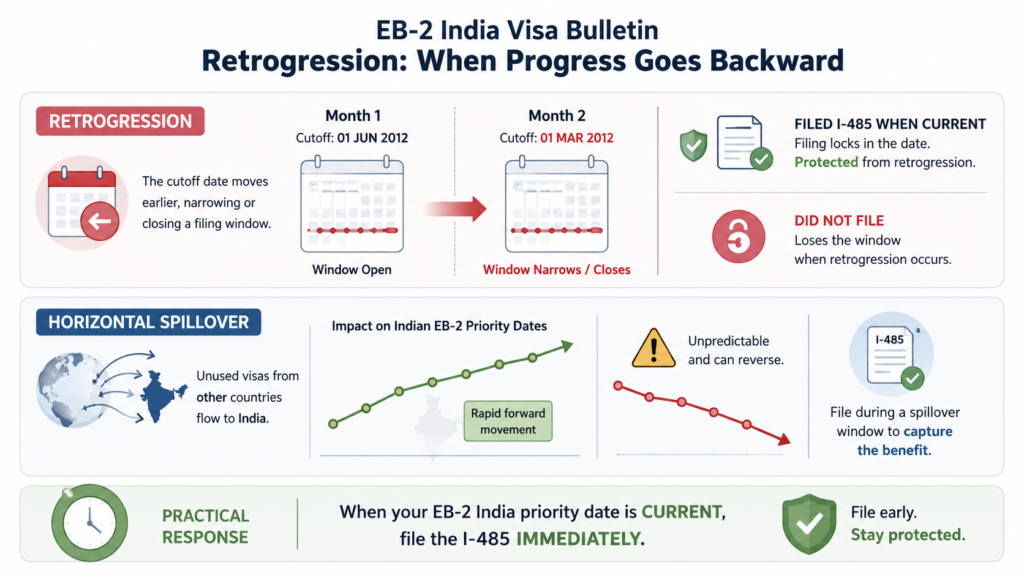
Retrogression refers to the backward movement of a priority date cutoff in the Visa Bulletin the month’s final action date moves earlier rather than later, narrowing or closing a filing window that was previously open.
For Indian EB-2 applicants, retrogression is not a remote risk. It has occurred multiple times across adjudication cycles and creates a specific problem: an applicant whose priority date was current in one month and had filed an I-485 is protected by that filing. An applicant who was current but had not yet filed loses the window when retrogression occurs.
The practical response to this reality: when an Indian EB-2 priority date becomes current under whichever chart USCIS accepts, file the I-485 immediately. The act of filing locks in the position and provides protection against subsequent retrogression, regardless of where the cutoff moves in later months.
Horizontal spillover the mechanism by which unused visa numbers from other countries flow to oversubscribed countries like India can produce rapid forward movement in Indian priority dates, as it did with the historically large advancement in the April 2026 Visa Bulletin. These movements are unpredictable and can reverse. An applicant who files during a spillover window captures the benefit; one who waits to see if it continues often loses it.
Where NIW Fits in the India Backlog Strategy
A common misconception: the NIW bypasses the India backlog. It does not. The NIW is a self-petition mechanism that allows the I-140 to be filed without employer sponsorship and without PERM labor certification. Once approved, the I-140 establishes a priority date and enters the same EB-2 India queue as a PERM-based filing.
What NIW does for Indian applicants:
-
- Files the I-140 immediately, without the 15-20-month PERM stage. This can compress the gap between “decide to file” and “priority date captured” by more than a year.
-
- Gives the applicant control over their own petition. The priority date does not depend on an employer’s willingness to sponsor or capacity to manage the PERM process.
-
- Preserves the priority date through career changes. Because the NIW is not tied to an employer, the priority date survives layoffs, employer changes, and career pivots with appropriate analysis of any portability requirements.
For an Indian applicant who qualifies, the NIW’s primary strategic value is the ability to capture the earliest possible priority date. Given that every month of delay in the queue translates to a month of additional wait at the other end, this is the most valuable thing the NIW does for Indian applicants not a shortcut to the front of the line, but the ability to get in line as early as possible.
The EB-1A Upgrade: The Most Powerful Strategy Available
For Indian professionals who meet the standard, upgrading to an EB-1A (Extraordinary Ability) or EB-1B (Outstanding Researcher/Professor) petition is the single most impactful move available. As of 2026, the EB-1 India queue is shorter than the EB-2 India queue by several years the differential has been as wide as eight to nine years.
Why this matters: a qualifying EB-1A petition can also retain the original EB-2 priority date. Under USCIS policy, an applicant with an earlier-priority-date approved I-140 in one category can “port” that priority date to a new I-140 in a different category. So an Indian professional who filed an EB-2 NIW with a 2018 priority date, then later qualifies for and approves an EB-1A, can file the EB-1A and carry the 2018 date with them entering the shorter EB-1 India queue with an earlier date than most of their competition.
The EB-1A standard is not out of reach for many senior professionals. USCIS evaluates EB-1A under the Kazarian standard, which requires a totality-of-record analysis across at least three of ten regulatory criteria. The standard requires demonstrating extraordinary ability in the sciences, arts, education, business, or athletics it does not require a Nobel Prize or thousands of citations.
Many applicants who could qualify for EB-1A have not filed because they assume it is reserved for the most famous or decorated professionals in their field. The Kazarian totality standard, applied to a professional with a strong record of original contributions, critical roles, above market compensation, and independent recognition, can often produce a viable EB-1A case where the petitioner did not initially think one was possible.
An honest evaluation of EB-1A eligibility, at the earliest point where a professional’s record might qualify, is one of the highest-value uses of an immigration strategy session for Indian applicants.
Cross Chargeability: The Spousal Strategy
Under INA §202(b), cross chargeability allows an applicant to be charged against the visa quota of their spouse’s country of birth rather than their own. For Indian-born applicants married to spouses born in non-backlogged countries, this provision can transform a decade-long wait into an immediate filing opportunity.
The mechanism: while the EB-2 India queue is measured in years, the EB-2 Rest of World category is frequently Current. An Indian-born professional who is cross-charged to their spouse’s qualifying country enters the Current queue, not the India-specific one. The application proceeds on the spouse’s chargeability, and both spouses receive green cards through the same process.
The requirements and constraints:
| Requirement | Detail |
| Who qualifies | Indian-born principal applicant married to a spouse born in a non-backlogged country (not India, China, Mexico, or the Philippines) |
| Qualifying spouse birth countries | UK, Germany, South Korea, Brazil, Nigeria, and most other countries not listed separately in the Visa Bulletin |
| Non-qualifying spouse birth countries | India, China (Mainland Born), Mexico, Philippines these have their own per-country backlogs |
| Joint filing requirement | Both spouses must file I-485 Adjustment of Status applications together; the principal cannot claim cross-chargeability if the derivative spouse is not included |
| Marriage requirement | Must be legally married at time of I-485 filing |
| Spouse physical presence | Derivative spouse is not required to be physically present in the U.S.; split processing (principal in U.S., spouse at consulate abroad) is available |
| Chargeability determination | Based on country of birth, not current citizenship or nationality an Indian citizen born in the UK qualifies |
| Chart requirement (2026) | USCIS may require Final Action Dates chart rather than Dates for Filing; cross-chargeability only helps if the spouse’s country date is current under whichever chart USCIS accepts that month |
| Retrogression risk | Even after filing, dates can retrogress. Filing as early as possible locks in the position. |
A Worked Example
A software engineer born in India has an EB-2 NIW priority date from 2016. Their spouse was born in Brazil. Under the India EB-2 Final Action Date in mid-2026, the engineer’s 2016 date is not yet current they are still years away from the front of the India queue.
Under cross-chargeability, both spouses file I-485 applications together. The engineer is cross-charged to Brazil’s quota. The EB-2 Brazil (Rest of World) date is Current. Both applications proceed immediately. The engineer receives their green card through the Brazil current queue, regardless of where the India cutoff stands.
The implication is significant: for Indian applicants whose spouses were born outside the four backlogged countries, this is often the fastest legal path to a green card available under current law.
Critical 2026 Procedural Note
USCIS periodically requires applicants to use the Final Action Dates chart rather than the more generous Dates for Filing chart. When this shift occurs as it did in May 2026 applicants who were current under DFF but not yet current under FAD lose their filing window. Cross chargeability follows the same chart requirements. The monthly Visa Bulletin release must be tracked, and eligible applicants should file immediately when a window opens rather than waiting to confirm whether it will remain open.
Married to a non-Indian spouse? Get a free NIW vs EB-1A evaluation from Immignis to assess whether cross-chargeability changes your timeline and what it requires to execute correctly.
Surviving the Wait on H-1B
For Indian applicants who are years away from a current priority date, the practical focus often shifts to navigating the H-1B dependency that comes with a long queue.
H-1B Extensions Beyond the Six-Year Cap
Under AC21, H-1B holders can receive three year extensions beyond the standard six-year limit if they have an approved I-140 and their priority date is not current. This extension mechanism is one of the most important benefits of filing the I-140 early even if adjustment of status is many years away.
The requirement: the I-140 must have been approved for at least one year, and the priority date must remain unavailable (i.e., not current). For Indian EB-2 applicants with current waiting periods, this condition is almost always met indefinitely. An approved NIW I-140 secured as early as possible establishes both the priority date and the AC21 extension eligibility.
AC21 Job Portability
Once an I-485 is filed and has been pending for 180 days, AC21 allows the applicant to change employers or job roles without jeopardizing the underlying petition, provided the new role is in the same or a similar occupational classification. For Indian applicants who file the I-485 during a DFF window, this portability can become available years before their priority date becomes current under the FAD chart.
Layoff Risk and Status Maintenance
A layoff while in the H-1B queue is one of the most disruptive events an Indian applicant faces. The priority date established by an approved I-140 survives a layoff and can be retained on a new I-140 filed by a new employer, or carried forward in certain circumstances. However, H-1B status must generally be maintained or a grace period used to transition to a new employer.

The most resilient strategy: an NIW I-140 that belongs to the worker, not the employer. A layoff does not revoke an NIW I-140 (unless the employer petitioner revoked it before separation, which is typically not a concern for self-petitions). The priority date is preserved.
Additional Strategic Options
Several other tools exist for Indian applicants navigating the backlog. Each has specific eligibility requirements and strategic tradeoffs.
-
- Priority date porting between EB-3 and EB-2. When an applicant qualifies for a different preference category, the earlier priority date from an approved I-140 in the original category can be carried to the new filing. EB-3 to EB-2 upgrades (when the applicant gains an advanced degree or a qualifying role) or occasional EB-2 to EB-3 strategic downgrades (when EB-3 temporarily moves ahead of EB-2 in India) both use this mechanism.
-
- Filing during DFF windows. When USCIS accepts the Dates for Filing chart, Indian applicants whose priority dates are before the DFF cutoff even if not yet current under FAD can file the I-485 and begin receiving EAD, Advance Parole, and after 180 days, AC21 portability. These interim benefits are material improvements in quality of life and career flexibility.
-
- O-1A as a complementary status. For professionals building toward EB-1A qualification, the O-1A visa (extraordinary ability, non-immigrant) provides continued work authorization and simultaneously produces the track record that strengthens an eventual EB-1A petition. The O-1A also requires employer or agent sponsorship, which is a constraint, but its evidentiary standard is somewhat more accessible than EB-1A.
-
- Global mobility options. For professionals open to it, other countries including the UK’s Global Talent Visa, Canada’s Express Entry, and several European startup visa programs offer talent-based pathways that can provide earlier permanent residency or citizenship options while the U.S. queue continues. This is a personal and family decision rather than a purely immigration one, but it is a realistic and increasingly common consideration for Indian professionals facing 10+ year waits.
Frequently Asked Questions
How long is the EB-2 NIW India backlog in 2026?
Does NIW allow Indian applicants to skip the backlog?
Why is the India green card backlog so severe?
What is cross-chargeability and how does it help Indian applicants?
Which countries qualify a spouse for cross-chargeability?
Can I use my spouse’s birth country if they are an Indian citizen but born abroad?
What is EB-1A and how does it compare to EB-2 NIW for Indian applicants?
How does H-1B extension work while waiting for an Indian EB-2 priority date?
What happens to my priority date if I change employers?
Should I track the Visa Bulletin every month?
The India backlog is a structural reality that cannot be wished away. The strategies available under current law can materially change how long an applicant waits and what flexibility they maintain while waiting. Book a long-term immigration planning consultation with Immignis to evaluate your priority date position, cross-chargeability eligibility, EB-1A viability, and the filing strategy most suited to your specific situation.