
How to Craft a Strong Petition Letter for EB2-NIW and EB1A
Last Updated on June 30, 2026 by Amelia
EB-2 NIW petition letter can make an EB-2 National Interest Waiver or EB-1A Extraordinary Ability petition easier for USCIS to review. It does not replace evidence. It does not lower the legal standard. Its real purpose is to organize the record, connect the evidence to the law, and explain why the petition satisfies the correct USCIS framework.
For EB-2 NIW, the petition letter should explain the proposed endeavor, the national importance of that endeavor, the applicant’s ability to advance it, and why the United States benefits from waiving the job offer and labor certification requirement.
For EB-1A, the petition letter should explain how the applicant satisfies the regulatory evidence criteria and why the total record proves sustained national or international acclaim, extraordinary ability, and a level of recognition placing the applicant among the small percentage at the top of the field.
In 2026, a persuasive petition letter should be precise, evidence-driven, and aligned with current USCIS policy trends. Generic templates, inflated language, and long biographies are usually weaker than a clear legal argument supported by exhibits.
| Quick answer A strong EB-2 NIW or EB-1A petition letter should tell USCIS exactly what category is being requested, what legal standard applies, what evidence supports each requirement, and why the record meets that standard. The strongest letters are not emotional appeals. They are structured, factual, and easy to verify. |
Why the Petition Letter Matters:
USCIS officers review large documentary records. A well-written petition letter helps the officer understand the case without having to reconstruct the argument from scattered exhibits. The letter should serve as a roadmap. It should identify the legal standard, cite the strongest evidence, and explain the meaning of that evidence in the applicant’s field.
- For EB-2 NIW, the letter should be organized around the Dhanasar three-prong framework.
- For EB-1A, the letter should be organized around the regulatory criteria and the final merits review.
- For both categories, the letter should avoid unsupported claims and should point to clear documentary proof.
EB-2 NIW vs. EB-1A Petition Letters: The Core Difference:
| Issue | EB-2 NIW Petition Letter | EB-1A Petition Letter |
| Main legal question | Does the applicant qualify for EB-2, and should the job offer and labor certification be waived in the national interest? | Has the applicant proven extraordinary ability through sustained acclaim and recognition at the top of the field? |
| Main focus | The proposed endeavor and its national importance. | The applicant’s record of recognized achievement. |
| Evidence style | Endeavor plan, national need, professional background, implementation ability, expert letters, project proof, policy or industry relevance. | Awards, judging, media, publications, citations, original contributions, memberships, leading roles, high remuneration, adoption evidence, expert letters. |
| USCIS framework | Matter of Dhanasar: substantial merit and national importance; well positioned; waiver beneficial to the United States. | Two-step review: regulatory criteria first, then final merits review of the entire record. |
| Common weakness | Describing the job or business as important without proving national importance. | Meeting three categories on paper without proving sustained acclaim or top-level standing. |
Part 1: How to Structure an EB-2 NIW Petition Letter:
An EB-2 NIW petition letter should not begin as a general biography. It should begin with the immigration category, the applicant’s EB-2 eligibility, and a concise statement of the proposed endeavor. The officer should understand the case theory within the first few paragraphs.
| Recommended Section | What It Should Explain |
| 1. Opening summary | Identify the petitioner, requested classification, basis for EB-2 eligibility, and a short version of the proposed endeavor. |
| 2. EB-2 threshold eligibility | Explain whether the applicant qualifies through an advanced degree, exceptional ability, or both, and cite supporting exhibits. |
| 3. Proposed endeavor | Define the future work clearly. Avoid describing only the applicant’s occupation. USCIS must understand the specific endeavor. |
| 4. Dhanasar Prong 1 | Show substantial merit and national importance. Explain why the work matters beyond one employer or private client. |
| 5. Dhanasar Prong 2 | Show that the applicant is well positioned through education, experience, achievements, resources, publications, patents, projects, business traction, or expert support. |
| 6. Dhanasar Prong 3 | Explain why waiving the job offer and labor certification benefits the United States. |
| 7. Conclusion | Summarize the legal basis for approval and request favorable adjudication. |
What Makes an EB-2 NIW Petition Letter Strong in 2026?
- A specific proposed endeavor, not a vague career goal.
- A clear explanation of national importance supported by policy, market, scientific, technical, public-health, infrastructure, economic, or industry evidence.
- A direct connection between the applicant’s past record and future plan.
- Evidence that the applicant can realistically advance the endeavor.
- A prong-by-prong structure that makes the USCIS analysis easy to follow.
- Independent evidence wherever possible, not only self-serving statements.
| Important drafting point for EB-2 NIW The petition letter should not simply say that the applicant’s field is important. It must explain why the applicant’s own proposed endeavor has substantial merit and national importance, and why this applicant is positioned to advance it. |
Part 2: How to Structure an EB-1A Petition Letter:
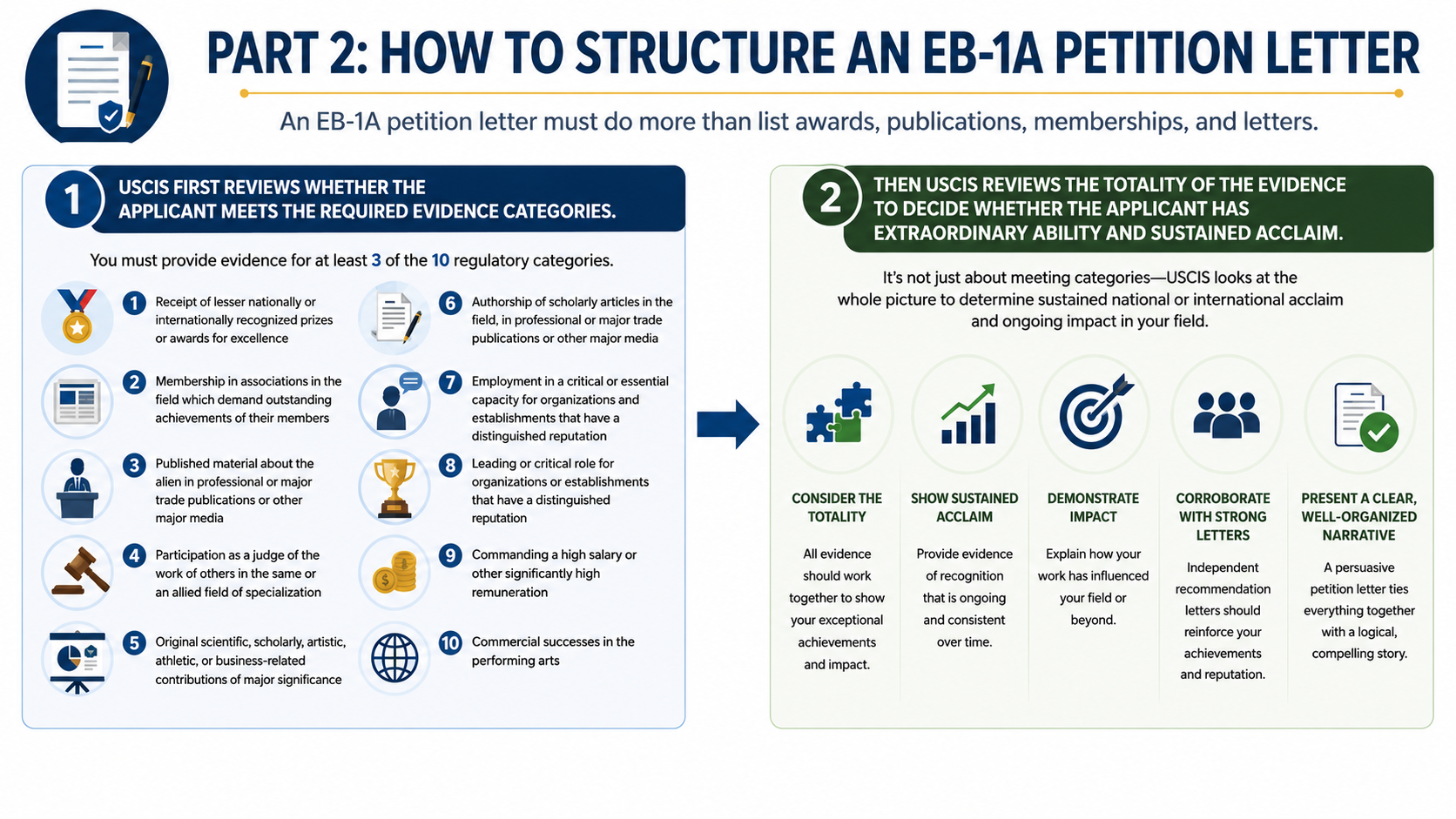
An EB-1A petition letter must do more than list awards, publications, memberships, and letters. USCIS first reviews whether the applicant meets the required evidence categories. Then USCIS reviews the totality of the evidence to decide whether the applicant has extraordinary ability and sustained acclaim.
| Recommended Section | What It Should Explain |
| 1. Opening summary | Identify the applicant’s field, area of extraordinary ability, requested EB-1A classification, and strongest evidence. |
| 2. Field definition | Define the field carefully so USCIS can understand the context in which the applicant is being evaluated. |
| 3. Regulatory criteria | Map the evidence to at least three EB-1A criteria, such as awards, judging, published material, original contributions, scholarly articles, leading roles, or high remuneration. |
| 4. Evidence context | Explain selectivity, reputation, independence, field relevance, and impact of each evidence category. |
| 5. Final merits review | Explain why the total record proves sustained acclaim and places the applicant among the small percentage at the top of the field. |
| 6. Future work in the United States | Show that the applicant intends to continue working in the area of extraordinary ability and that the work will benefit the United States. |
| 7. Conclusion | Request approval based on the regulatory criteria and the final merits showing. |
What Makes an EB-1A Petition Letter Strong in 2026?
- It defines the applicant’s field accurately.
- It does not rely only on meeting three criteria mechanically.
- It explains why the evidence matters in the field.
- It distinguishes ordinary career success from extraordinary ability.
- It uses independent proof of impact, recognition, influence, adoption, citations, awards, judging, media, leadership, or remuneration.
- It includes a strong final merits section that ties the entire record together.
| Important drafting point for EB-1A Meeting three EB-1A criteria is not the end of the analysis. The letter must also explain why the full record proves extraordinary ability and sustained acclaim. |
Evidence Should Drive the Letter:
A petition letter should never make claims that the exhibits cannot support. Strong drafting begins with an evidence audit. Before writing, review the record and decide which documents prove each legal requirement.
| Evidence Type | Useful for EB-2 NIW | Useful for EB-1A |
| Academic degrees and transcripts | Shows EB-2 threshold eligibility and technical foundation. | May support background, but usually not enough by itself. |
| Professional experience | Shows ability to advance the proposed endeavor. | Can support leading or critical roles if the organizations and roles are distinguished. |
| Publications and citations | Shows expertise and potential field relevance. | Can support scholarly articles and original contributions. |
| Patents, products, or technical systems | Can show practical value and national-importance connection. | Can support original contributions if impact or adoption is proven. |
| Awards and honors | Can support well-positioned analysis. | Can support recognized awards if selectivity and field importance are shown. |
| Media coverage | Can support credibility or public relevance. | Can support published material about the applicant if the coverage is independent and field-relevant. |
| Expert letters | Useful when specific, independent, and evidence-based. | Useful when they explain field-level significance, not only personal praise. |
| Business plan or implementation plan | Important for entrepreneurs, consultants, and founders. | Usually secondary unless it supports future work in the area of extraordinary ability. |
| Judging or peer review | Can support expertise and positioning. | Can directly support the judging criterion. |
| Salary or remuneration evidence | May show market value or seniority. | Can support high remuneration if compared with field data. |
Recommended Writing Style:
The best petition letters are professional, direct, and easy to verify. USCIS officers do not need marketing language. They need a clear explanation of why the legal standard is met.
- Use plain, formal English.
- Write short paragraphs with clear topic sentences.
- Use headings that match the USCIS legal framework.
- Cite exhibits consistently.
- Avoid exaggeration and unsupported adjectives.
- Explain technical work in non-technical terms when needed.
- Do not repeat the same achievement in every section unless it serves a different legal point.
- Do not copy an EB-2 NIW letter into an EB-1A petition or the other way around.
Example Petition Letter Language:
The following examples show the tone and structure that can be used. The final petition letter should always be customized to the applicant’s actual field, evidence, and legal strategy.
| Category | Example Statement |
| EB-2 NIW opening | This petition seeks classification under the employment-based second preference category and a waiver of the job offer and labor certification requirements because the petitioner’s proposed endeavor addresses a nationally important need in the United States and the record shows that the petitioner is well positioned to advance it. |
| EB-2 NIW Prong 1 | The proposed endeavor has substantial merit and national importance because it addresses a documented U.S. need in [field/sector], where improved methods, systems, or professional capacity can affect public, economic, scientific, technological, or institutional outcomes beyond a single employer. |
| EB-2 NIW Prong 2 | The petitioner is well positioned to advance the proposed endeavor because the record includes specialized education, progressive professional experience, project leadership, technical achievements, independent expert support, and evidence of practical implementation. |
| EB-2 NIW Prong 3 | On balance, requiring a specific job offer and labor certification would not best serve the national interest because the petitioner’s work is self-directed, specialized, and tied to broader U.S. needs that extend beyond a single labor-certified position. |
| EB-1A regulatory criteria | The petitioner satisfies multiple regulatory criteria, including original contributions of major significance, judging the work of others, authorship of scholarly articles, and a leading or critical role for distinguished organizations. |
| EB-1A final merits | When the evidence is considered in its totality, the record shows sustained recognition, independent validation, and field-level impact consistent with the extraordinary ability standard. |
Common Mistakes to Avoid:
- Writing a long biography without a legal structure.
- Using the same petition format for EB-2 NIW and EB-1A.
- Making broad claims about national importance without evidence.
- Assuming that employment in an important field automatically qualifies for NIW.
- Assuming that meeting three EB-1A categories automatically proves extraordinary ability.
- Using weak recommendation letters that provide praise but no specific facts.
- Relying on paid media, open memberships, or low-selectivity awards without explaining their evidentiary value.
- Failing to explain technical work in language that a general immigration officer can understand.
- Submitting exhibits without explaining why they matter.
- Ignoring final merits review in EB-1A.
How Immignis Can Help:
Immignis helps professionals, researchers, entrepreneurs, executives, founders, and high-achieving individuals organize evidence and prepare stronger EB-2 NIW and EB-1A petition strategies.
- Profile evaluation for EB-2 NIW and EB-1A.
- Proposed endeavor development for NIW cases.
- Evidence mapping against USCIS criteria.
- Petition-letter structure and drafting support.
- Recommendation-letter planning and coordination.
- Expert-letter strategy.
- RFE response planning.
- Long-term profile-building strategy for applicants who are not yet ready for EB-1A.
Conclusion:
A strong EB-2 NIW or EB-1A petition letter is not just a cover page. It is the central narrative that connects the applicant’s evidence to the legal standard. For EB-2 NIW, the letter should focus on the proposed endeavor, national importance, the applicant’s positioning, and why the waiver benefits the United States. For EB-1A, the letter should focus on regulatory criteria, field-level recognition, sustained acclaim, and final merits.
The best petition letters are clear, specific, and evidence-based. They help USCIS understand not only what the applicant has done, but why those achievements satisfy the immigration category being requested.
If you are preparing an EB-2 NIW or EB-1A petition and want a stronger strategy, Immignis can help you evaluate your evidence, identify the right pathway, and present your case with clarity and precision.
Frequently Asked Questions:
Is a petition letter required for EB-2 NIW or EB-1A?
A petition letter is commonly used to organize and explain the case, although the evidence itself remains the foundation of the petition. A strong letter helps USCIS understand how the exhibits satisfy the legal standard.
Can the same petition letter be used for EB-2 NIW and EB-1A?
No. EB-2 NIW and EB-1A have different legal standards. EB-2 NIW focuses on the proposed endeavor and national interest. EB-1A focuses on extraordinary ability and sustained acclaim.
How long should an EB-2 NIW or EB-1A petition letter be?
There is no fixed length. The letter should be long enough to explain the case clearly, but not so long that it becomes repetitive. Quality, structure, and evidence citation matter more than page count.
What is the biggest mistake in EB-2 NIW petition letters?
The biggest mistake is describing a field as important without proving that the applicant’s specific proposed endeavor has national importance and that the applicant is well positioned to advance it.
What is the biggest mistake in EB-1A petition letters?
The biggest mistake is assuming that meeting three evidence categories automatically proves extraordinary ability. The final merits section must explain why the full record shows sustained acclaim and top-level standing.
Should recommendation letters be quoted in the petition letter?
Short, targeted quotes may help, but the petition letter should not rely on long quotations. It should explain how the letters support the legal requirements and where the officer can find the exhibits.
Can entrepreneurs use a petition letter for EB-2 NIW?
Yes. Entrepreneur NIW cases often need a strong petition letter because the proposed endeavor, business model, traction, national importance, and execution plan must be explained carefully.
Should the petition letter include government policy references?
Policy references can help when they are directly connected to the proposed endeavor or field. They should not be used as decoration. The letter should explain why the applicant’s work aligns with the cited policy or national need.