
I Filed EB-2 NIW and Got an RFE: What Happens Now, Step by Step
An EB-2 NIW RFE response is not a denial. It is a formal notice that USCIS has reviewed the initial petition, identified specific gaps or questions, and is giving the petitioner an opportunity to address them before a decision is issued. Officers are not required to issue RFEs they can deny outright. When they issue one, it generally signals that a plausible path to approval exists, and that addressing the identified concerns specifically and completely may produce a different outcome.
This guide explains what an RFE actually means, why NIW petitions receive them, what the response process looks like step by step, and how to approach the evidence and argument that give the response the best chance of succeeding.
What an EB-2 NIW RFE Is and What It Isn’t
A Request for Evidence is a formal USCIS communication that identifies one or more specific deficiencies in a pending petition and asks the petitioner to provide additional documentation, explanation, or clarification within a defined window.
What an RFE is not:
- A preliminary denial
- A judgment that the petitioner is unqualified
- A signal that the petition cannot succeed
What an RFE is:
- A formal invitation to complete the record on specific identified issues
- Evidence that the officer found the petition worth developing further rather than denying outright
- An opportunity to strengthen the argument and evidence on the specific points the officer found insufficient
The distinction matters strategically. An RFE response is not a defense of the original filing. It is a targeted, evidence-supported answer to the officer’s specific concerns, structured to close the identified gaps while reinforcing the overall petition argument.
RFE vs Notice of Intent to Deny: Understanding the Difference
Two distinct USCIS notices cause confusion because both indicate the petition cannot currently be approved. Understanding the difference affects how the response should be framed.
| Factor | Request for Evidence (RFE) | Notice of Intent to Deny (NOID) |
| USCIS stance | Needs more information to decide | Has identified grounds for denial and intends to act on them |
| What it signals | Officer sees a plausible path to approval if gaps are filled | Officer has reached a preliminary conclusion of ineligibility |
| Primary goal of response | Complete the record and address specific gaps | Rebut the officer’s stated reasons for denial with targeted legal argument |
| Typical timing | First formal notification after initial review | Can follow an RFE if the response didn’t resolve concerns, or issued initially |
| Can it still be approved? | Yes a strong response often achieves approval | Yes, but the evidentiary burden is higher |
| What happens if unanswered | Adjudication on the original, incomplete record (almost always denial) | Denial issued without further notice |
For NIW petitions, RFEs are more common than NOIDs and represent the standard vehicle for addressing substantive gaps. A NOID indicates the officer has moved from “I need more information” to “I have found grounds for denial.” The response burden is higher for a NOID, and legal counsel is particularly important when one is received.
Why NIW Petitions Receive RFEs
NIW petitions receive RFEs for predictable reasons that cluster around specific weaknesses in the Dhanasar three-prong analysis. Understanding the trigger helps focus the response on what the officer actually needs.
| Common RFE Trigger | Prong Affected | What the Officer Is Signaling |
| Vague or overly broad proposed endeavor | Prong 1 | Cannot evaluate national importance without knowing specifically what the work produces |
| Field-level national importance claim only | Prong 1 | Has not seen how this petitioner’s specific contribution differs from ordinary employment in the field |
| Single-employer benefit framing | Prong 1 | Work appears to benefit one organization; national-level portability not established |
| Generic or praise-only recommendation letters | Prongs 1 + 2 | Letters do not provide specific evidence of field-level influence or national-level significance |
| Weak Prong 3 argument or none at all | Prong 3 | No justification for why the waiver serves U.S. interests over standard labor certification |
| Credential-impact mismatch | Prong 2 | Petitioner’s background does not credibly connect to the proposed endeavor’s field |
| Absence of quantified outcomes | Prongs 1 + 2 | Claims of impact are unsubstantiated; officer cannot verify scope or scale of benefit |
| No federal priority anchor | Prong 1 | National importance is asserted but not connected to any documented government interest |
The pattern that has become more pronounced in recent adjudication cycles is Prong 3 scrutiny. RFEs increasingly ask specifically why waiving the labor certification requirement serves the U.S. national interest in this petitioner’s particular case an argument that many initial petitions treat as implicit or self-evident. The officer’s question is direct: why does the U.S. benefit more from foregoing the standard labor market test than from enforcing it?
The 87-Day Deadline: What You Need to Know Immediately
Critical: The 87-day response window begins on the DATE PRINTED on the RFE notice, not the date you receive it. USCIS must physically receive your response by that date a postmark is not sufficient.
As soon as an RFE is received, the first action is to identify the printed date on the notice and calculate the response deadline. Do this before reading anything else. The deadline does not adjust for postal delays, weekends, or the date the notice arrived in hand.
Practical deadline management:
- Target submission by day 75, not day 87. This provides a ten-day buffer for shipping, potential corrections, and last-minute verification.
- Use a trackable courier service with delivery confirmation. Documented proof of the delivery date is essential if questions arise later.
- Missing the deadline means adjudication on the original incomplete record which almost always results in denial. There is no standard grace period.
If the deadline is very close when the RFE is received within 20 to 30 days this is a circumstance where professional counsel can help assess whether an extension request or other procedural option is available, and how to prioritize the response given the compressed timeline.
Step-by-Step NIW RFE Response Strategy
A well-structured response is not a document dump. It is a targeted legal brief with supporting evidence, organized to give the officer a clear path from their stated concern to its resolution.
- Read the RFE in full and catalog every concern. The RFE will typically raise two to five specific issues. Some are primary (the officer’s main concern, often involving a Dhanasar prong) and some are secondary (missing documents, unclear credentials, etc.). Every issue must be addressed, regardless of whether it seems minor. Leaving one item unanswered provides grounds for denial.
- Map each concern to the Dhanasar framework. For each issue raised, identify which prong it relates to and what type of evidence would satisfy the officer’s concern. Prong 1 concerns typically require national importance evidence with portability and a federal anchor. Prong 2 concerns typically require credential-to-endeavor connection evidence. Prong 3 concerns require explicit waiver justification.
- Assess what evidence exists and what must be developed. Some concerns can be addressed with existing evidence that was not originally organized or labeled clearly. Others require new evidence additional expert letters, quantified data, updated adoption metrics, or a more developed execution plan.
- Develop new evidence strategically. New expert letters for an RFE response should be framed around the specific concern the officer raised, not as general endorsements. A letter written to address a Prong 3 concern must directly argue the waiver justification. A letter written to address a national importance concern must provide the federal anchor and portability evidence that was missing or thin in the original filing.
- Draft the cover letter as a legal brief. The cover letter is the spine of the response. It should: identify the petition and the RFE, acknowledge each concern the officer raised, summarize how the response addresses each one with specific reference to the evidence provided, and present the overall Dhanasar argument as a coherent whole.
- Organize the evidence package with a mapped exhibit index. The exhibit index must explicitly link each officer concern to the exhibit that addresses it. Page-number every exhibit. Place the original RFE notice with its barcode on top. Use tabs or clear labeling for rapid navigation.
- Verify every non-English document has a certified translation. This is a common administrative oversight that gives an officer an easy technical basis for denial.
- Submit with adequate time and use trackable delivery. Target submission by day 75. Use a service that provides a dated delivery confirmation. Keep copies of everything submitted.
How to Strengthen Evidence for Specific RFE Concerns
Prong 1: National Importance Was Not Established
This is the most common substantive RFE concern. The officer found the proposed endeavor too vague, the national importance claim insufficiently connected to documented federal priorities, or the portability of the work’s benefit unclear.

Evidence strategies:
- Develop a more precisely defined proposed endeavor if the original was abstract the RFE response can refine the scope and articulation without materially changing the underlying work
- Add explicit citations to federal agency strategy documents, legislative frameworks, or government reports that identify the specific problem the work addresses as a national priority
- Provide new independent expert letters that bridge the petitioner’s technical work to national-level significance specifically asking writers to address the concern the officer raised
- Document portability evidence: adoption by other organizations, use of the methodology at institutions beyond the current employer, or open access to the outputs
- Add third-party data from BEA, BLS, industry analysts, or government reports quantifying the scope and scale of the problem the work addresses
Prong 2: Petitioner’s Positioning Was Not Established
The officer found a gap between the petitioner’s record and the proposed endeavor, or found the evidence of field-level recognition insufficient.
Evidence strategies:
- Add documentation explicitly connecting the petitioner’s specific credentials and experience to the specific proposed endeavor the connection must be stated, not assumed
- Provide additional adoption or traction evidence: citations of the petitioner’s work, adoption metrics, deployment records, or expert confirmation of field-level influence
- For entrepreneurial cases: add funding documentation, accelerator records, customer contracts, or other traction evidence that demonstrates the execution infrastructure is real
- Strengthen recommendation letters: new letters should describe specific contributions with outcomes, not general excellence
Prong 3: Waiver Justification Was Not Established
The officer found no compelling argument for why it benefits the United States to waive the labor certification requirement for this specific petitioner. This concern requires a dedicated legal argument, not simply more credential evidence.
Evidence strategies:
- Draft an explicit Prong 3 argument in the cover letter that identifies the specific reason why the standard PERM process is contrary to the national interest in this case
- For entrepreneurs and founders: document the structural impracticality of PERM the organizational structure that makes a traditional job offer impossible
- For time-sensitive research: document the timeline urgency specific milestones, partner timelines, or federal grant windows that a multi-year PERM delay would compromise
- Obtain an expert letter that specifically argues the waiver justification from the writer’s independent professional perspective
- For unique positioning cases: document what specifically makes this petitioner’s combination of expertise, relationships, and execution infrastructure not replicable through standard recruitment
What Not to Do in an RFE Response
Do not ignore any issue the officer raised, however minor it appears. Officers can deny based on unaddressed items even when the primary concerns were resolved.
Do not pivot to a completely different proposed endeavor. Refining the articulation, scope, or methods of the existing endeavor is acceptable. Changing the fundamental nature of the work creates a material inconsistency in the record that officers use as grounds for denial.
Do not resubmit the original petition with minor additions. A response that restates the original filing without directly addressing the officer’s specific concerns rarely succeeds. The response must be tailored to the RFE, not recycled from the original.
Do not use template or boilerplate language in new letters or narrative. Officers recognize formulaic responses and discount them accordingly. New evidence must reflect genuine engagement with the specific concerns raised.
Do not miss the deadline. There is no standard grace period. A response received one day after the printed deadline date will typically result in adjudication on the original incomplete record.
Dealing with an RFE alone is manageable but high-stakes. Get an urgent NIW RFE case review from Immignis to identify what the officer actually needs and how to address it before you file your response.
After Submitting the Response: What to Expect
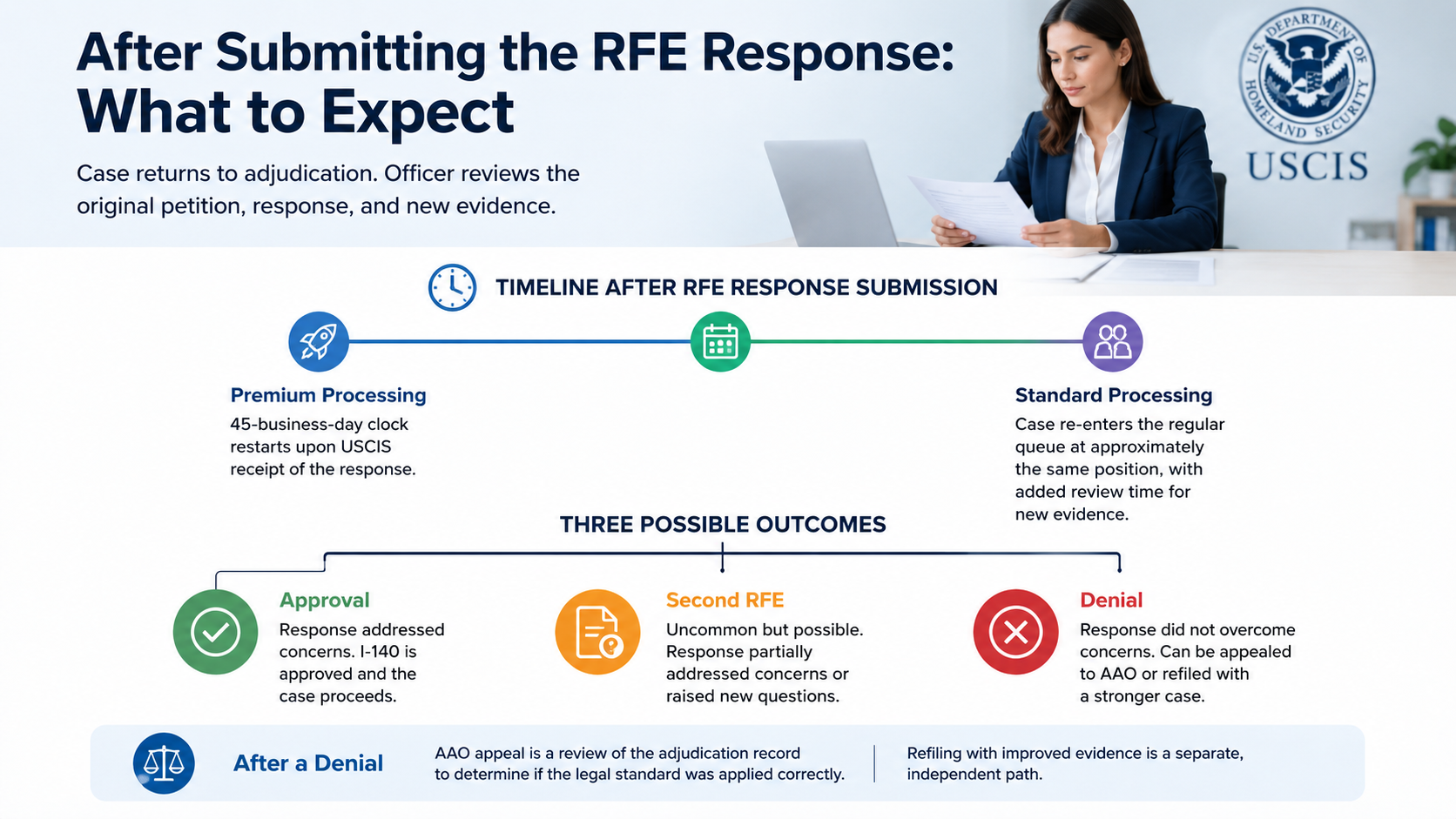
Once the response is submitted and received by USCIS, the case returns to adjudication. The officer reviews the original petition together with the response and all new evidence.
Timeline after RFE response submission varies. Under premium processing, if premium processing was active, the 45-business-day clock restarts upon USCIS receipt of the response. Under standard processing, the case re-enters the regular queue at approximately the same position, with the added review time for the new evidence.
Three possible outcomes:
- Approval. The response adequately addressed the officer’s concerns. The I-140 is approved and the case proceeds.
- Second RFE. Uncommon but possible if the response partially addressed the concerns or raised new questions. Procedurally identical to the first.
- Denial. The response did not overcome the officer’s concerns. A denial can be appealed to the AAO or the petition can be refiled with a substantially strengthened evidence package.
After a denial, the AAO appeal is not a new filing it is a review of the adjudication record to determine whether the officer applied the legal standard correctly. Refiling with an improved petition is a separate, independent path.
Should You Handle an RFE Response Yourself or Work with Counsel?
Self-represented responses to USCIS RFEs are permitted, and some applicants handle them successfully. The honest assessment of whether professional help is worth pursuing depends on the nature of the concerns raised.
RFEs that may be manageable without counsel:
- Administrative gaps: missing translations, credential equivalency documentation, or clerical corrections
- Standard supporting document requests where the information is straightforward to compile
- Cases where the RFE is narrow and the officer’s concern is clearly limited to one specific missing piece
RFEs that warrant professional guidance:
- Concerns going to the core Dhanasar prongs national importance, well-positioned, or waiver justification
- RFE language that uses phrases like “the record does not establish” or “you have not demonstrated” these signal legal deficiencies, not simple document gaps
- Cases where the officer appears to be questioning whether the proposed endeavor qualifies at all, rather than asking for more evidence of an accepted argument
- Situations where Prong 3 was entirely absent from the original filing and must be constructed from scratch
- Cases with compressed timelines that require rapid strategic assessment
A practical middle path that works well: use professional guidance for the strategic framing and legal argument structure of the response, while the petitioner handles the factual content gathering evidence, briefing letter writers, and supplying the career documentation. The attorney structures the legal brief; the petitioner supplies the substance.
What professional help most concretely offers in an RFE context: the ability to read USCIS’s formal language with the legal precision it requires, the experience to distinguish between a manageable evidentiary gap and a fundamental eligibility concern, and the institutional knowledge of what specific evidence types have effectively resolved similar RFEs in current adjudication cycles.
Frequently Asked Questions
What is an EB-2 NIW RFE?
A Request for Evidence is a formal USCIS notice identifying specific gaps or questions in a pending NIW petition and asking the petitioner to provide additional evidence within a defined window. It is not a denial. It means USCIS requires additional evidence or clarification before completing its decision.
Is an RFE a bad sign for my NIW petition?
Not necessarily. RFEs are common in NIW cases and many petitions are approved after a strong response. An RFE indicates the officer needed more than the original filing provided it does not mean the petitioner is unqualified or the petition cannot succeed.
How long do I have to respond to an NIW RFE?
The standard response window is 87 calendar days from the date printed on the RFE notice not the date of receipt. USCIS must physically receive the response by that date. Experienced practitioners recommend submitting by day 75 to allow for shipping time.
What should I include in an NIW RFE response?
A cover letter functioning as a legal brief addressing each officer concern, an exhibit index mapping each concern to its corresponding evidence, new or strengthened expert letters targeting the specific prongs raised, quantified outcome data, federal priority documentation, and where applicable, an explicit Prong 3 waiver justification.
Can an NIW petition still be approved after an RFE?
Yes. Many NIW petitions are approved after RFE responses that directly address the officer’s concerns with credible new evidence. The response is treated as a second opportunity to complete the petition record, and approval is a standard outcome for well-constructed responses.
What are the most common reasons NIW petitions receive RFEs?
Vague proposed endeavors, national importance claims that assert field importance without demonstrating specific contribution, absence of portability evidence, generic recommendation letters, and underdeveloped or absent Prong 3 arguments. Prong 3 scrutiny has increased notably in recent adjudication cycles.
What is the difference between an RFE and a NOID?
An RFE asks for additional evidence or clarification before a decision is made. A Notice of Intent to Deny signals the officer has identified grounds for denial and requires a rebuttal to overcome them. NOIDs represent a higher level of concern than RFEs and demand a more targeted legal response.
Can I respond to an NIW RFE without an attorney?
Self-represented responses are permitted. However, RFE notices use legal language with specific implications, the Dhanasar analysis is complex, and a response that restates the original filing without strategically addressing the officer’s stated concerns typically fails. Professional guidance is particularly valuable when the concerns go to core Dhanasar prong deficiencies rather than administrative omissions.
Can I change my proposed endeavor in an RFE response?
Minor refinements to the scope, articulation, or methodology of the proposed endeavor are acceptable. A material change to the nature of the work shifting to a different field or fundamentally different type of work creates record inconsistencies that officers treat as grounds for denial.
What happens if I miss the RFE deadline?
USCIS adjudicates the petition on the original, incomplete record. This almost always results in denial. There is no standard grace period. If the deadline is imminent when the RFE is received, immediate professional consultation is advisable to assess available options.
An RFE is a defined problem with a defined solution. The officer has identified specific concerns; the response addresses them specifically and completely. Book a strategic NIW defense consultation with Immignis to map your RFE concerns to the Dhanasar framework, identify the evidence that closes each gap, and structure a response that gives your petition the best available outcome.