
Strategies for Building a National Interest Case: EB2-NIW Success Guide
Last Updated on July 2, 2026 by Amelia
EB-2 NIW Success Guide 2026: How to Build a Strong National Interest Case
EB2 NIW Success Guide: The EB-2 National Interest Waiver, often called EB-2 NIW, is one of the most valuable U.S. green card pathways for highly skilled professionals who want to file without a specific employer sponsor. It allows qualified applicants to ask USCIS to waive the usual job offer and labor certification requirements because their proposed work serves the national interest of the United States.
In 2026, a successful EB-2 NIW case requires more than a strong resume, an advanced degree, or general claims that the applicant works in an important field. USCIS now expects a clear proposed endeavor, a direct connection between the applicant’s qualifications and that endeavor, credible evidence of national importance, and a persuasive explanation of why the United States benefits from waiving the job offer and labor certification process.
This EB2 NIW success guide guide explains how to build an EB-2 NIW national interest case under the current policy environment. It is designed for professionals, researchers, entrepreneurs, physicians, engineers, technology specialists, public-health experts, infrastructure professionals, educators, and business leaders who want to understand what a strong NIW petition should prove.
What Makes a Strong EB-2 NIW Case?
A strong EB-2 NIW case usually proves five things clearly:
- The applicant qualifies for the EB-2 category through an advanced degree or exceptional ability.
- The proposed endeavor is specific, credible, and connected to a real U.S. need.
- The endeavor has substantial merit and national importance.
- The applicant is well positioned to advance the endeavor through past achievements, education, experience, implementation capacity, recognition, or expert support.
- The United States would benefit from waiving the job offer and labor certification requirements in this case.
The strongest petitions do not leave USCIS to infer the argument. They explain the proposed endeavor, map the evidence to each legal requirement, and show why the applicant’s future work has value beyond one private job or one local employer.
What Is EB-2 NIW?
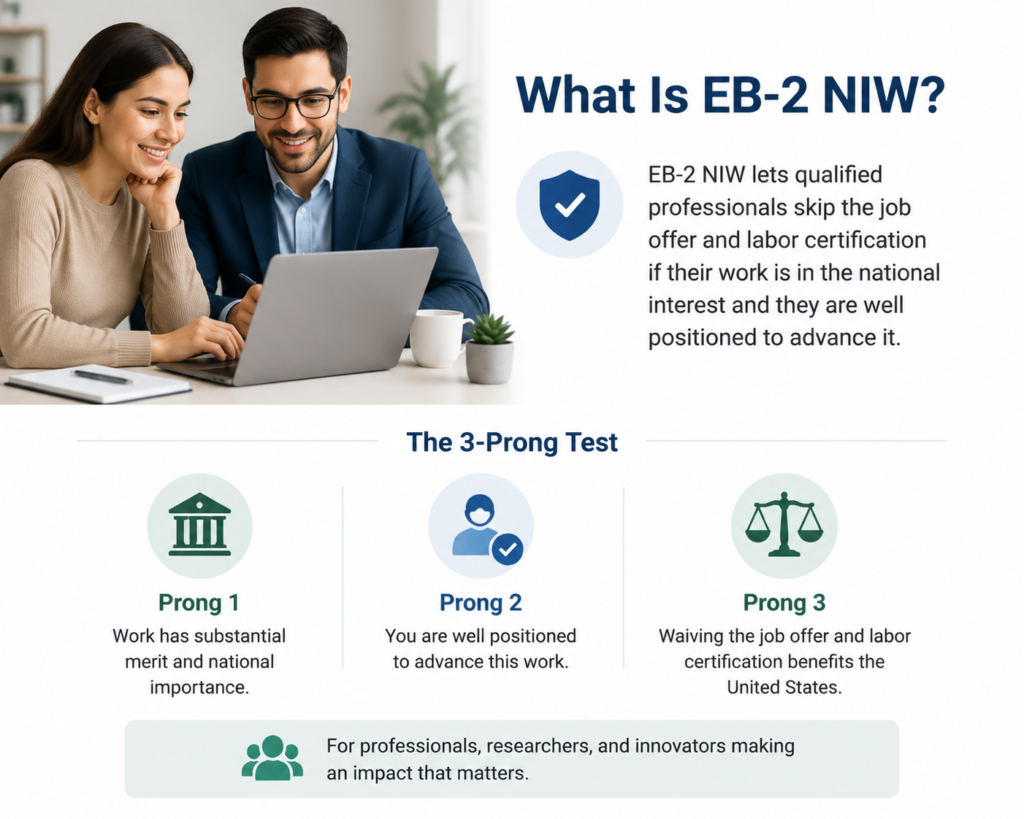
EB-2 NIW is part of the employment-based second preference immigrant category. A standard EB-2 case normally requires a job offer and labor certification. The National Interest Waiver asks USCIS to waive those requirements when the applicant’s work is important enough to the United States and the applicant is well positioned to advance that work.
To qualify, the applicant must first meet the EB-2 threshold. This usually means qualifying as either an advanced-degree professional or a person of exceptional ability in the sciences, arts, or business. After that threshold is met, USCIS applies the three-prong framework from Matter of Dhanasar.
| Dhanasar prong | What the petition must prove |
| Prong 1 | The proposed endeavor has substantial merit and national importance. |
| Prong 2 | The applicant is well positioned to advance the proposed endeavor. |
| Prong 3 | On balance, it would be beneficial to the United States to waive the job offer and labor certification requirements. |
What Changed in Recent USCIS Policy Trends?
The current policy direction is more specific and evidence-focused. USCIS has clarified that officers should first examine whether the applicant qualifies under the underlying EB-2 category and whether that qualification connects to the proposed endeavor. This matters because an applicant’s degree, claimed exceptional ability, and future plan should fit together.
For example, a person may hold an advanced degree, but the proposed endeavor must still be connected to a profession or area where that education and expertise are relevant. A person claiming exceptional ability must show that the exceptional ability relates to the work they intend to advance in the United States.
The practical lesson is simple: an NIW case should not be built as a loose collection of achievements. It should be built as one coherent national interest argument.
Step 1: Define the Proposed Endeavor with Precision
The proposed endeavor is the center of the EB-2 NIW petition. It is not the same as a job title, occupation, company name, or broad field. It is the specific work the applicant intends to advance in the United States.
A weak proposed endeavor may say: “I will work in artificial intelligence.” A stronger proposed endeavor may say: “I will develop and implement AI-assisted predictive analytics systems that help U.S. healthcare providers identify high-risk patient deterioration earlier and reduce preventable hospital readmissions.”
The second version is stronger because it explains the field, the method, the target users, and the intended U.S. benefit.
A good proposed endeavor should answer:
- What exactly will the applicant do?
- Which problem does the work address?
- Who may benefit from the work?
- Why does the work matter beyond one private employer?
- How does the applicant’s background support the plan?
- What is the realistic path for advancing the endeavor in the United States?
Step 2: Prove the EB-2 Threshold Before Arguing the Waiver
USCIS first needs to see that the applicant belongs in the EB-2 category. This part should not be treated as a formality.
| EB-2 route | Evidence to prepare | Strategy point |
| Advanced degree | Master’s degree, Ph.D., professional degree, or bachelor’s degree plus at least five years of progressive post-baccalaureate experience. | Show that the degree or experience relates to the proposed endeavor. |
| Exceptional ability | Evidence showing expertise significantly above that ordinarily encountered, such as degree records, experience letters, licenses, salary evidence, memberships, recognition, or major achievements. | Connect the exceptional ability to the same field or skill set required for the endeavor. |
This connection is important. If the applicant’s education and experience are in one field but the proposed endeavor is in an unrelated field, the petition may appear weak even if the applicant has impressive credentials.
Step 3: Build Prong 1 – Substantial Merit and National Importance
Prong 1 has two parts: substantial merit and national importance. Substantial merit means the work has real value. National importance means the work has broader significance in the United States.
Substantial merit can exist in many fields, including science, technology, healthcare, business, education, energy, infrastructure, public safety, environmental protection, agriculture, finance, arts, and culture. The challenge is usually national importance, because USCIS wants more than proof that the field is important.
A strong national-importance argument should explain the broader implications of the endeavor. It may show that the work addresses a national shortage, improves public health outcomes, supports critical infrastructure, strengthens cybersecurity, advances U.S. technological leadership, improves economic productivity, serves underserved populations, or contributes to an area of recognized public need.
| Weak national-interest claim | Stronger national-importance framing |
| Cybersecurity is important. | The endeavor will improve cloud security and software supply-chain risk detection for U.S. organizations that depend on secure digital infrastructure. |
| Healthcare needs innovation. | The endeavor will advance predictive monitoring methods that may help healthcare providers reduce preventable deterioration and improve operational efficiency. |
| My business will create jobs. | The endeavor is supported by a credible growth plan, documented market need, early traction, and a model that can generate skilled employment or productivity benefits beyond the applicant’s own income. |
| AI is a national priority. | The endeavor applies AI to a specific U.S. problem, such as critical infrastructure monitoring, medical diagnostics, fraud prevention, energy optimization, or public-sector service delivery. |
Step 4: Show Why the Impact Extends Beyond One Employer or Client
Many NIW petitions fail because the applicant describes a useful job, but not a nationally important endeavor. USCIS may view the case as valuable to one company, one project, or one customer base. A strong petition should explain how the work can have broader implications.
Depending on the field, broader implications may be shown through:
- Adoption of the applicant’s methods, tools, research, designs, products, or standards by other organizations.
- Publication, citation, patent, licensing, commercialization, or implementation evidence.
- Evidence that the applicant’s work addresses a recognized industry, government, public-health, infrastructure, or economic need.
- Letters from independent experts explaining why the work matters beyond the applicant’s employer.
- Data showing cost savings, efficiency gains, improved outcomes, risk reduction, expanded access, or public benefit.
- Market research or policy evidence showing national demand for the applicant’s proposed work.
The petition should avoid assuming that a respected occupation automatically proves national importance. A software engineer, physician, founder, professor, architect, or financial analyst may do important work, but the petition still needs to show why this particular endeavor rises to the national-interest level.
Step 5: Prove the Applicant Is Well Positioned to Advance the Endeavor
Prong 2 asks whether the applicant has the ability, record, support, and realistic path to advance the proposed endeavor. It does not require certainty of success. It requires credible evidence that the applicant is positioned to move the work forward.
Strong well-positioned evidence may include:
- Advanced education or specialized training directly related to the endeavor.
- Professional experience in the same or closely related field.
- A record of successful projects, products, research, systems, implementations, or leadership roles.
- Publications, citations, patents, licenses, certifications, media recognition, or awards where relevant.
- Funding, customers, pilots, contracts, partnerships, or institutional support.
- A practical implementation plan for the United States.
- Recommendation letters from experts who explain the applicant’s role, ability, and future potential with specific examples.
The best evidence is specific. A generic letter saying the applicant is “hardworking” or “valuable” is much weaker than a letter explaining the applicant’s technical contribution, measurable impact, leadership responsibility, and why the person is positioned to advance the proposed endeavor.
Step 6: Make the Dhanasar Prong 3 Argument Persuasive
Prong 3 is the balancing test. USCIS asks whether, on balance, the United States would benefit from waiving the job offer and labor certification requirements.
This section should not simply say that the applicant is talented. It should explain why the traditional labor certification process does not fit the nature of the proposed endeavor or why the national interest is better served by allowing the applicant to continue the work independently.
Useful arguments may include:
- The endeavor is self-directed, research-based, entrepreneurial, cross-sector, or project-based.
- The work may involve multiple collaborators, institutions, clients, or implementation sites instead of one fixed employer.
- The applicant’s specialized expertise is tied to a national problem that needs continued advancement.
- A labor-certified job would not fully capture the scope or public value of the endeavor.
- The applicant has a credible record of advancing similar work and a concrete plan for continuing it in the United States.
The argument should be careful and evidence-based. USCIS does not waive labor certification simply because an applicant prefers flexibility. The petition should show why the waiver benefits the United States.
Step 7: Use U.S. Policy Priorities Carefully
Federal policy alignment can strengthen an EB-2 NIW petition, especially in fields such as artificial intelligence, cybersecurity, healthcare, public health, semiconductor technology, clean energy, advanced manufacturing, critical infrastructure, education, and transportation.
However, citing federal policy is not enough. The petition must connect the policy to the applicant’s specific endeavor. A case should not simply quote national strategy documents. It should explain how the applicant’s work supports the policy concern in a practical, credible way.
| Policy reference | How to use it correctly |
| Federal AI, cybersecurity, or advanced technology priorities | Show how the applicant’s specific work advances a defined technical or operational need. |
| Public-health or healthcare modernization goals | Connect the endeavor to measurable improvements, access, efficiency, safety, or disease-prevention outcomes. |
| Clean energy or infrastructure policy | Explain the applicant’s role in improving reliability, sustainability, resilience, cost, or deployment capacity. |
| Economic competitiveness or workforce development | Show how the work may improve productivity, entrepreneurship, job creation, training, or industry capacity. |
Step 8: Prepare an Evidence Map
An EB-2 NIW petition should be organized so that each exhibit has a legal purpose. Evidence should not be attached randomly. A clear evidence map helps USCIS understand how the documents support each prong.
| Evidence type | Where it helps | What it should prove |
| Degrees, transcripts, evaluations | EB-2 threshold and Prong 2 | The applicant has relevant education or advanced training. |
| Experience letters | EB-2 threshold and Prong 2 | The applicant has progressive, relevant professional experience. |
| Project reports or technical documentation | Prongs 1 and 2 | The applicant has done work connected to the proposed endeavor. |
| Publications, citations, patents, licenses | Prongs 1 and 2 | The work has originality, technical value, or field recognition. |
| Recommendation letters | Prongs 1, 2, and 3 | Experts can explain national importance, applicant capability, and value of waiver. |
| Business plan or implementation plan | Prongs 1, 2, and 3 | The endeavor is realistic, structured, and capable of advancement. |
| Market, policy, or industry reports | Prong 1 | The problem addressed by the endeavor is significant in the United States. |
| Funding, contracts, pilots, customers, partnerships | Prong 2 | The applicant has traction, support, or execution capacity. |
Step 9: Write a Clear Petition Narrative
A successful EB-2 NIW petition should read like a structured legal argument. The petition letter should guide the officer through the case. It should not force the officer to search through exhibits to understand the applicant’s story.
A strong structure may follow this order:
- Identify the requested classification and waiver.
- Summarize the applicant’s professional background.
- Define the proposed endeavor in clear language.
- Establish EB-2 threshold eligibility.
- Explain substantial merit and national importance.
- Show why the applicant is well positioned to advance the endeavor.
- Explain why the waiver benefits the United States.
- Close by tying the evidence to the legal standard.
The best petition letters are direct, organized, and evidence-based. They avoid excessive adjectives and focus on proof.
Step 10: Avoid Common EB-2 NIW Mistakes
| Common mistake | Why it hurts the case | Better approach |
| Using a vague proposed endeavor | USCIS may not understand what work is being advanced. | Define the endeavor with field, method, problem, and U.S. benefit. |
| Relying only on degree or job title | EB-2 eligibility alone does not prove NIW eligibility. | Connect the applicant’s credentials to a nationally important endeavor. |
| Claiming the whole field is important | USCIS wants the importance of the specific endeavor. | Show the broader implications of this applicant’s work. |
| Submitting generic letters | Letters without details carry limited value. | Use letters that discuss role, impact, and national-interest relevance. |
| Overstating future benefits | Unsupported claims can trigger RFEs or denials. | Use credible projections, documented need, and realistic implementation plans. |
| Ignoring Prong 3 | A strong profile does not automatically justify the waiver. | Explain why the waiver itself benefits the United States. |
EB-2 NIW Strategy for Entrepreneurs
Entrepreneurs can qualify for EB-2 NIW, but business cases must be handled carefully. A business idea alone is not enough. The petition should show that the proposed enterprise or business activity has broader U.S. importance and that the applicant has the ability to advance it.
Strong entrepreneur evidence may include:
- A detailed business plan with a credible U.S. implementation model.
- Evidence of customers, pilots, revenue, investment, grants, partnerships, or market validation.
- A clear explanation of how the business serves a broader public, economic, technological, healthcare, infrastructure, or workforce need.
- Evidence of founder experience, prior execution, technical expertise, leadership, or industry recognition.
- Independent letters from credible experts, partners, customers, or industry stakeholders.
For entrepreneur NIW cases, the goal is to show more than business ownership. The petition should explain why the venture matters to the United States and why this founder is positioned to advance it.
EB-2 NIW Strategy for STEM and Technical Professionals
STEM professionals often have strong NIW potential, especially when their work connects to U.S. priorities such as AI, cybersecurity, healthcare technology, advanced manufacturing, data infrastructure, clean energy, aerospace, transportation, biotechnology, or critical infrastructure.
Still, the petition should avoid relying on field importance alone. A strong STEM NIW petition should explain the applicant’s technical role, the specific problem being addressed, the expected U.S. benefit, and the applicant’s ability to implement the work.
Example of a Stronger National Interest Framing
Weak version: “I am a data scientist, and data science is important to the United States.”
Stronger version: “The proposed endeavor is to develop and apply predictive analytics methods that help U.S. healthcare organizations identify operational risks, reduce avoidable resource waste, and improve patient-flow planning. This work has substantial merit because it addresses healthcare efficiency and quality. It has national importance because U.S. healthcare systems face widespread pressure from staffing shortages, rising costs, and operational strain. The petitioner is well positioned because of prior work in predictive modeling, healthcare datasets, peer-reviewed publications, and documented implementation experience.”
The stronger version gives USCIS a clear proposed endeavor, explains national importance, and connects the applicant’s background to the work.
How Immignis Can Help Build an EB-2 NIW Case:
Immignis helps professionals, entrepreneurs, researchers, and high-achieving applicants evaluate and develop EB-2 NIW strategies. A strong petition begins with a careful review of the applicant’s background, evidence, proposed endeavor, and immigration goals.
Our EB-2 NIW support may include:
- Profile evaluation and strategy review.
- Proposed endeavor development.
- Dhanasar prong-by-prong analysis.
- Evidence mapping and document planning.
- Recommendation-letter strategy.
- Petition-letter drafting support.
- RFE response strategy where needed.
- Long-term profile-building recommendations for professionals who need stronger evidence before filing.
The objective is to present a credible, well-supported case that shows why the applicant’s work matters to the United States and why the applicant is positioned to advance it.
Conclusion:
Building a strong EB-2 NIW national interest case requires strategy, evidence, and clear legal reasoning. The strongest cases define a specific proposed endeavor, prove EB-2 eligibility, demonstrate substantial merit and national importance, show that the applicant is well positioned, and explain why the United States benefits from waiving the job offer and labor certification requirements.
In 2026, USCIS expects petitioners to connect every major claim to evidence. A strong EB-2 NIW case should not rely on broad statements or generic recommendation letters. It should show a focused national interest theory supported by credible documents, expert explanations, and a realistic plan for future work in the United States.
If you are preparing an EB-2 NIW petition or want to know whether your professional background can support a national interest case, Immignis can help you evaluate your profile and build a strategy around your strongest evidence.
Frequently Asked Questions
What is the most important part of an EB-2 NIW case?
The proposed endeavor is one of the most important parts of the case. It tells USCIS what work the applicant intends to advance and gives structure to the national-importance and well-positioned arguments.
Does EB-2 NIW require a job offer?
No. EB-2 NIW allows qualified applicants to request a waiver of the job offer and labor certification requirements if the national interest standard is met.
Does EB-2 NIW require publications?
No. Publications can help, especially for researchers and technical professionals, but they are not required in every case. Strong cases can also rely on projects, patents, business evidence, implementation records, expert letters, awards, funding, or other proof of impact.
Is an advanced degree enough for EB-2 NIW approval?
No. An advanced degree may help satisfy the EB-2 threshold, but the applicant must still satisfy the National Interest Waiver standard under the Dhanasar framework.
Can entrepreneurs qualify for EB-2 NIW?
Yes. Entrepreneurs can qualify if they meet the EB-2 threshold and show that their proposed endeavor has national importance, that they are well positioned to advance it, and that a waiver benefits the United States.
What makes a recommendation letter strong for EB-2 NIW?
A strong letter is specific, credible, and evidence-based. It should explain the applicant’s work, role, impact, and why the proposed endeavor matters to the United States.
Can EB-2 NIW be filed with premium processing?
Yes. Premium processing is available for EB-2 NIW Form I-140 petitions, but it only speeds USCIS action. It does not guarantee approval.
Does an approved EB-2 NIW immediately give a green card?
No. An approved Form I-140 is an important step, but the applicant must still complete adjustment of status or consular processing, and the priority date must be current under the Visa Bulletin.



Comment
EB-2 NIW National Importance: Essential 2026 Guide
August 16, 2026 - 12:45 pm[…] National Interest Waiver allows USCIS to waive the requirement that an employment based immigrant have a specific job offer and an […]