

Strategies to Prove Exceptional Ability for EB-2 NIW
Last Updated on July 2, 2026 by Amelia
EB-2 NIW, or Employment-Based Second Preference National Interest Waiver, remains one of the most valuable U.S. green card options for qualified professionals who want to self-petition without a permanent job offer and without the PERM labor certification process.
However, one of the most common mistakes in EB-2 NIW content is mixing the EB-2 standard with the EB-1A standard. EB-1A requires extraordinary ability. EB-2 NIW requires the applicant to first qualify under EB-2, usually as an advanced degree professional or as a person of exceptional ability, and then prove that the National Interest Waiver should be granted under the Dhanasar framework.
This distinction matters. An applicant does not need to prove EB-1A-level extraordinary ability to win an EB-2 NIW case. At the same time, strong evidence of achievements, recognition, publications, patents, leadership, high salary, expert support, or field impact can strengthen an EB-2 NIW petition if it is presented correctly.
In 2026, the strongest EB-2 NIW petitions are not built around generic claims that a person is talented. They are built around a defined proposed endeavor, credible evidence of national importance, proof that the applicant is well positioned to advance the endeavor, and a persuasive explanation of why waiving the job offer and labor certification benefits the United States.
| Quick answer: To prove exceptional ability for EB-2 NIW, the applicant should show expertise significantly above what is ordinarily encountered in the field, usually by satisfying at least three regulatory evidence categories. But exceptional ability alone does not win an NIW case. The evidence must also support the applicant’s proposed endeavor, national importance, well-positioned ability, and the benefit of waiving the job offer and labor certification. |
Exceptional Ability vs. Extraordinary Ability: Why the Words Matter
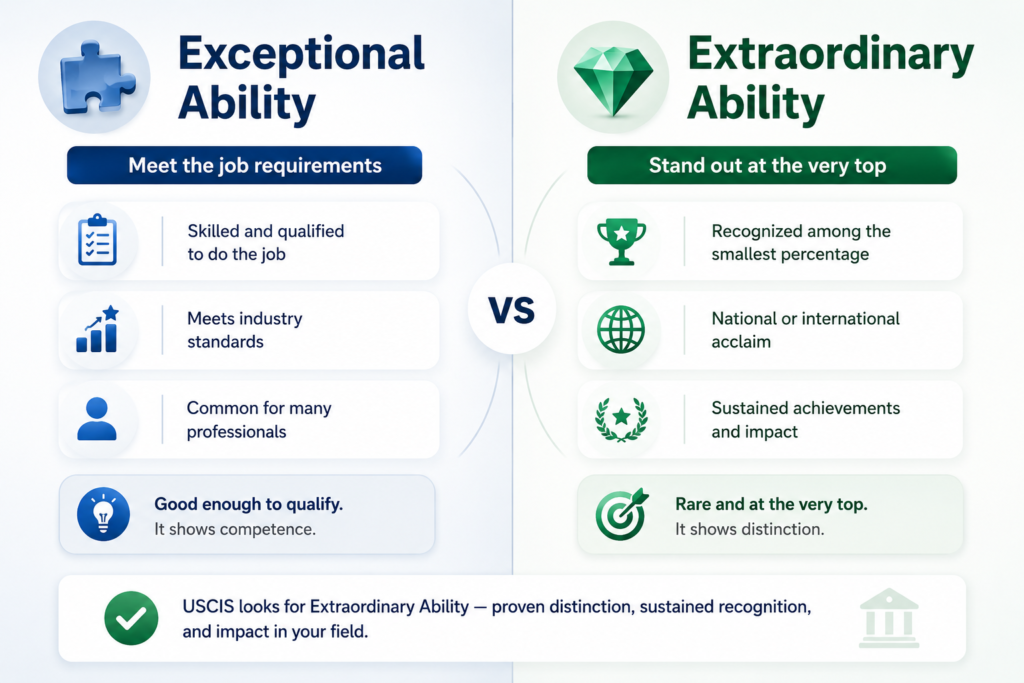
Extraordinary ability is the EB-1A standard. It requires sustained national or international acclaim and evidence showing that the person is among the small percentage at the top of the field.
Exceptional ability is an EB-2 standard. Under federal regulations, exceptional ability means a degree of expertise significantly above that ordinarily encountered in the sciences, arts, or business. This is a high standard, but it is different from EB-1A extraordinary ability.
For EB-2 NIW, the applicant must first qualify for EB-2. This can be done through the advanced degree route or the exceptional ability route. After that, USCIS evaluates whether the applicant merits the National Interest Waiver.
| Question | EB-2 NIW answer | Practical meaning |
| Do I need extraordinary ability? | No. Extraordinary ability is the EB-1A standard. | Do not frame EB-2 NIW as EB-1A unless you are discussing overlapping evidence. |
| Do I need exceptional ability? | Only if you are not qualifying through the advanced degree route, or if you choose to present both routes. | Many applicants qualify through an advanced degree; others rely on exceptional ability. |
| Can awards, media, publications, citations, patents, or leadership help? | Yes, if they support EB-2 eligibility and the Dhanasar prongs. | Strong achievement evidence must be connected to the proposed endeavor and U.S. benefit. |
Step 1: Prove the Basic EB-2 Foundation
Before USCIS evaluates the National Interest Waiver, the petitioner must first show that the applicant qualifies for the underlying EB-2 classification. In practice, this usually happens through one of two routes.
| Route | Core requirement | Typical evidence |
| Advanced degree professional | A U.S. advanced degree, foreign equivalent, or a bachelor’s degree plus at least five years of progressive post-baccalaureate experience in the specialty. | Degrees, evaluations, transcripts, employment letters, job descriptions, and evidence that the occupation is a profession. |
| Exceptional ability | Expertise significantly above that ordinarily encountered in the sciences, arts, or business. | At least three regulatory evidence categories, such as academic records, ten years of experience, license, high salary, professional memberships, and recognition for achievements. |
Step 2: Use the Six Exceptional Ability Evidence Categories Correctly
For applicants relying on exceptional ability, the petition should generally document at least three of the regulatory categories. The goal is not simply to check three boxes. The goal is to prove that the applicant’s expertise is significantly above what is ordinarily encountered in the field and that this expertise relates to the proposed endeavor.
| Exceptional ability category | What it means | Stronger evidence approach |
| Academic record | A degree, diploma, certificate, or similar award related to the area of exceptional ability. | Use degree evaluations, transcripts, certificates, and explanation of how the education supports the proposed endeavor. |
| Ten years of full-time experience | Letters from current or former employers showing at least ten years of full-time experience in the occupation. | Include roles, dates, duties, progressive responsibility, technical depth, and project impact. |
| License or certification | A license to practice the profession or certification for a particular profession or occupation. | Explain the selectivity, field relevance, and why the credential supports specialized expertise. |
| High salary or remuneration | Evidence that compensation demonstrates exceptional ability. | Use salary records, contracts, tax records, industry salary data, and comparison evidence. |
| Professional associations | Membership in professional associations. | Show that the association is relevant, credible, and, where possible, selective or achievement-based. |
| Recognition for achievements | Recognition by peers, government entities, professional organizations, or business organizations. | Use awards, adoption evidence, patents, client/institutional letters, media, speaking invitations, or independent expert letters. |
Step 3: If You Qualify Through an Advanced Degree, Still Build Achievement Evidence
Many EB-2 NIW applicants qualify through the advanced degree route and do not need to prove exceptional ability. But this does not mean evidence of achievements is irrelevant. Achievement evidence can strengthen the second part of the case: the National Interest Waiver analysis.
For example, publications, patents, project results, media, grants, leadership roles, technical deployments, citations, peer review, or industry adoption may show that the applicant is well positioned to advance the proposed endeavor. These materials can also help prove that the endeavor is serious, credible, and nationally important.
| Evidence | How it helps EB-2 threshold | How it helps NIW |
| Publications and citations | May support expertise in a specialized field. | Can show influence, knowledge production, and recognition relevant to the endeavor. |
| Patents or technical products | May show specialized professional achievement. | Can show originality, implementation potential, and industry relevance. |
| Leadership roles | May support experience and professional standing. | Can show ability to execute the proposed endeavor. |
| Awards or honors | May support recognition for achievements. | Can help prove field-level credibility and well-positioned ability. |
| Media or industry coverage | May support recognition. | Can show broader attention to the applicant’s work, if the coverage is substantive. |
Step 4: Connect Every Achievement to the Dhanasar Framework
The central question in an EB-2 NIW petition is not only whether the applicant is talented. USCIS asks whether the proposed endeavor has substantial merit and national importance, whether the applicant is well positioned to advance it, and whether the United States benefits from waiving the job offer and labor certification requirements.
For this reason, evidence should be organized around the legal framework. A strong article, business plan, expert letter, or petition letter should not leave USCIS to guess why the evidence matters.
| Evidence type | Prong 1: merit and national importance | Prong 2: well positioned | Prong 3: waiver benefit |
| Awards | Can show the field recognizes the importance of the area. | Shows credibility and professional distinction. | May support why the applicant should not be limited to one employer-sponsored role. |
| Publications/citations | Can show relevance to national problems or technical fields. | Shows knowledge, influence, and ability to advance research or practice. | May support the value of independent or cross-institutional work. |
| Patents/products | Can show practical merit and potential impact. | Shows execution ability and originality. | May support commercial or technological flexibility outside PERM. |
| Project outcomes | Can prove measurable benefits, cost savings, health effects, safety improvements, or efficiency gains. | Shows the applicant has already delivered results. | Can show urgency or need for flexible implementation. |
| Expert letters | Can explain why the endeavor matters in the United States. | Can validate the applicant’s role and ability. | Can explain why the waiver supports national interest. |
Step 5: Build Strong Evidence of Recognition and Impact
Recognition evidence is strongest when it is independent, specific, and tied to a real contribution. A certificate or article alone may not be enough. USCIS is more persuaded when the evidence shows what the applicant did, who recognized it, how selective or important the recognition was, and why it matters to the proposed endeavor.
- Awards and honors: Explain the award criteria, selection process, number of candidates, reputation of the awarding body, and connection to the applicant’s work.
- Publications and citations: Provide citation records, journal or conference reputation, author role, and an explanation of how the work influenced research, industry, policy, or practice.
- Patents and technical contributions: Show filing or grant records, implementation, licensing, use by others, commercialization, or technical adoption.
- Professional memberships: Distinguish open membership from selective membership. If membership required achievement, document the criteria.
- Peer review and judging: Show invitations, reviewer records, event or journal credibility, and why the applicant was selected as a reviewer or judge.
- Media coverage: Use substantive coverage about the applicant’s work, not purely promotional or paid content. Explain the publication’s relevance and audience.
- Leadership evidence: Document the applicant’s role, responsibilities, organizational reputation, and measurable results.
- Recommendation letters: Use detailed letters from credible experts who can explain the applicant’s specific work and national-interest relevance.
Step 6: Define the Proposed Endeavor Before Collecting Evidence
One of the most important 2026 petition-quality issues is the proposed endeavor. USCIS does not want only a job title, field name, or general career plan. The endeavor should describe the specific work the applicant intends to advance in the United States.
For example, ‘software engineer’ is an occupation. A stronger proposed endeavor would explain the applicant’s specific work, such as developing secure cloud-native systems for healthcare infrastructure, AI-enabled fraud detection for financial systems, or data-driven optimization methods for public transportation networks.
Once the proposed endeavor is defined, the applicant can select evidence that supports that specific endeavor. This makes the petition clearer and reduces the risk that USCIS views the evidence as impressive but disconnected.
| Weak framing | Stronger NIW framing |
| I am an experienced engineer. | I will advance resilient cloud infrastructure methods that reduce outage risk and strengthen secure software delivery for U.S. enterprise systems. |
| I work in healthcare. | I will improve healthcare data workflows that support early detection, better patient monitoring, and operational efficiency in U.S. care settings. |
| I am a business owner. | I will scale a workforce-development platform that addresses documented U.S. skill shortages in a national-priority sector. |
| I am a researcher with publications. | I will advance research and applied methods that address a defined national problem and can be adopted by institutions, industry, or public stakeholders. |
Examples of Evidence Strategy by Field
| Field | Evidence that may prove strong ability | How to connect it to NIW |
| Artificial intelligence and data science | Published models, applied algorithms, patents, deployments, industry adoption, peer review, citations. | Explain how the work supports U.S. priorities such as healthcare, cybersecurity, infrastructure, education, logistics, or productivity. |
| Healthcare and public health | Clinical projects, patient-safety outcomes, research, epidemiological work, hospital adoption, public-health reports. | Show how the endeavor improves health access, quality, safety, cost reduction, disease prevention, or population-health planning. |
| Cybersecurity | Security architecture, incident-prevention systems, software supply-chain controls, certifications, technical reports, enterprise implementation. | Connect the work to critical infrastructure, data security, financial systems, healthcare systems, or national cyber resilience. |
| Energy, climate, and environment | Patents, field testing, energy savings, environmental monitoring, research, grants, implementation records. | Show national relevance through energy resilience, emissions reduction, grid reliability, water quality, or climate adaptation. |
| Entrepreneurship | Business plan, funding, customers, product validation, partnerships, job creation evidence, market research, revenue traction. | Avoid broad economic claims. Show why the business addresses a specific U.S. need beyond private profit. |
| Education and workforce development | Curriculum design, training outcomes, institutional adoption, employer partnerships, program metrics. | Tie the endeavor to U.S. skill gaps, labor-market needs, access to education, or workforce competitiveness. |
Step 7: Use Expert Letters as Evidence, Not Decoration
Recommendation letters remain useful, but generic praise is weak. A strong EB-2 NIW expert letter should explain the applicant’s specific role, the significance of the work, the connection to the proposed endeavor, and the reason the United States benefits from the applicant advancing that work.
Letters are stronger when they come from credible, independent, and field-relevant sources. A letter from a supervisor can explain direct work performance. An independent expert can explain field significance. A government, quasi-government, institutional, or industry stakeholder can sometimes strengthen the national-importance argument if the letter is specific and well supported.
| Weak letter language | Stronger letter language |
| The applicant is hardworking and intelligent. | The applicant designed a deployment framework that reduced system instability by 32% across production workloads, supporting the reliability of patient-facing digital systems. |
| The applicant’s field is important. | The applicant’s proposed endeavor addresses a documented U.S. cybersecurity risk involving software supply-chain vulnerabilities in enterprise systems. |
| I recommend approval. | Based on the applicant’s documented prior implementation, technical specialization, and planned U.S. work, I believe the applicant is well positioned to advance the proposed endeavor. |
Common Mistakes to Avoid
- Using the phrase ‘extraordinary ability’ as if it is the EB-2 NIW legal standard.
- Submitting evidence of achievements without explaining how the evidence supports the proposed endeavor.
- Claiming national importance only because the field is important.
- Relying on paid media or promotional content without independent proof of impact.
- Using recommendation letters that repeat the same general statements without details.
- Treating publications, patents, awards, or memberships as automatic approval evidence.
- Ignoring the third Dhanasar prong and failing to explain why the job offer and labor certification should be waived.
- Submitting a business plan that describes profit potential but does not prove broader U.S. benefit.
- Failing to connect exceptional ability to the proposed endeavor, especially after the 2025 USCIS NIW policy clarification.
EB-2 NIW Evidence Checklist for 2026
| Evidence area | Questions the petition should answer |
| EB-2 threshold | Does the applicant qualify through an advanced degree, exceptional ability, or both? |
| Proposed endeavor | Is the endeavor specific, credible, and more detailed than a job title? |
| National importance | Does the evidence show broader U.S. importance beyond one employer, client, or local private benefit? |
| Well positioned | Does the record show that the applicant has the skills, achievements, plan, and support to advance the endeavor? |
| Waiver benefit | Does the petition explain why waiving the job offer and labor certification benefits the United States? |
| Expert support | Do letters explain specific work, impact, credibility, and future relevance? |
| Independent proof | Are claims supported by documents, data, adoption, publications, contracts, media, or institutional records? |
| Presentation | Is the petition organized around the USCIS legal framework rather than a random evidence list? |
How Immignis Can Help
Immignis helps professionals, researchers, entrepreneurs, executives, engineers, healthcare professionals, academics, and other skilled applicants evaluate whether EB-2 NIW is a realistic option under current USCIS standards.
Our work focuses on identifying the strongest EB-2 route, developing a clear proposed endeavor, mapping evidence to the Dhanasar prongs, planning expert letters, organizing documentation, and preparing a petition narrative that explains why the applicant’s work matters to the United States.
For applicants who have strong achievements but an unclear immigration strategy, the first step is not to collect more documents randomly. The first step is to understand what the evidence must prove.
Conclusion
EB-2 NIW does not require extraordinary ability. It requires the applicant to meet the EB-2 threshold as an advanced degree professional or person of exceptional ability, and then satisfy the National Interest Waiver standard.
Strong evidence of awards, publications, patents, media, memberships, leadership, salary, expert recognition, and original contributions can significantly strengthen a petition. But these documents must be connected to a specific proposed endeavor and to the Dhanasar framework.
In 2026, successful EB-2 NIW petitions are specific, well documented, and strategically organized. The applicant must show not only what they have achieved, but why those achievements make them well positioned to advance work that benefits the United States.
Frequently Asked Questions
Does EB-2 NIW require extraordinary ability?
No. Extraordinary ability is the EB-1A standard. EB-2 NIW requires the applicant to first qualify under EB-2, usually through an advanced degree or exceptional ability, and then satisfy the National Interest Waiver standard.
What is exceptional ability for EB-2 NIW?
Exceptional ability means expertise significantly above what is ordinarily encountered in the sciences, arts, or business. Applicants relying on exceptional ability generally need to meet at least three regulatory evidence categories.
Can I apply for EB-2 NIW with a master’s degree?
Yes, a master’s degree or foreign equivalent may satisfy the advanced degree route, but the applicant must still prove the National Interest Waiver requirements.
Can I apply for EB-2 NIW without a master’s degree?
Yes, some applicants qualify through a bachelor’s degree plus at least five years of progressive post-baccalaureate experience, or through exceptional ability.
Do publications and citations guarantee EB-2 NIW approval?
No. Publications and citations can help, but USCIS evaluates whether the evidence supports the proposed endeavor, national importance, and the applicant’s ability to advance the work.
Are patents useful for EB-2 NIW?
Yes, patents can be helpful, especially if there is evidence of implementation, licensing, adoption, commercialization, or technical significance. A patent alone may not be enough.
Is media coverage important for EB-2 NIW?
Media coverage can help if it is substantive, credible, and focused on the applicant’s work. Paid or promotional coverage is weaker unless supported by independent evidence.
Can entrepreneurs prove exceptional ability for EB-2 NIW?
Yes, entrepreneurs can qualify, but they must show strong evidence of ability and a proposed endeavor with broader U.S. importance. General claims about job creation or business success are usually not enough.
How many recommendation letters are needed for EB-2 NIW?
There is no fixed number. Quality matters more than quantity. Letters should be specific, credible, and supported by independent documents.
What is the biggest evidence mistake in EB-2 NIW cases?
The biggest mistake is submitting impressive documents without explaining how they support the proposed endeavor, national importance, well-positioned ability, and waiver benefit.



Comment
EB-2 NIW Exceptional Ability Criteria: Full USCIS Standard
August 25, 2026 - 8:53 am[…] EB-2 NIW exceptional ability criteria framework rewards petitioners who understand that three criteria satisfied at threshold is the […]