State and Local Immigration Policies in the U.S. in 2026: What Immigrants, Employers, and Families Should Know
Last Updated on July 9, 2026 by Amelia
Written by Emily Carter, Immigration-Law Specialist
Reviewed by Jonathan Miller, Esq., Licensed U.S. Immigration Attorney
State and Local Immigration Policies in the United States in 2026
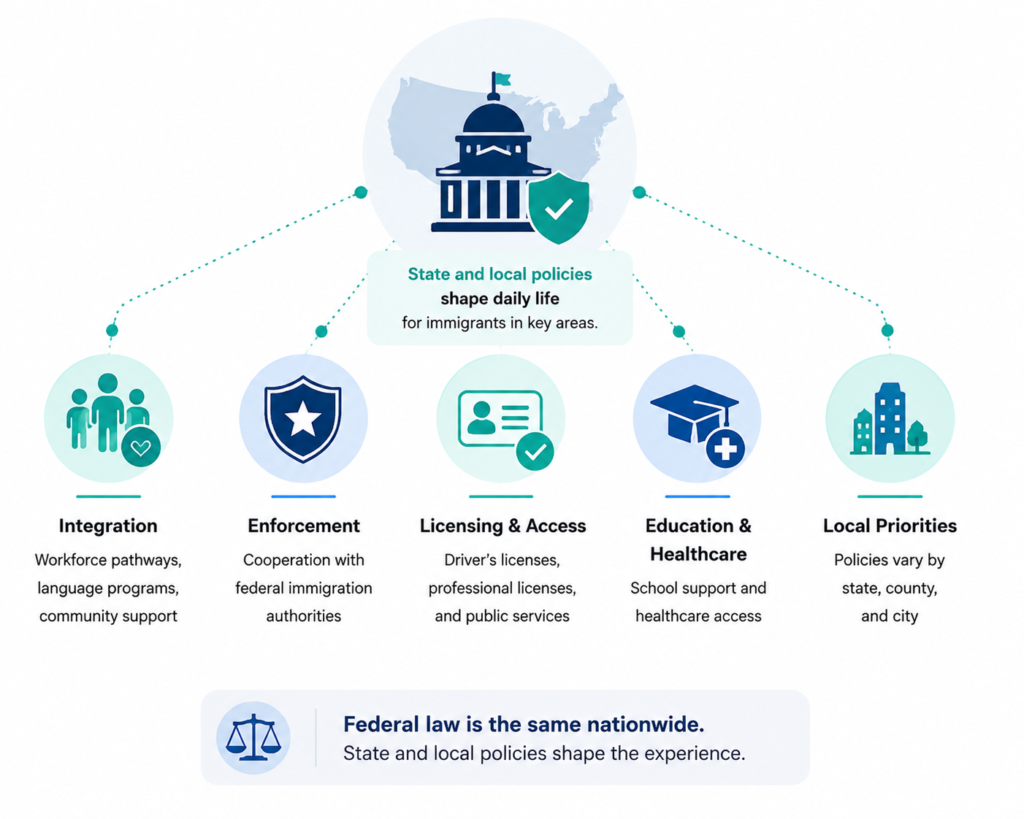
Immigration law in the United States is primarily federal law. Visas, green cards, asylum, removal, border control, and most immigration-enforcement authority are controlled by the federal government. At the same time, immigrants live, work, study, drive, receive healthcare, open businesses, and raise families inside states, counties, and cities. For that reason, state and local governments play a powerful role in shaping everyday immigrant life.
Since 2024, state and local immigration policy has become more active, more divided, and more legally contested. Some states have focused on immigrant integration, workforce participation, professional licensing, language access, education, and health coverage. Other states have expanded cooperation with federal immigration enforcement, restricted access to certain services, or attempted to create state-level immigration offenses. The result is a patchwork system in which an immigrant’s practical experience can differ greatly from one state to another.
For immigrants, employers, universities, healthcare systems, service providers, and families, this changing landscape matters. A person may be subject to the same federal immigration system nationwide, but the state where that person lives can affect access to a driver’s license, professional license, public benefits, local policing practices, school support, healthcare programs, and community resources.
This updated 2026 guide explains how state and local immigration policies work, what has changed since the earlier version of this article, and why local policy choices now matter for immigrant integration, enforcement, workforce planning, and family stability in the United States.
| Policy area | What state and local governments can influence | 2026 trend |
| Immigrant integration | Workforce pathways, English-language programs, community navigation, entrepreneurship support, Offices of New Americans | More states are formalizing integration through dedicated offices and coordination programs. |
| Employment and licensing | Occupational licensing, credential recognition, healthcare workforce pathways, state workforce initiatives | Healthcare shortages are pushing many states to consider or implement licensing pathways for internationally trained professionals. |
| Education and student access | In-state tuition, state financial aid, school services, language access, refugee and asylum-seeker support | Policies differ widely; some states expand access, while others restrict benefits or documentation pathways. |
| Driver’s licenses and IDs | Eligibility rules for state IDs and driver’s licenses | Still a key state-level difference affecting work, school, family mobility, and public safety. |
| Healthcare and services | State-funded health coverage, nutrition assistance, public-benefit rules, language access | A sharp divide has emerged: some states are reducing immigrant programs for budget reasons while others are filling federal eligibility gaps. |
| Local enforcement cooperation | 287(g) agreements, jail notification policies, detainer practices, use of local resources | Cooperation with federal enforcement has expanded in some places and been restricted in others. |
| State immigration enforcement laws | Attempts to criminalize unauthorized entry or authorize state/local arrest authority | Several laws remain subject to federal preemption and constitutional litigation. |
1. Immigration Is Federal, but Daily Life Is Local
The U.S. Constitution and federal immigration statutes place core immigration decisions in federal hands. A state cannot create its own visa category, approve a green card, grant asylum, issue a work permit, or order removal in the same way the federal government can. However, states and local governments control many systems that immigrants interact with every day.
These systems include schools, state colleges, public-health programs, licensing boards, local police departments, state agencies, housing programs, workforce-development offices, and municipal services. As a result, state policy can either support integration or create practical barriers.
A modern immigration strategy must therefore consider two layers: the federal immigration status of the person, and the state or local policy environment where the person plans to live, study, work, or operate a business.
2. The Rise of State Immigration Policymaking
State immigration activity did not begin in 2024, but the pace and political intensity have increased. The National Conference of State Legislatures now maintains a dedicated immigration legislation database covering enacted laws and adopted resolutions from 2024 onward, including topics such as education, employment, health, identification, driver’s licenses, law enforcement, public benefits, and voting.
The main point is simple: immigration is no longer only a federal policy issue discussed in Washington, D.C. It is now a recurring state legislative topic, a local budget issue, a workforce-planning issue, and a public-safety issue.
- Some states are using immigration policy to address labor shortages and demographic decline.
- Some states are using state laws to expand cooperation with federal immigration enforcement.
- Some states are reducing state-funded benefits for immigrants because of budget pressure.
- Some states are expanding protections or filling gaps created by federal eligibility changes.
- Many cities and counties are caught between federal pressure, state mandates, local budgets, and community-trust concerns.
3. Pro-Integration Policies: Offices of New Americans and Workforce Support
One of the clearest pro-integration trends is the growth of Offices of New Americans. These offices are usually created to coordinate immigrant integration, workforce access, English-language learning, entrepreneurship support, credential navigation, and community services.
For example, Maine launched its Office of New Americans in January 2025. The office describes its mission as strengthening the workforce, supporting community vitality, and helping immigrants connect to employers and services. Its early priorities include workforce pathways, entrepreneurship support, coordination among organizations, and English-language acquisition.
This type of office does not grant immigration status. Its value is practical: it helps states organize immigrant-related services, reduce duplication, connect employers to immigrant talent, and make local integration less fragmented.
- For immigrants, these offices can help locate trusted services and workforce resources.
- For employers, they can become a bridge to internationally trained talent.
- For states, they can support economic integration and reduce lost workforce potential.
- For local communities, they can improve coordination among schools, nonprofits, health systems, and agencies.
4. Professional Licensing and Healthcare Workforce Policy
Healthcare shortages have made professional licensing one of the most important state-level immigration policy areas. Many internationally trained doctors, nurses, pharmacists, therapists, and healthcare professionals live in the United States but cannot fully use their qualifications because state licensing systems often require repeated training, exams, or long credentialing processes.
By 2026, several states had moved toward alternative licensing pathways for internationally trained physicians. According to World Education Services, 27 states and two territories had passed alternative pathways to licensure by May 2026, with multiple states actively accepting applications and issuing licenses.
This trend is important because it shows how immigration policy, workforce policy, and public-health needs overlap. A state may not be able to issue a federal work permit, but it can decide whether a qualified foreign-trained professional has a realistic path to a state license once federal work authorization is available.
| Licensing issue | Why it matters | Policy direction |
| Foreign-trained physicians | Many communities face provider shortages, especially rural and underserved areas. | States are creating supervised, provisional, or alternative licensure routes. |
| Credential recognition | Repeated training requirements can delay entry into needed professions. | Some states are reviewing how international credentials are evaluated. |
| Healthcare workforce planning | Immigrant professionals may help reduce shortages when licensing is accessible and standards remain rigorous. | Licensing reform is becoming both an immigrant-integration and public-health strategy. |
5. Driver’s Licenses, IDs, Education Access, and Local Services
Driver’s license eligibility remains one of the most practical state-level immigration issues. In states that allow broader access to licenses or driving privilege cards, immigrants may be better able to travel to work, school, medical appointments, and family responsibilities. Supporters also argue that licensing improves road safety because more drivers can be tested, insured, and identified.
Education policy is another major area of state authority. States may decide whether certain immigrant students qualify for in-state tuition, state financial aid, scholarship programs, language access, or special support services. These decisions can have long-term effects on workforce development and economic mobility.
Local governments also influence access to municipal IDs, language assistance, emergency services, school enrollment support, and community navigation. These measures may not change federal immigration status, but they can strongly affect whether immigrant families are able to function safely and productively in daily life.
6. Healthcare and Public Benefits: A Divided 2026 Landscape
State-funded health coverage and public-benefit programs have become more contested in 2025 and 2026. KFF’s June 2026 review found that states had enacted or proposed a range of measures affecting immigrants’ access to state-funded healthcare and other services, while also changing how states cooperate with or limit federal enforcement activity.
The direction is not uniform. Some states have eliminated, reduced, capped, or proposed scaling back state-funded health coverage for immigrants because of budget pressures. Other states have moved to expand or preserve coverage for certain immigrant groups, especially where federal eligibility changes create gaps for lawfully present immigrants.
This means immigrants and advisers should not assume that access to state-funded services is the same across the country. Eligibility can vary by immigration status, age, income, state residency, benefit type, and date of enrollment.
- States may expand coverage for some groups while reducing benefits for others.
- Budget pressure has become a major driver of benefit restrictions.
- Federal eligibility changes can push states either to fill gaps or reduce spending.
- Applicants should verify state-specific rules before relying on any public benefit or health program.
7. Enforcement Cooperation: 287(g), Detainers, and Local Policing
One of the most sensitive areas of state and local immigration policy is cooperation with federal immigration enforcement. Under the 287(g) program, ICE may enter into agreements with state or local law-enforcement agencies that allow designated officers to perform certain immigration-enforcement functions under federal supervision.
In 2025 and 2026, 287(g) cooperation became a major national issue. ICE materials in 2026 described a sharp increase in 287(g) agreements, while civil-rights and immigrant-advocacy organizations raised concerns about racial profiling, local-resource burdens, and reduced community trust. Some states and counties moved toward greater cooperation, while others considered or enacted limits on local participation. For immigrants, the practical effect is significant. Local contact with law enforcement, a jail booking, a traffic stop, or a criminal arrest may carry different immigration consequences depending on local cooperation policies. For local governments, the question is also administrative: whether cooperation improves public safety, strains budgets, affects policing priorities, or changes immigrant-community trust.
| Local enforcement policy | Possible practical effect | Key consideration |
| 287(g) agreement | Local officers may perform specified immigration functions under a federal agreement. | Requires careful review of the agreement model, training, supervision, reporting, and civil-rights safeguards. |
| ICE detainer cooperation | Local jails may notify ICE or hold individuals after local release time where legally allowed. | Policies vary by state and locality; constitutional and liability concerns may arise. |
| Trust or sanctuary policies | Local agencies may limit use of local resources for civil immigration enforcement. | These policies may face political pressure or federal litigation but often rest on local-control arguments. |
8. State Immigration Enforcement Laws and Constitutional Litigation
Several states have attempted to go further than cooperation and create state-level immigration offenses or authorize state and local officers to arrest individuals based on suspected unauthorized entry. These laws raise serious constitutional questions because immigration enforcement has traditionally been treated as a federal responsibility.
Texas Senate Bill 4 is the most visible example. Its legal status has shifted repeatedly through federal court proceedings, and as of 2026 it remained part of a continuing legal battle over how far a state can go in creating immigration-related arrest and removal mechanisms. Florida’s SB 4-C and similar state laws have also faced federal court challenges based on preemption and constitutional concerns.
The lesson for immigrants, employers, and service providers is that state enforcement laws may change quickly because of court orders. A law may be signed by a governor, blocked by a court, partially allowed to take effect, stayed again, or revised. Anyone affected by such laws should confirm the current status before making decisions.
9. The Laken Riley Act and the Growing Role of States in Federal Enforcement Litigation
The Laken Riley Act, enacted as Public Law 119-1 on January 29, 2025, is a federal law that expanded mandatory detention language for certain noncitizens who are charged with, arrested for, convicted of, or admit conduct involving specified offenses such as burglary, theft, larceny, shoplifting, assault of a law-enforcement officer, or a crime causing death or serious bodily injury.
The law is also important for state and local immigration policy because it gives state attorneys general or other authorized state officers specific standing to sue federal immigration agencies over certain detention, release, parole, removal, or visa-sanction decisions where the state claims harm. This gives states a more direct statutory role in federal immigration litigation.
For local governments and immigrant communities, this federal-state enforcement interaction is likely to remain important. Even where immigration status decisions remain federal, states may influence enforcement priorities through litigation, cooperation agreements, data-sharing policies, and local jail practices.
10. Sanctuary Policies, Trust Policies, and Federal Pressure
Many cities and some states use sanctuary, welcoming, or trust policies to limit local participation in civil immigration enforcement. These policies are not all the same. Some restrict when local law enforcement may honor ICE detainers. Some limit information-sharing beyond what federal law requires. Some restrict use of city funds or personnel for immigration enforcement. Others focus on immigrant access to schools, services, and reporting crime without fear.
In 2025 and 2026, sanctuary policies faced renewed federal pressure, including executive actions and lawsuits targeting jurisdictions accused of obstructing federal immigration enforcement. At the same time, courts have often recognized that local governments may control how they use their own employees, funds, and law-enforcement priorities, provided they do not directly block federal officers from enforcing federal law.
This remains a legally and politically active area. The safest way to describe it for readers is not to say that sanctuary policies are always valid or always invalid. The accurate position is that these policies vary widely and are often tested through federal-state litigation.
11. What This Means for Immigrants and Families
For immigrants and families, state policy can affect daily stability even when federal immigration status remains unchanged. A family considering where to live may need to consider local school access, driver’s license rules, healthcare eligibility, police cooperation policies, professional licensing, and availability of trusted community organizations.
- Check whether your state offers driver’s license or state ID access for your immigration category.
- Review state-funded health coverage rules before relying on a benefit program.
- Understand whether local law enforcement has a 287(g) agreement or detainer-cooperation policy.
- Students should check in-state tuition and state financial-aid eligibility early.
- Professionals should review licensing-board rules before choosing where to practice.
- Families should use reliable local legal-service providers and avoid outdated online information.
12. What This Means for Employers, Universities, and Service Providers
Employers, universities, healthcare systems, and nonprofits should treat state immigration policy as part of risk management and workforce planning. Immigration status is federal, but onboarding, licensing, student support, workplace verification, public-benefit navigation, and local enforcement exposure are often state-specific.
- Employers should not assume that a professional license pathway is the same in every state.
- Healthcare systems should monitor international-credential reforms and underserved-area licensing options.
- Universities should keep updated information on tuition, state aid, DACA, TPS, refugee, asylum-seeker, and undocumented-student policies.
- Nonprofits should track benefit eligibility changes, language-access requirements, and local enforcement cooperation.
- Local agencies should train staff to avoid giving immigration advice outside their role and to refer complex cases to qualified professionals.
Common Mistakes to Avoid
- Assuming immigration rules are identical in all states because immigration is federal.
- Relying on old information about benefits, licenses, sanctuary policies, or enforcement cooperation.
- Confusing a state professional license with federal work authorization.
- Assuming that a state law is enforceable simply because it was enacted, without checking court orders.
- Treating all sanctuary policies as identical.
- Ignoring how local law-enforcement cooperation can affect immigrants after arrest, jail booking, or detainer requests.
- Using political slogans instead of checking actual statutes, agency guidance, court orders, and local policies.
Conclusion
State and local governments do not control the core federal immigration system, but they strongly influence how immigrants live, work, study, access services, and interact with public institutions in the United States. Since 2024, state and local immigration policy has become more active and more divided. Some states are building integration systems and workforce pathways, while others are expanding enforcement cooperation, restricting services, or testing the limits of state authority in court.
For immigrants, families, employers, universities, and service providers, the practical lesson is clear: immigration planning should not stop at the federal level. The state and local environment can affect safety, stability, professional licensing, education access, healthcare, and long-term opportunity.
Immignis helps individuals, families, professionals, entrepreneurs, and organizations understand how U.S. immigration strategy connects with real-world planning. If you are evaluating your U.S. immigration options, employment-based strategy, family planning, or long-term settlement pathway, a careful review of both federal immigration rules and state-level realities can make your plan stronger and more practical.
Frequently Asked Questions
Can a state grant immigration status?
No. Visa approval, green card approval, asylum, removal, and work authorization are generally federal immigration matters. States can influence daily access to services, licenses, education, and law-enforcement cooperation, but they do not grant federal immigration status.
Why do state immigration laws matter if immigration is federal?
State laws matter because immigrants live inside state and local systems. A state can affect access to driver’s licenses, professional licensing, state-funded benefits, schools, local policing, and integration services.
What is an Office of New Americans?
An Office of New Americans is usually a state or local office that coordinates immigrant integration, workforce access, English-language learning, entrepreneurship support, community services, and agency coordination.
What is the 287(g) program?
The 287(g) program allows ICE to enter agreements with state or local law-enforcement agencies so designated officers may perform certain immigration-enforcement functions under federal supervision.
Are sanctuary policies the same everywhere?
No. Sanctuary, trust, and welcoming policies vary widely. Some focus on detainers, some on use of local funds, some on data-sharing, and some on access to local services.
Can undocumented immigrants get driver’s licenses?
It depends on the state. Some states allow broader access to driver’s licenses or driving privilege cards, while others require proof of lawful presence.
Can internationally trained doctors practice in the United States?
Only if they meet federal work-authorization requirements and state licensing requirements. Some states are creating alternative pathways for internationally trained physicians, but rules vary by state.
Can state immigration enforcement laws be challenged in court?
Yes. State laws that attempt to create immigration offenses or authorize state immigration enforcement may face federal preemption and constitutional challenges.
Do public benefits affect immigration status?
Public-benefit rules are complex and depend on the benefit, immigration category, state, and federal law. Applicants should get case-specific guidance before applying for benefits when immigration consequences are possible.
What should immigrants check before moving to a new state?
They should review driver’s license rules, healthcare eligibility, professional licensing, school access, local enforcement cooperation, community resources, and state-funded benefit rules.