Frequently Asked U.S. Embassy Visa Interview Questions in 2026
Last Updated on July 9, 2026 by Amelia
A U.S. Embassy or Consulate visa interview is not a memorized question-and-answer test. It is a focused eligibility review where U.S. Embassy visa interview questions are used by the the consular officer uses the visa application, the interview, supporting documents, and U.S. immigration law to decide whether the applicant qualifies for the visa category requested.
The right preparation is not to rehearse artificial answers. The right preparation is to understand the purpose of your visa, organize your documents, answer truthfully, and make sure your explanation is consistent with your DS-160 or DS-260, your travel history, your financial position, and your long-term plans.
This updated 2026 guide explains common U.S. Embassy visa interview questions, why officers ask them, and how applicants can answer clearly without sounding scripted.
Important 2026 Updates Applicants Should Know
- More in-person interviews: Effective October 1, 2025, the Department of State narrowed interview-waiver eligibility. Many nonimmigrant visa applicants, including age groups that previously had broader interview-waiver access, may now generally need an in-person interview unless they fit a listed exception.
- Country of residence or nationality: Since December 2025, the Department of State has instructed most nonimmigrant visa applicants to schedule interviews in their country of nationality or residence. Applying outside those countries may make qualification harder and may create longer wait times.
- Online presence review: In 2026, the Department of State expanded online presence review for several additional nonimmigrant visa classifications, adding to categories already subject to review. Applicants should ensure their online information is truthful and consistent with their visa purpose.
- DS-160 and DS-260 consistency: For nonimmigrant visas, the DS-160 is a key application record. For immigrant visas, the DS-260 and civil documents are central. Interview answers should match the forms and documents already submitted.
What Does the Consular Officer Want to Know?
In most interviews, the officer is trying to answer five practical questions:
- Do you qualify for the specific visa category?
- Is your purpose of travel genuine and consistent with the visa type?
- Do your documents and answers match your application?
- For nonimmigrant visas, have you shown that you will follow the visa rules and depart when required, unless the category allows dual intent?
- Are there any security, misrepresentation, public-charge, prior-immigration, criminal, or inadmissibility concerns?
Documents to Review Before the Interview
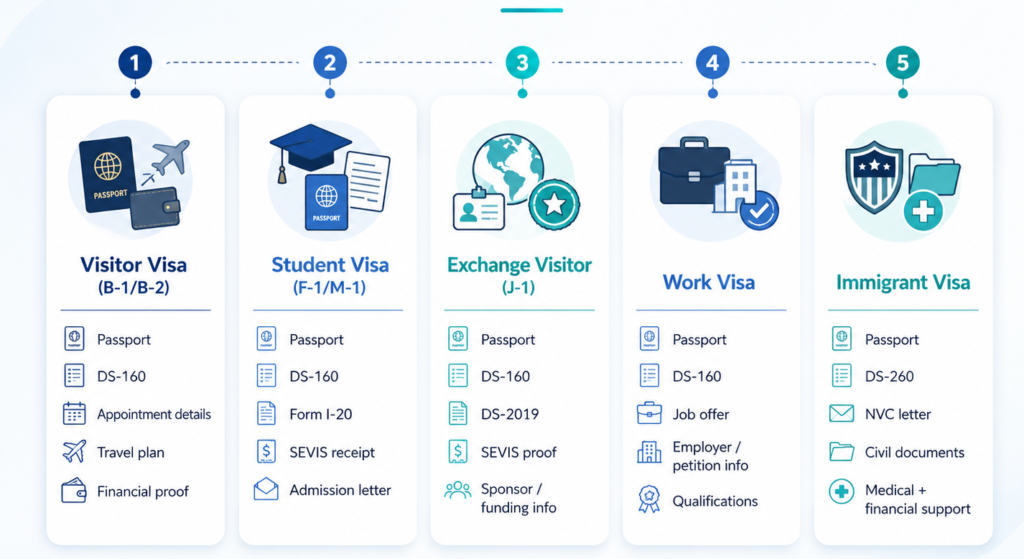
Required documents vary by visa type and by U.S. Embassy or Consulate. Applicants should always follow the instructions of the specific post where they are applying. However, most applicants should review the following before attending the interview:
| Visa type | Documents and records to review |
| Visitor visa (B-1/B-2) | DS-160 confirmation page, passport, appointment confirmation, fee receipt if required, travel itinerary, purpose of visit, financial ability, employment or business evidence, family or residence ties, prior travel history. |
| Student visa (F-1/M-1) | DS-160 confirmation page, passport, Form I-20, SEVIS fee proof, admission letter, funding evidence, academic history, study plan, and post-study plans. |
| Exchange visitor visa (J-1) | DS-160 confirmation page, passport, Form DS-2019, SEVIS fee proof, exchange-program purpose, funding, home-country plans, and program sponsor information. |
| Work visa categories | DS-160 confirmation page, passport, petition approval notice where applicable, job offer, employer details, role description, qualifications, salary, and worksite information. |
| Immigrant visa | NVC appointment letter, passport, DS-260 confirmation page, civil documents, police certificates, medical exam, photographs, financial evidence or affidavit of support where required, and original/certified documents. |
Common U.S. Embassy Visa Interview Questions and How to Answer
1. What is the purpose of your trip to the United States?
Why officers ask this: This question is common in visitor, business, student, exchange, and work visa interviews. The officer wants to confirm that your travel purpose matches the visa category.
How to answer: Answer directly. State the purpose, location, dates, and who is involved. Do not add unnecessary stories. For a B-2 visitor, mention tourism, family visit, medical treatment, or a specific event. For B-1, explain the business activity without suggesting unauthorized employment.
Example answer: I plan to visit the United States for two weeks to attend my cousin’s wedding in New Jersey and spend a few days sightseeing in New York. My return date is already planned, and I will resume my work after the trip.
2. Why did you choose this visa category?
Why officers ask this: The officer wants to see whether you understand the purpose and limits of the visa category.
How to answer: Explain the legal purpose of the visa in plain language. For example, B-1/B-2 is for temporary business or tourism, F-1 is for study, J-1 is for exchange, and an immigrant visa is for permanent residence after an approved petition or selected category.
Example answer: I selected the F-1 visa because my main purpose is full-time study in a master’s program. I understand that my primary activity must be study, and any work must follow F-1 rules.
3. Why did you choose this university, employer, program, or destination?
Why officers ask this: For student, exchange, and work visas, officers often test whether the choice is logical and documented.
How to answer: Connect your answer to specific academic, professional, or travel reasons. Avoid generic answers such as ‘it is famous’ or ‘it is in America.’
Example answer: I chose this university because the program includes a concentration in data analytics for healthcare, which matches my previous academic background and my planned career path.
4. What ties do you have to your home country or country of residence?
Why officers ask this: For many nonimmigrant visas, especially visitor and student visas, applicants must show that they qualify for temporary admission. Officers may consider employment, family, property, education, business, community responsibilities, and lawful residence outside the United States.
How to answer: Give facts, not emotional statements. Mention current job, business, family responsibilities, property, education, professional license, or other reasons you are expected to return. H-1B and L visa applicants are treated differently because those categories permit dual intent, but truthful answers are still required.
Example answer: I am employed as a project manager in my home country, and my employer has approved a three-week leave. My spouse and children live there, and I own an apartment where I will return after the trip.
5. Who will pay for your trip, study, or stay?
Why officers ask this: The officer wants to confirm that you have financial ability and will not rely on unauthorized work or public support.
How to answer: Explain the source of funds clearly. Bring bank statements, salary slips, business income records, scholarship letters, sponsor documents, or other proof relevant to the visa type.
Example answer: I will pay for the trip from my savings. I have my bank statements and employment letter showing my regular income.
6. Do you plan to work in the United States?
Why officers ask this: This question checks whether you understand the limits of your visa. B-1/B-2 visitors generally cannot work in the United States. Students and exchange visitors may have limited work authorization only under specific rules.
How to answer: Answer honestly and match the visa category. Do not say you will work unless the visa category allows it and you have authorization.
Example answer: No. I am applying for a visitor visa and do not plan to work in the United States. My visit is temporary and for tourism and family purposes only.
7. Have you visited the United States before?
Why officers ask this: The officer reviews travel history and previous compliance with visa rules.
How to answer: Give dates and purpose. If you complied with prior stays, say so briefly. If there was an overstay, refusal, or status issue, answer truthfully and be prepared to explain.
Example answer: Yes. I visited the United States in 2019 for a conference in Chicago. I stayed for two weeks and departed before my authorized stay expired.
8. Where will you stay in the United States?
Why officers ask this: The officer wants to see that your travel plan is realistic.
How to answer: State the hotel, university housing, employer-provided housing, family address, or temporary accommodation. If plans are not final, explain what is confirmed and what remains pending.
Example answer: I will stay at a hotel in Manhattan for the first four nights and then with my brother in New Jersey for the rest of the visit.
9. What will you do after your visit, program, or visa period ends?
Why officers ask this: For nonimmigrant visas, this question checks future plans and whether the applicant understands the temporary nature of the visa.
How to answer: State a concrete plan connected to your job, business, studies, family, or professional path outside the United States.
Example answer: After completing my short visit, I will return to my job and continue managing my current projects. My leave has been approved only for the travel dates.
10. What if your visa is refused?
Why officers ask this: Some officers ask this to test whether the trip is essential, whether the applicant understands the process, and whether the applicant will answer calmly.
How to answer: Do not argue or show desperation. State that you will respect the decision and review whether you can provide stronger evidence or reapply if circumstances change.
Example answer: I understand that the decision is made under U.S. law. If the visa is refused, I will review the reason and consider reapplying only if I can address the issue or if my circumstances change.
11. Is everything in your DS-160 or DS-260 correct?
Why officers ask this: The application form is a central record. Inconsistencies can create credibility problems.
How to answer: Review your form before the interview. If you discover a mistake, follow the Embassy or Consulate’s instructions. Do not try to hide errors during the interview.
Example answer: Yes, I reviewed the form before attending the interview. The information is accurate to the best of my knowledge.
12. Have you ever been refused a visa, overstayed, or had immigration problems?
Why officers ask this: The officer must assess prior immigration history and possible ineligibilities.
How to answer: Answer truthfully. A prior refusal is not automatically fatal, but misrepresentation can be far more serious than the original issue.
Example answer: Yes, I was refused a visitor visa in 2022 under section 214(b). Since then, my employment and financial circumstances have changed, and I have included updated evidence.
13. What is your social media or online presence?
Why officers ask this: In 2026, some visa categories are subject to expanded online presence review. Officers may also review information provided in the application and publicly available information where relevant.
How to answer: Do not delete or alter information to mislead. Make sure your online profile does not contradict your stated job, education, purpose of travel, or identity information.
Example answer: My online profiles reflect my professional work and education. They are consistent with the information in my visa application.
14. For immigrant visa applicants: who is petitioning you and what is the basis of your case?
Why officers ask this: Immigrant visa interviews confirm eligibility for permanent residence based on an approved petition, family relationship, employment category, diversity visa selection, or another lawful basis.
How to answer: Know the petition basis. Family applicants should know the relationship facts. Employment applicants should understand the job offer, employer, priority date, or self-petition basis. Bring original/certified civil documents and financial documents where required.
Example answer: My immigrant visa is based on an approved employment petition. I understand the category, the employer or petition basis, and I have brought the required civil and financial documents.
Questions by Visa Category
| Visa category | Common interview questions |
| B-1/B-2 visitor visa | Why are you traveling? How long will you stay? Who will pay? What do you do for work? Who is in the United States? What ties do you have outside the United States? Have you visited before? |
| F-1 student visa | Why this university? Why this program? Who is funding your studies? What is your academic background? What will you do after graduation? Do you understand F-1 work restrictions? |
| J-1 exchange visitor visa | What is the exchange program? Who is the sponsor? What will you do after the program? Who is funding it? Are you subject to a home-residency requirement? |
| H-1B, L-1, O-1, or other work visas | Who is your employer? What is your role? Where will you work? What are your qualifications? What salary will you receive? How does the job match the petition? |
| E-2 investor visa | What business are you investing in? How much have you invested? What is your ownership? Is the business real and operating? What is your role? How will the business support more than you and your family? |
| K-1 fiance(e) visa | How did you meet? When did you last see each other? What are your marriage plans? What evidence supports the relationship? Who will financially support you? |
| Family immigrant visa | Who is the petitioner? What is your relationship? When did the relationship begin? Are civil documents complete? Is the affidavit of support sufficient? |
| Employment immigrant visa | What is the approved petition? What is the job or self-petition basis? What are your qualifications? Do your documents match the approved case? |
How to Answer Well Without Sounding Memorized
- Keep answers short and direct. Most interviews are brief, and long explanations may create confusion.
- Answer the question asked. Do not volunteer unrelated information unless it is necessary to clarify the answer.
- Use facts, dates, names, and documents when helpful.
- Make sure your answers match your DS-160, DS-260, I-20, petition approval, invitation letter, financial documents, and travel history.
- Do not guess. If you do not know an exact date or detail, say that clearly and explain what you do know.
Never present false documents or false information. Misrepresentation can create serious immigration consequences.
Common Mistakes to Avoid
| Mistake | Why it hurts the application |
| Memorized, scripted answers | They may sound unnatural and may not respond to the actual question. |
| Inconsistent travel dates | Different dates across the DS-160, invitation letter, hotel booking, and interview answer can create doubt. |
| Weak explanation of funding | The officer may question whether the applicant can afford the trip or program lawfully. |
| Overstating U.S. ties | For temporary visas, too much emphasis on U.S. family or job opportunities can weaken nonimmigrant intent. |
| Ignoring prior refusals | Officers can see prior visa history. Failure to disclose can damage credibility. |
| Assuming an invitation letter guarantees approval | For visitor visas, an invitation letter may help explain purpose, but the applicant must qualify based on their own circumstances. |
| Buying nonrefundable tickets before visa approval | The Department of State advises applicants not to make final travel plans or buy tickets until they have a visa. |
If the Visa Is Refused
A refusal does not always mean the applicant is permanently barred from receiving a visa. The meaning depends on the legal basis of the refusal.
- Section 214(b): This applies to many nonimmigrant visa cases. It usually means the applicant did not sufficiently prove eligibility for the visa category and/or did not overcome the legal presumption of immigrant intent. There is no appeal, but a person may reapply if circumstances change or stronger evidence is available.
- Section 221(g): This often means the officer needs additional documents or administrative processing before a final decision can be made. The applicant should follow the instructions in the refusal letter.
Other ineligibilities: Some refusals involve public charge, misrepresentation, unlawful presence, criminal grounds, security issues, or other legal grounds. These require case-specific analysis.
How Immignis Can Help
Immignis helps applicants prepare for U.S. visa and immigration processes by reviewing the purpose of travel, identifying document weaknesses, organizing evidence, and helping applicants understand the questions that may arise in their specific visa category.
The goal is not to create artificial answers. The goal is to help applicants present their genuine case clearly, consistently, and professionally.
Conclusion
U.S. Embassy visa interviews are serious but manageable when the applicant is prepared. The best answers are truthful, specific, and consistent with the visa category. Applicants should understand the purpose of their visa, review their forms carefully, organize supporting documents, and be ready to explain their plans in a calm and direct way.
In 2026, interview preparation should also account for narrower interview-waiver rules, country-of-residence scheduling guidance, online presence review in certain categories, and greater emphasis on consistency between the application, documents, and interview answers.
Frequently Asked Questions
Do U.S. visa officers ask the same questions to everyone?
No. Questions depend on the visa category, the applicant’s background, travel history, documents, and case-specific issues.
Should I memorize answers before the visa interview?
No. Applicants should prepare facts and documents, but memorized answers may sound unnatural. Truthful and clear answers are better.
Is a visitor visa invitation letter required?
No. For visitor visas, the applicant must qualify based on their own circumstances. An invitation letter can help explain purpose, but it does not guarantee approval.
Can I attend a visa interview outside my home country?
In some cases it may be possible, but current Department of State guidance says nonimmigrant applicants should generally schedule interviews in their country of nationality or residence. Applying elsewhere may make qualification harder or create longer waits.
What is a 214(b) refusal?
It is a nonimmigrant visa refusal that generally means the applicant did not prove eligibility for the visa category and/or did not overcome the presumption of immigrant intent.
What is administrative processing?
Administrative processing means the officer cannot issue the visa immediately and additional review or documents may be needed. Timing varies by case.
Does a visa guarantee entry to the United States?
No. A visa allows a person to travel to a U.S. port of entry and request admission. CBP decides whether to admit the traveler.
Can I work in the United States on a visitor visa?
No. A B-1/B-2 visitor visa does not permit employment in the United States.