
National Interest Waiver Requirements: What USCIS Actually Means (And What Applicants Get Wrong)
Last Updated on August 16, 2026 by Amelia
EB-2 NIW national importance is one of the most consistently misunderstood requirements in employment based immigration. Applicants often assume that the standard requires global fame, government employment, scientific research, or an officially recognized title. None of those assumptions match how USCIS evaluates Prong 1 under the Matter of Dhanasar framework.
This article corrects those misconceptions directly and explains what the standard actually demands and how to build an argument that meets it.
What “National Interest” Actually Means Under USCIS Rules
The National Interest Waiver allows USCIS to waive the requirement that an employment based immigrant have a specific job offer and an approved labor certification not because the applicant is famous or extraordinary in a general sense, but because their proposed work serves the interests of the United States at a scale that makes the waiver appropriate.
Under the Dhanasar framework, “national interest” is not a single test. It is the conclusion reached by satisfying two distinct sub-requirements:
- Substantial merit: the work has inherent value in its field it is meaningful, useful, and grounded in real expertise.
- National importance: the potential impact of the work extends broadly enough to benefit the United States beyond a single organization, region, or client.
These two concepts are frequently merged in petitions, which creates a structural problem. A piece of work can have substantial merit be technically sophisticated and genuinely valuable to a single employer without having national importance. And work that is framed as nationally important without establishing its inherent merit first will not survive Prong 1 analysis.
The working framework: substantial merit is about what the work is; national importance is about what the work does for the country.
The Dhanasar Case That Reshaped the Standard
Before 2016, NIW adjudication followed the New York State Department of Transportation (NYSDOT) standard, which required petitioners to show that their work was in an area of substantial intrinsic merit, that the benefit from the work would be national in scope, and that the national interest would be adversely affected if labor certification were required. The standard was applied inconsistently and had become difficult to satisfy for non-traditional careers.
In Matter of Dhanasar, the AAO replaced NYSDOT with the current three prong test. The shift was deliberate and significant. The new standard moved from asking whether national interest “would be adversely affected” by requiring certification a difficult counterfactual to asking whether waiving certification serves the national interest on balance. This reframing opened the pathway to a broader range of applicants and made the argument structure more defensible.
What Dhanasar did not do: it did not lower the evidentiary bar. If anything, it made the standard more precise. Officers now evaluate whether the specific proposed work has prospective national level benefit not just whether the general field is important.
The practical implication is significant. Dhanasar evaluates the endeavor forward, not backward. Past achievements matter only as evidence that the petitioner is capable of executing the proposed work. They do not substitute for a clear articulation of what that work will produce and who in the United States will benefit.
Substantial Merit vs. National Importance: Why the Distinction Matters
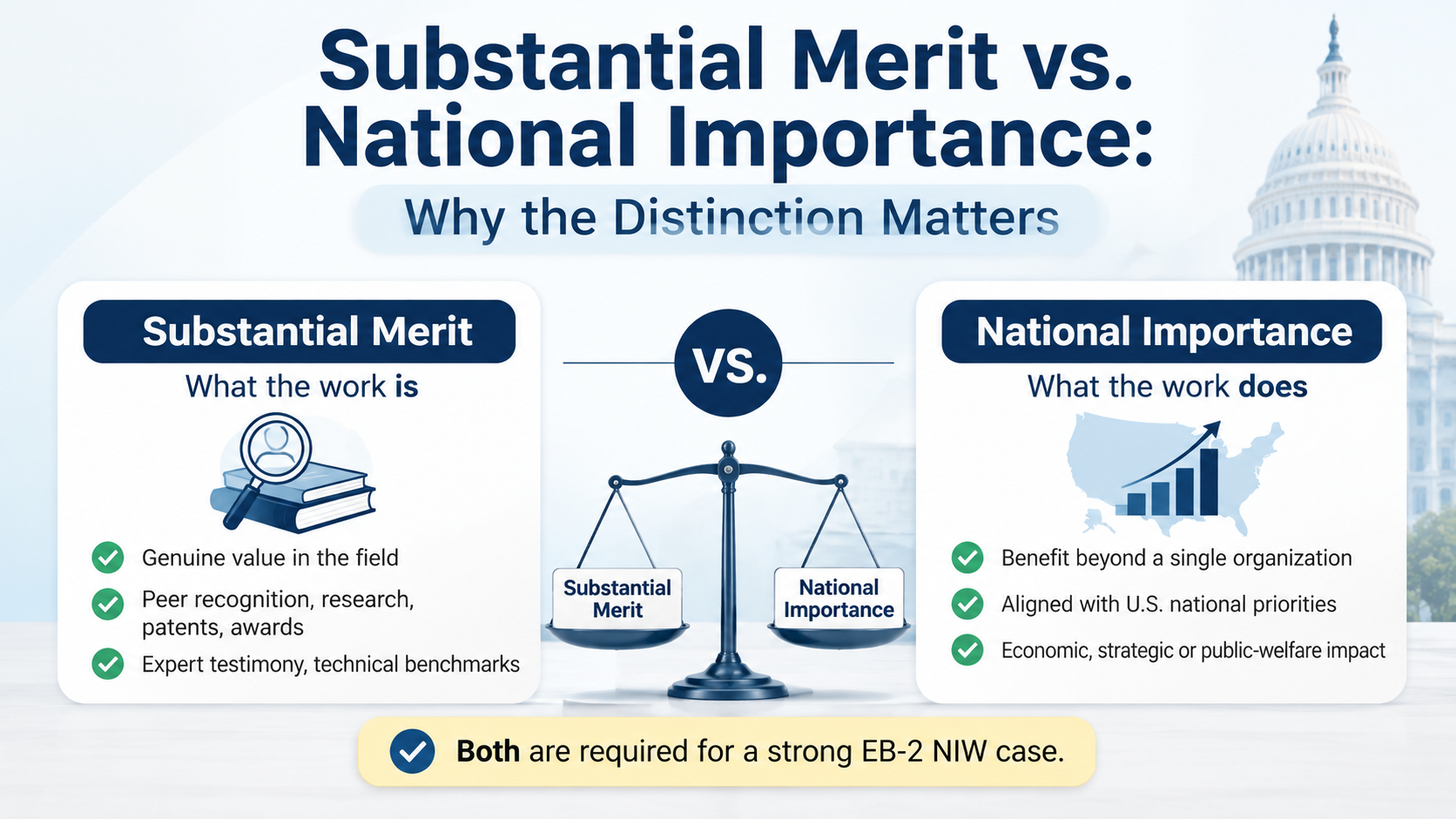
This is the distinction most petitions blur, and blurring it is one of the most common causes of RFEs on Prong 1.
Substantial merit is established by showing that the work has recognized value within its field. The threshold is not extreme it does not require the work to be the most important contribution in the field, only that it has genuine value. Strong substantial merit evidence includes:
- Peer recognition through publications, citations, patents, or industry awards
- Expert testimony that the work addresses a meaningful problem in the field
- Technical benchmarks, performance data, or deployment outcomes that substantiate quality
- Demand for the work evidenced by contracts, clients, collaborators, or funding
National importance is a separate, additional requirement. It asks whether the scope of the work’s benefit reaches the national level. Evidence that satisfies this prong typically includes:
- Explicit connection to a documented federal priority, agency strategy, or legislative framework
- Demonstrated or projected impact on sectors the U.S. government has identified as critical
- Evidence that the work’s methods or outputs are portable adoptable by other organizations, jurisdictions, or industries beyond the petitioner’s employer
- Economic, strategic, or public welfare effects that the petitioner can credibly quantify or support with third-party data
A petition that establishes substantial merit but not national importance fails Prong 1. So does a petition that asserts national importance without first grounding the argument in the work’s genuine merit. Officers read both in sequence and notice when one is thin.
Weak: “My research in machine learning has substantial merit because machine learning is an important field. The national importance of this work is demonstrated by the fact that AI is a national priority.”
This version conflates field importance with both requirements. It asserts rather than demonstrates. It gives the officer nothing to evaluate.
Stronger: “The proposed endeavor develops explainable AI diagnostic tools for clinical decision support in U.S. hospitals, addressing the accuracy and transparency gaps flagged by the FDA’s AI/ML-based software action plan. The tools are designed for integration into electronic health record systems across hospital networks, with projected measurable improvement in diagnostic consistency for high volume conditions.”
This version establishes merit (the work addresses real gaps in an applied medical context), national importance (the FDA has identified this problem at the policy level), and portability (hospital networks, not one employer).
Why Most Applicants Misread the Standard
Several persistent misreadings appear in petitions across every adjudication cycle.
Confusing prestige with national importance. A prestigious employer, a well ranked institution, or a recognizable title does not satisfy Prong 1. Officers evaluate the proposed work, not the platform from which it is conducted.
Assuming the field carries the argument. “Healthcare is a national priority” establishes nothing about the petitioner’s specific contribution. The applicant must prove their particular work advances the national need not just that the need exists.
Treating past achievements as the endeavor. NIW is a forward looking standard. A list of publications, degrees, and past projects is Prong 2 evidence (proving the petitioner is well-positioned) not Prong 1 evidence (establishing what the future work will achieve and for whom).
Using geographic presence to argue national scope. Work conducted “in the United States” is not work with national importance. The geographic scope of impact not location of employment is what the standard measures.
Merging Prong 1 with Prong 3. Applicants sometimes address why it would be impractical to require a job offer (Prong 3) inside the national importance argument (Prong 1). These are separate analyses, and conflating them weakens both.
These errors are recoverable in a well drafted petition. They are not recoverable if an RFE arrives and the underlying argument was never built correctly in the first place.
Want to know if your current framing meets the standard? Get a free national interest evaluation from Immignis before you invest further in the petition.
Strong National Interest Arguments by Field
The following examples illustrate how the national importance argument is structured across different sectors. Each shows the same architecture: specific work, federal anchor, and portability mechanism.
Healthcare and Public Health
Healthcare cases succeed when they tie the proposed work to federal agency priorities rather than to a single institution’s operations. NIH strategic plans, FDA guidance documents, and HHS priorities provide strong anchors. Effective framing addresses a specific problem federal agencies have identified diagnostic accuracy, data fragmentation, health disparities, substance-use response, maternal mortality and demonstrates that the petitioner’s contribution extends beyond one hospital or clinic.
Working framing: To develop interoperable clinical data pipelines for U.S. community hospitals, addressing the data fragmentation that HHS and NIH have identified as a systemic barrier to equitable care delivery. The pipeline architecture is designed for open adoption across hospital networks outside the petitioner’s employer.
AI and Emerging Technology
AI cases are common and increasingly competitive. Simply working in AI no longer establishes national importance on its own. The argument requires specificity: which application, what problem, which federal priority, what deployment pathway. The most credible AI cases connect to documented agency concerns FDA, NIST, NSF, DOE, or DARPA and show a concrete mechanism by which the work influences systems beyond the petitioner’s employer.
Working framing: To design interpretable machine learning frameworks for anomaly detection in federally regulated financial infrastructure, addressing the systemic risk and auditability gaps identified in recent Treasury and OCC guidance. The framework is architected for adoption by financial institutions subject to federal oversight.
Cybersecurity and Defense
Cybersecurity cases typically have strong federal anchors available CISA, DoD, NSF, and NIST publish extensively on national security and critical infrastructure vulnerabilities. The challenge is specificity: “cybersecurity is important to national security” is the weakest possible framing. The petition must identify the specific vulnerability or gap the petitioner’s work addresses and show how it contributes to systems beyond one organization.
Working framing: To advance threat modeling methodologies for operational technology environments in U.S. energy and water infrastructure, addressing the specific attack-surface vulnerabilities documented in CISA’s National Cyber Strategy. The methodology is designed for adaptation by regional utility operators across multiple states.
Climate and Clean Energy
Clean energy cases benefit from multiple federal anchor points: DOE grid modernization initiatives, the Inflation Reduction Act’s clean energy framework, EPA priorities, and FERC regulatory contexts. The strongest petitions tie the proposed work to specific documented bottlenecks grid interconnection delays, storage technology gaps, rural electrification challenges and show a scalability pathway beyond one project or utility.
Entrepreneurship and Economic Growth
Entrepreneurial NIW cases often struggle because the proposed endeavor sounds like a business plan rather than a national-interest argument. The shift that changes outcomes: frame the venture’s contribution to a documented national problem rather than its commercial potential. Accelerator acceptance, venture capital from reputable U.S. firms, SBIR or STTR federal grants, and federal contracting history all serve as strong corroborating evidence. Job creation in economically underserved areas, documented in credible financial projections, can also contribute to the national importance argument.
Education and Workforce Development
Education cases anchor effectively to Department of Education strategic priorities, Department of Labor workforce development frameworks, and state implementation of federal education initiatives. The strongest petitions document adoption frameworks, curricula, or pedagogical models used by institutions beyond the petitioner’s employer and connect the work to labor market outcomes the federal government has identified as critical.
Evidence That USCIS Actually Trusts
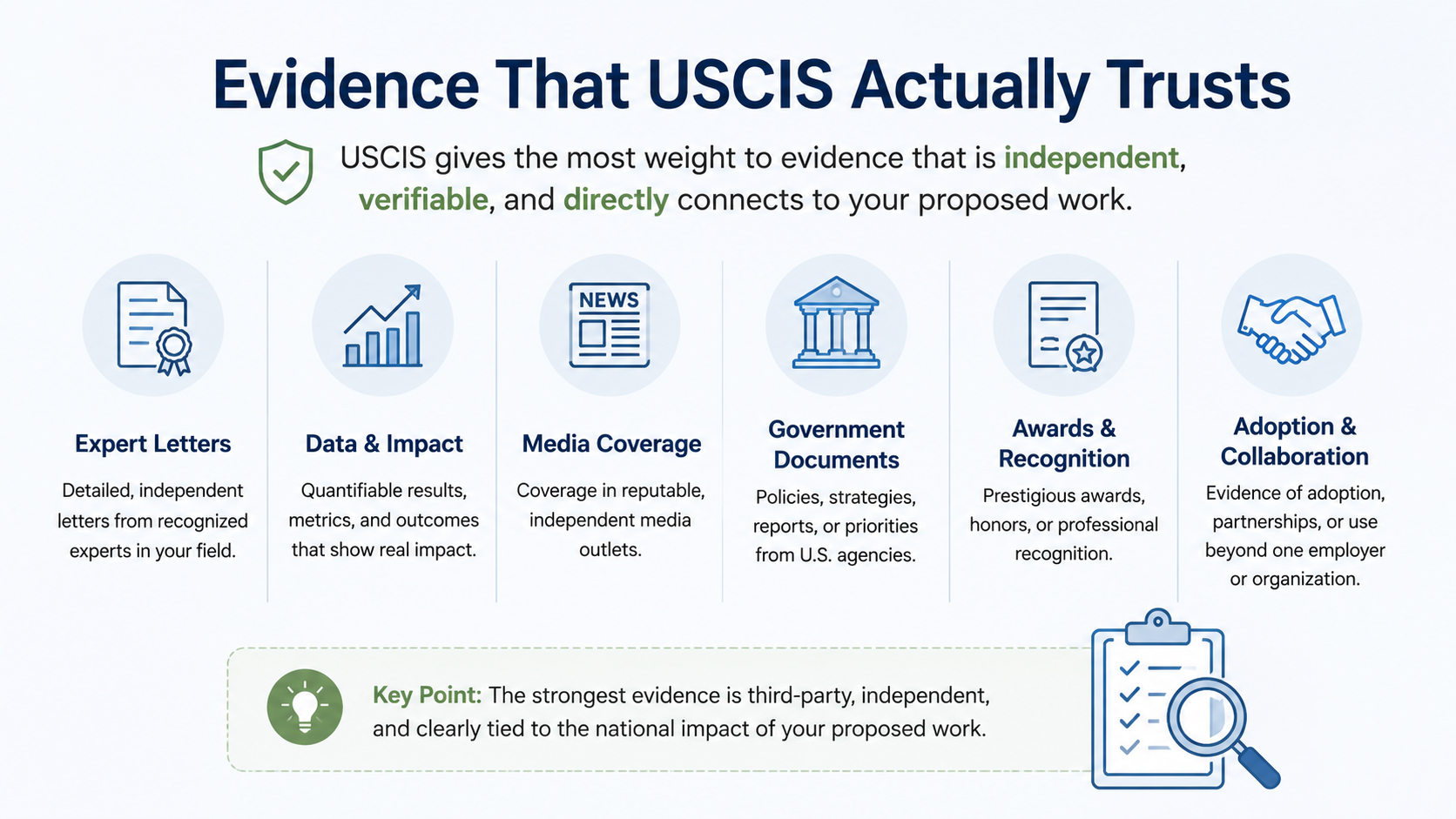
The gap between the evidence applicants gather and the evidence officers find persuasive is one of the most consistent problems in NIW filings. The categories below reflect what actually moves adjudication.
Expert Recommendation Letters
Recommendation letters are the most important evidence category in most NIW petitions, and the most commonly misused. The letters that carry weight are specific, independent, and field bridging.
- Specific: the letter describes particular contributions methodologies developed, results achieved, problems solved not personality traits or general excellence.
- Independent: the letter writer has no professional or financial stake in the petitioner’s success. Letters from employers, direct supervisors, or investors carry less weight than letters from credible experts at arms’ length.
- Field bridging: the most valuable letters explicitly connect the petitioner’s technical work to a national level interest an agency priority, a sector wide problem, a policy gap that the expert is positioned to speak to credibly.
Letters using phrases like “brilliant,” “uniquely qualified,” or “outstanding in every respect” without substantive elaboration are routinely discounted. An adjudicator cannot evaluate adjectives; they can evaluate specific claims supported by context.
Publications and Citation Records
For research focused petitions, publications and citations document that the field has responded to the petitioner’s work. The quality and independence of citing works matters more than raw count. A modest but well cited paper in a high impact venue carries more weight than a long list of conference papers with limited citations. For non-STEM applicants, the equivalent is documented adoption organizations that have used the petitioner’s frameworks, methodologies, or outputs outside the petitioner’s own institution.
Government Interest and Federal Validation
Letters from government agencies or officials, federal contracts, federal grant awards (SBIR, STTR, NIH R01), advisory appointments, and citations in official government reports or rulemaking each provide strong, independent validation that the work has national level significance. These are difficult to obtain but carry disproportionate weight when present. Even a letter from a government agency that does not fund the petitioner, but can speak to the relevance of the work to agency priorities, is valuable.
Industry Recognition and Independent Signals
Outside the academic context, industry recognition takes several forms: leadership in standard setting bodies, invitations to testify before regulatory agencies, citations in trade press or major media as a domain authority, election to industry boards, and peer awards judged by independent professionals. The key word throughout is “independent” recognition by entities with no stake in the petitioner’s outcome.
Quantified Outcomes and Real-World Impact
Deployments, implementations, and measurable outcomes answer the implicit “so what” question that adjudicators bring to every petition. How many organizations have adopted this framework? How many people does this technology serve? What has changed because of this work? Officers can evaluate quantities and outcomes in ways they cannot evaluate aspirational claims. Where exact numbers are not available, credible estimates supported by third party data are stronger than no quantification at all.
Common Mistakes That Trigger Prong 1 RFEs
The RFE patterns below appear consistently across adjudication cycles and can be anticipated and avoided in initial filing.
- Vague endeavor definition. “Research in AI” or “work in the healthcare field” gives the officer no object to evaluate. The proposed endeavor must define the specific problem, the method, and the intended outcome at a level of precision that permits independent assessment.
- Field level national importance claims. Arguing that “cybersecurity is a national priority” without demonstrating the petitioner’s specific contribution to that priority is a non-argument. It describes the category, not the petitioner’s role within it.
- Single-employer impact framing. Describing work whose benefit is confined to one company’s operations or one institution’s outcomes is the most common source of Prong 1 denial. Portability evidence is required.
- Credentials first, impact last structure. Petitions that spend pages on degrees and publications before reaching the national importance argument are structurally inverted. Officers evaluate the proposed endeavor first; credentials should serve the argument, not precede it.
- Treating Prong 1 as a summary section. Some petitions briefly state the endeavor in two or three sentences and then spend the bulk of the letter on Prong 2 evidence. Prong 1 is not a formality. It is the foundational legal argument the petition is built on.
- Relying on EB-1A framing. Applicants who have also considered the EB-1A sometimes carry over “award” and “acclaim” framing into an NIW petition. The NIW is not an extraordinary-ability claim. It is a future benefit claim. The evidence structure and the argument structure are different.
How to Build the National Interest Narrative
The national interest argument is a narrative a structured chain of reasoning that takes the officer from the specific proposed work to the conclusion that the United States benefits from waiving the labor certification requirement. That chain has five links.
1. Define the proposed endeavor with precision. The endeavor is the subject of the argument. Everything else depends on it being clear. One to three sentences: what the petitioner will do, how they will do it, and what outputs the work will produce.
2. Establish that the work has substantial merit. Use objective evidence third-party publications, technical benchmarks, demand signals, expert testimony to show the work has genuine value in its field. This is distinct from the national importance argument and should be developed separately.
3. Anchor to a documented national priority. Identify the federal agency strategy, legislative framework, or government report that recognizes the problem the petitioner’s work addresses. This anchor transforms a private claim into an argument rooted in documented public interest.
4. Show that the impact is portable. Demonstrate that the work’s benefits extend beyond the petitioner’s current employer. Adoption by other organizations, replicable methodologies, open specification outputs, or industry wide frameworks all establish portability.
5. Quantify reach where possible. Translate the work’s scope into specific beneficiaries, jurisdictions, institutions, or economic effects. Even approximate figures supported by credible sources are more persuasive than unquantified assertions.
These five elements should appear in the petition letter in roughly this sequence, with each element developed before the next is introduced. The officer should be able to follow the chain without inference.
The Prong 3 Connection
Prong 1 and Prong 3 are related but distinct. Once national importance is established under Prong 1, Prong 3 asks whether on balance it benefits the United States to waive the labor certification and job-offer requirements specifically for this petitioner’s proposed endeavor.
Several factors strengthen the Prong 3 argument when built on a solid Prong 1 foundation:
- The work is time sensitive and a PERM delay would meaningfully harm its national level execution
- The petitioner is a self-starting entrepreneur or founder for whom a traditional job offer is structurally impractical
- The work is in a federally designated critical field where the U.S. government has documented a shortage of qualified practitioners
- The petitioner’s specific expertise, established relationships, or infrastructure cannot be readily replicated by a standard hire
Where applicants make errors: arguing Prong 3 without establishing Prong 1 first (the balancing argument has nothing to balance against), and repeating the national importance argument verbatim under Prong 3 rather than extending it into the waiver specific analysis.
Frequently Asked Questions
What does USCIS mean by “national interest” in an NIW petition?
USCIS defines national interest through two distinct requirements under Dhanasar: substantial merit, meaning the work has genuine value in its field, and national importance, meaning the work’s impact benefits the United States beyond a single employer or region. Both must be demonstrated through evidence, not assertion.
What qualifies as national importance for EB-2 NIW?
National importance is established by showing that the proposed work’s benefits extend beyond a single organization, are tied to documented federal priorities, and have a portability mechanism methods, outputs, or frameworks that other organizations or sectors can adopt. Impact on a national scale does not require literal coverage of the entire country.
How does USCIS evaluate national interest waiver cases?
USCIS evaluates NIW cases under the three prong Dhanasar framework. Officers assess whether the proposed endeavor has substantial merit and national importance, whether the petitioner is credibly positioned to advance it, and whether waiving the labor certification requirement benefits the U.S. on balance.
What is the difference between substantial merit and national importance?
Substantial merit refers to the inherent quality and value of the work in its own field. National importance refers to the scale of its potential benefit whether it reaches beyond a single employer to serve broader U.S. interests. A petition must establish both separately; they are related but distinct legal requirements.
Does national importance require nationwide geographic reach?
No. USCIS does not require literal nationwide geographic footprint. A locally situated project can have national importance if it produces outcomes frameworks, technologies, policies that are replicable, adopted nationally, or tied to federally identified priorities. The scope of impact matters more than the physical location of the work.
Why do NIW petitions fail the national interest requirement?
Most failures trace to four patterns: vague endeavor definitions that cannot be evaluated, field level national importance claims that do not demonstrate the petitioner’s specific contribution, single employer impact framing that lacks portability, and credentials first petitions that build the Prong 2 case without adequately establishing Prong 1.
Can business professionals prove national importance for NIW?
Yes. Business professionals in finance, economic systems, regulated industries, entrepreneurship, and public impact sectors regularly satisfy Prong 1 by anchoring their work to CFPB, Treasury, Federal Reserve, SBA, or other federal priorities and demonstrating influence that extends beyond their immediate organization.
What evidence most effectively supports a national interest argument?
The most credible evidence categories are: specific and independent expert recommendation letters, citations or documented adoption by external organizations, government letters or federal funding validating the work, independent industry recognition, and quantified real world outcomes. General field level claims without supporting specifics carry minimal weight.
Is a federal grant required to establish national importance?
No. Federal grants are strong evidence but not required. Many approved NIW petitions lack federal funding entirely. National importance can be established through documented federal priority alignment, independent expert testimony, industry adoption, and portability evidence without any direct government funding.
How does the Dhanasar standard differ from the old NYSDOT test?
The old NYSDOT test required applicants to show that national interest would be ‘adversely affected’ if labor certification were required a difficult counterfactual. Dhanasar replaced this with a forward looking balancing test focused on whether the proposed work benefits the U.S. and whether waiving certification serves the national interest. The new standard is more structured and accessible to a broader range of applicants.
Understanding how USCIS evaluates national importance is the first step. Building a petition that meets the standard under current adjudication patterns is the second. Book a strategic NIW petition review with Immignis to evaluate your proposed endeavor, evidence framework, and national importance argument before you file.



Comment
EB-2 NIW for PhD Holders: Avoid This Critical Mistake
August 27, 2026 - 12:57 pm[…] policy researchers at institutions outside the petitioner’s field is better evidence of portable national benefit than a paper cited only within one theoretical […]