
How to Build Your EB-1A Profile from Scratch: A 12-Month Blueprint
Most immigration guides treat EB-1A as an eligibility assessment: do you qualify or not? This guide treats it as a project. For professionals who are close but not yet ready, the EB-1A profile building strategy that works is not waiting until the record looks right on its own. It is a structured, month-by-month effort to create the specific types of documented recognition that USCIS’s final merits determination requires through activities that are genuinely valuable to your career, regardless of their immigration purpose.
This is the operational guide. It assumes you already understand the standard, the criteria, and the evidence requirements. It focuses entirely on execution: what to do, in what order, how to approach each activity, how to track what you’re building, and how to know when you’re ready to file.
The Core Principle: Build Value, Not Credentials
The most important design principle for EB-1A profile-building is one that makes the process genuinely sustainable: every activity you pursue should be worth doing for your career, independently of its immigration purpose.
This is not just ethical framing. It is strategic. USCIS officers evaluating final merits can distinguish between authentic professional engagement and manufactured credential-building. Peer review history that reflects genuine participation in a field’s knowledge-production process looks different from a list of review credits assembled to satisfy a criterion. Advisory roles held because you brought genuine expertise to an organization look different from advisory board memberships collected as resume items.

When you build an EB-1A profile through activities that are independently valuable peer review that improves your understanding of the field’s frontier, expert publications that establish genuine thought leadership, advisory roles that expand your professional network and influence the resulting evidence has an authenticity that credentials-for-immigration lacks. It also makes the build process sustainable alongside a full-time career, because you’re not creating parallel workstreams. You’re doing more of the professional activities you should already be doing at your career stage.
The practical test for any planned activity: would you pursue this if EB-1A didn’t exist? If the honest answer is no, reconsider whether the activity genuinely serves both purposes.
Before Month 1: The Baseline Audit
Before any month-by-month activities begin, spend two to three hours completing a criteria baseline audit. This is the single most important preparation step because it determines which activities will produce the most usable evidence in the shortest time.
The audit process:
For each of the ten EB-1A criteria, assess your current record against three questions:
- Does evidence currently exist that satisfies this criterion?
- If yes, is that evidence strong (independent, specific, documented) or thin (internal, generic, undocumented)?
- If no, can credible evidence be built within 12 months?
Map the results into three categories:
- File now (evidence exists and is strong)
- Document and frame (evidence exists but needs organization and framing to be usable)
- Build (evidence does not yet exist but can be created)
Most professionals completing this audit for the first time discover that two to three criteria fall in the “document and frame” category evidence that exists but has never been organized as immigration documentation. Criterion 9 (salary) is almost always here: the compensation exists; the comparative analysis doesn’t. Criterion 8 (critical role) is often here too: the organizational reliance was real; the letters establishing it don’t exist yet.
Identifying which criteria fall in each category tells you where to spend your first 90 days and where to focus the longer build.
Months 1-3: Foundation
The goal in the first quarter is not to create new evidence. It is to initiate activities that will produce evidence in later quarters, and to convert existing evidence into usable documentation.
Week 1-2: Initiate the Judging Pipeline
Judging (Criterion 4) is the most time-efficient criterion to build because you can initiate it in the first week of the process but it takes 3-6 months to accumulate a credible history, so starting immediately matters.
How to approach editorial boards:
Identify two to three indexed journals in your specific subfield not your broad field. The more specific the journal, the more credible the subsequent invitation. For most technical and research fields, the relevant journals are identifiable through the citation networks of your own publications or the publications you most frequently read.
Send a direct email to the editor-in-chief or the managing editor (contact information is usually on the journal’s website). The message should be specific and brief:
“I am [Name], [current role] with [brief credential relevant to the journal’s scope]. My work focuses on [specific area matching the journal’s scope]. I would welcome the opportunity to serve as a peer reviewer for [Journal Name] in [specific area]. I have [brief relevant experience publications, industry work, etc.]. If you are expanding your reviewer pool in this area, I would be glad to discuss further.”
Do not send generic mass emails. Journals can identify form outreach and editors respond better to evidence that you read the journal and understand its scope.
For conferences: review the call for papers for two to three major conferences in your field for the coming year. Most conferences accept applications to serve on program review committees. Apply specifically for review committees, not just as a presenter. Mention specific prior work that qualifies you to evaluate submissions in the conference’s target area.
What to retain from the start: Every invitation email you receive, every confirmation of completed review, every editorial acknowledgment. Create a dedicated folder immediately. Reviewing without documentation is reviewing without evidence.
Month 1-2: Begin the Salary Documentation
Criterion 9 is, in the audit, typically a “document and frame” criterion. The compensation exists; the comparative framework doesn’t. This is a one-time analytical task that can be completed in two to four weeks.
The components:
-
- Total compensation statement: base salary, annual bonus, annualized equity value (use the most recent funding round or current stock price for publicly traded companies), and any other compensation components
-
- BLS Occupational Employment and Wage Statistics for the relevant SOC code and geographic market (available free at bls.gov/oes)
-
- One to two supplementary industry salary surveys for the specific role (Levels.fyi for software engineering, Radford or Mercer for broader tech and business roles, specialty surveys for finance, healthcare, and other fields)
-
- A one-page analytical document situating your compensation in the percentile distribution, written or commissioned from an independent compensation analyst
This documentation package should be drafted now and updated at the 12-month mark before filing.
Month 2-3: Document the Critical Role Evidence
For professionals in senior positions, the evidence for Criterion 8 is often already embedded in project records, email archives, and organizational documents but it has never been assembled as immigration documentation.
What to collect now:
- Organizational charts from the past two to three years showing the position’s place in the hierarchy
- Documentation of two to three specific decisions or projects where the petitioner’s specific judgment was determinative not just important, but specifically required expertise that a generalist or replacement hire would not have had
- Performance review language that describes organizational reliance, not just performance quality
- Any board presentations, executive communications, or external documents that specifically reference the petitioner’s contribution to organizational outcomes
This documentation becomes the source material for Criterion 8 letters. The letters themselves will be written by executives who observed the reliance but those letters are most effective when the writer can reference specific, documented events. Collecting the documentation now ensures that the letter-writing process in months 10-12 is grounded in specifics, not general recollections.
Month 1-3 deliverables:
- Judging pipeline initiated with two to three journals and one to two conference committees
- Salary documentation package drafted
- Critical role documentary evidence organized
- Letter writer candidates identified (five to seven names; outreach not yet initiated)
- Criteria audit completed with build priorities mapped
Months 4-6: Building Independent Recognition
The second quarter is where new evidence is created. The focus is on generating recognition from sources outside the petitioner’s organization the independent documentation that final merits review requires and that cannot be assembled retroactively.
Peer Review: First Completions and Documentation
By month 4, journal review invitations from the month 1-2 outreach should have arrived or be arriving. As reviews are completed:
- Retain the full invitation email
- Save the completed review submission with timestamp
- Save any editorial acknowledgment or thank-you communication
- Note the journal’s impact factor, indexing status, and scope this becomes exhibit documentation
The quality of each review matters beyond immigration purposes. Editors who receive thoughtful, substantive reviews are more likely to invite the reviewer again and more likely to escalate the relationship toward editorial board membership.
Expert Media: Initial Outreach
Criterion 3 (published material) is most effectively satisfied by articles where the publication independently sought the petitioner as an authority. This requires outreach, but outreach that is substantive rather than promotional.
How to approach publications:
Identify two to three industry publications relevant to your specific area of expertise. Look for publications that regularly feature practitioner expert analysis not just news reporting and not company blogs. Trade journals, professional association publications, and specialized industry media are better targets than general business press for most professionals.
Research what topics the publication has recently covered and identify a specific angle where you have genuine expert perspective that differs from existing coverage. Contact the editor or relevant section editor with a specific pitch:
“I’ve been following [Publication]’s coverage of [specific topic]. I’ve been working on [specific area] for [timeframe] and have a perspective on [specific angle] that I haven’t seen covered yet: [one-sentence summary of the angle]. Would this be relevant for a feature or expert commentary piece?”
The pitch is specific, demonstrates familiarity with the publication, and offers something the publication hasn’t covered rather than repeating existing coverage. Editors respond to pitches that make their job easier.
From initial contact to published piece typically takes four to eight weeks. Begin outreach in month 4 to have evidence in hand by months 6-8.
Advisory and External Roles: Active Pursuit
Advisory board positions, industry standards committee participation, and professional association committee roles all create Criterion 8 evidence (external critical role) and sometimes Criterion 2 evidence (selective association). The key characteristic: these roles must be at external organizations, not the petitioner’s employer.
How to identify opportunities:
- Professional associations in the specific field often have technical committees, working groups, or advisory panels that accept applications or nominations. Review association governance documents for open positions.
- Startups in an adjacent or downstream industry often seek experienced practitioners for advisory boards. A relevant startup founder contact made through conferences or professional networks is often the most accessible path.
- Standards bodies (IEEE, ANSI, ISO working groups, and their equivalents in specific industries) maintain committees that accept industry practitioner participation.
What makes these roles count: The role must be external to the petitioner’s organization, it must involve genuine engagement (not a nominal title), and documentation of the role appointment letter, committee membership documentation, organizational description must be retained.
Month 4-6 deliverables:
- First 3-5 peer reviews completed and documented
- Two to three media outreach contacts made; at least one piece in pipeline
- At least one external advisory or committee role pursued and preferably confirmed
- Letter writer relationship cultivation begun (professional engagement, not formal requests yet)
Months 7-9: Deepening Authority Signals
The third quarter is about building depth in the evidence that already exists and preparing the relational foundation for the letter-writing process.
Expand Judging to More Senior Roles
By month 7, a review history of 8-15 completed reviews across credible indexed journals creates a track record that can support applications for more senior judging positions.
Senior judging opportunities:
-
- Editorial board membership: Contact the editor of a journal where you have completed multiple reviews. Reference the review history specifically. “I’ve completed [X] reviews for [Journal] over the past several months and would welcome the opportunity to discuss joining the editorial board in [specific subfield area].” Editorial boards are not competitive applications in the traditional sense editors who know a reviewer’s quality are often receptive.
-
- Conference program committee: For conferences where you reviewed submissions, express interest in a program committee seat for the next year’s conference. Program chairs often recruit from the existing reviewer pool.
-
- Grant panels: Federal agencies and private foundations rotate reviewers on scientific and technical grant panels. NSF, NIH, DOE, and equivalent agencies accept applications or nominations. Funding in the area of expertise is a typical prerequisite; being in the field and having reviewed prior work often qualifies.
Expert Publications: Completion and Documentation
The media outreach from months 4-6 should be producing or approaching completion. For any pieces in final stages:
-
- Retain the publication’s editorial confirmation email
-
- Collect evidence of the publication’s standing: masthead, circulation information, editorial description of audience and scope
-
- Document that the publication sought out the petitioner rather than the petitioner submitting the invitation email or editorial correspondence is the key evidence
For pieces not yet in progress: initiate one additional media contact in month 7 targeting a publication or medium not already in the pipeline. Variety in publication types (trade journal + technology publication, or academic journal + industry association publication) strengthens the final merits narrative.
Cultivating Letter Writers: The Relationship Investment
The letters that will carry the most weight in the EB-1A petition come from genuinely independent experts who know the petitioner’s work through its public impact, not through a professional or personal relationship. Building credibility with these people takes time and genuine engagement which is why cultivation should begin in months 7-9, not in month 11 when letters are needed.
Who makes a strong letter writer:
-
- Researchers at other institutions who cite or have implemented the petitioner’s work
-
- Senior practitioners at peer organizations who can speak to field-level influence
-
- Government researchers working on adjacent problems
-
- Program officers at funding agencies whose grant priorities align with the petitioner’s area
-
- Industry organization officers who have interacted with the petitioner through external roles
How to build genuine relationships:
-
- Engage substantively with their published work a thoughtful comment on a recent paper or article is a credible opening
-
- Introduce yourself at conferences with a specific reference to their work and how it relates to yours
-
- Cite their work in your own publications or expert articles
-
- Invite them to review your work before submission, creating a professional exchange
-
- Engage in relevant professional association activities where they participate
The goal by month 9 is to have five to seven people in this network who could genuinely describe the petitioner’s work from an independent standpoint people whose letters will read as authentic expert testimony rather than solicited endorsements.
Month 7–9 deliverables:
-
- 15-25 total peer reviews completed across credible indexed venues
-
- At least one senior judging role (editorial board, program committee, or grant panel) confirmed or in progress
-
- Two to three expert publications completed or in final stages
-
- Five to seven letter writer candidates with established substantive relationships
-
- Complete documentation organized by criterion
Months 10-12: Evidence Stacking and Filing Preparation
The final quarter is preparation, not creation. The major evidence generating work is largely complete; months 10-12 consolidate it and prepare the petition package.
Revisit the Criteria Audit
The baseline audit from month 1 should now be revisited with 12 months of new evidence. For each criterion, reassess:
- Has the evidence strengthened beyond the initial assessment?
- Are three criteria now strongly supported by independent, specific documentation?
- Is there a fourth criterion that has emerged and should be added to the petition?
This reassessment determines the final criteria selection. The petition should lead with the three (or occasionally four) criteria where the evidence is strongest and most coherent, not the three criteria the petitioner originally intended to claim.
Brief Letter Writers
This is the most relationship-sensitive step in the process. Each letter writer should receive a briefing packet tailored to their specific perspective and the criterion their letter is best positioned to address.
What goes in the briefing packet:
-
- One-page professional biography a summary of the petitioner’s background and specific area of expertise, written accessibly for someone who may be adjacent to but not deeply inside the petitioner’s exact subfield
-
- Proposed endeavor summary (if NIW has been or will be filed) or equivalent description of the petitioner’s planned U.S. activity
-
- Three to five specific contributions with supporting data not a career summary, but the specific achievements most relevant to the letter writer’s vantage point, with metrics and documentation links
-
- A plain-language explanation of the EB-1A standard one page explaining what the letter needs to accomplish, without requiring the writer to be an immigration expert
-
- A specific angle for this writer explicit guidance on which criterion their letter should address and what specific perspective they are uniquely positioned to provide
The angle guidance is the most important element. Without it, writers default to general endorsements. With it, each letter addresses a specific dimension of the extraordinary standing argument from the perspective the writer can most credibly provide.
Allow adequate lead time. Request letters in month 10 with a target return by the end of month 11. Follow up once mid-month if needed. A letter rushed at the last minute is typically a weaker letter.
The Filing Readiness Test
Before filing, apply this specific self-test. Read, in sequence:
-
- The two-sentence summary of the proposed EB-1A argument (or the petition’s opening argument)
-
- The three strongest evidence exhibits, one per criterion
-
- The two strongest letter writers’ drafts
Then ask: would a stranger with no background in this field, reading only these five elements, conclude that this professional is among the small percentage at the top of their specific area of work?
Not “would they be impressed” but specifically, would they conclude extraordinary standing above most practitioners, not just strong professional with impressive credentials.
If yes: the petition is ready to file.
If no: identify which element is weakest and address it before filing. The filing readiness test often reveals that the missing piece is not more evidence but a better expert letter one that explicitly contextualizes the evidence in field terms rather than summarizing it.
Month 10-12 deliverables:
-
- Criteria audit revisited and final criteria selection confirmed
-
- All letter writer briefing packets sent and letters received and reviewed
-
- All exhibit documentation organized, labeled, and paginated
-
- Non-English documents translated and certified where applicable
-
- Salary documentation updated with current compensation data
-
- Filing readiness test passed
Common Build Process Mistakes
These are not petition mistakes they are mistakes made during the 12-month build that waste months and reduce the quality of the resulting evidence.
Starting media outreach in month 9. Publications take 4-8 weeks from pitch to publication. Starting in month 9 means the piece may not be in hand before the target filing date. Begin outreach in month 4.
Reviewing for minor or low-impact journals. Not all peer review is equal. Ten reviews for a journal with an impact factor of 0.3 in a marginal subfield is weaker evidence than five reviews for a journal with an impact factor of 4.0 in the petitioner’s core area. Quality and specificity of the judging activity matters more than volume.
Waiting to document the critical role. The people who can write effective Criterion 8 letters are most accessible now. Former managers, executive stakeholders, board members these relationships are warmest when the work is recent and the relationship is active. Every month of delay reduces the specificity and intensity of what they can write.
Building advisory roles at organizations without documented standing. A nominal advisory board position at a startup with no market presence, funding history, or external recognition does not establish a critical role in a distinguished organization. The organization’s standing matters as much as the role.
Treating letter cultivation as a last-minute task. Letters from genuinely independent experts require genuine professional relationships. A cold request for a letter from someone who barely knows the petitioner produces a generic letter even when the expert is willing. The relationship investment in months 7-9 is what makes the month 10-12 letters substantive.
The Parallel NIW Strategy
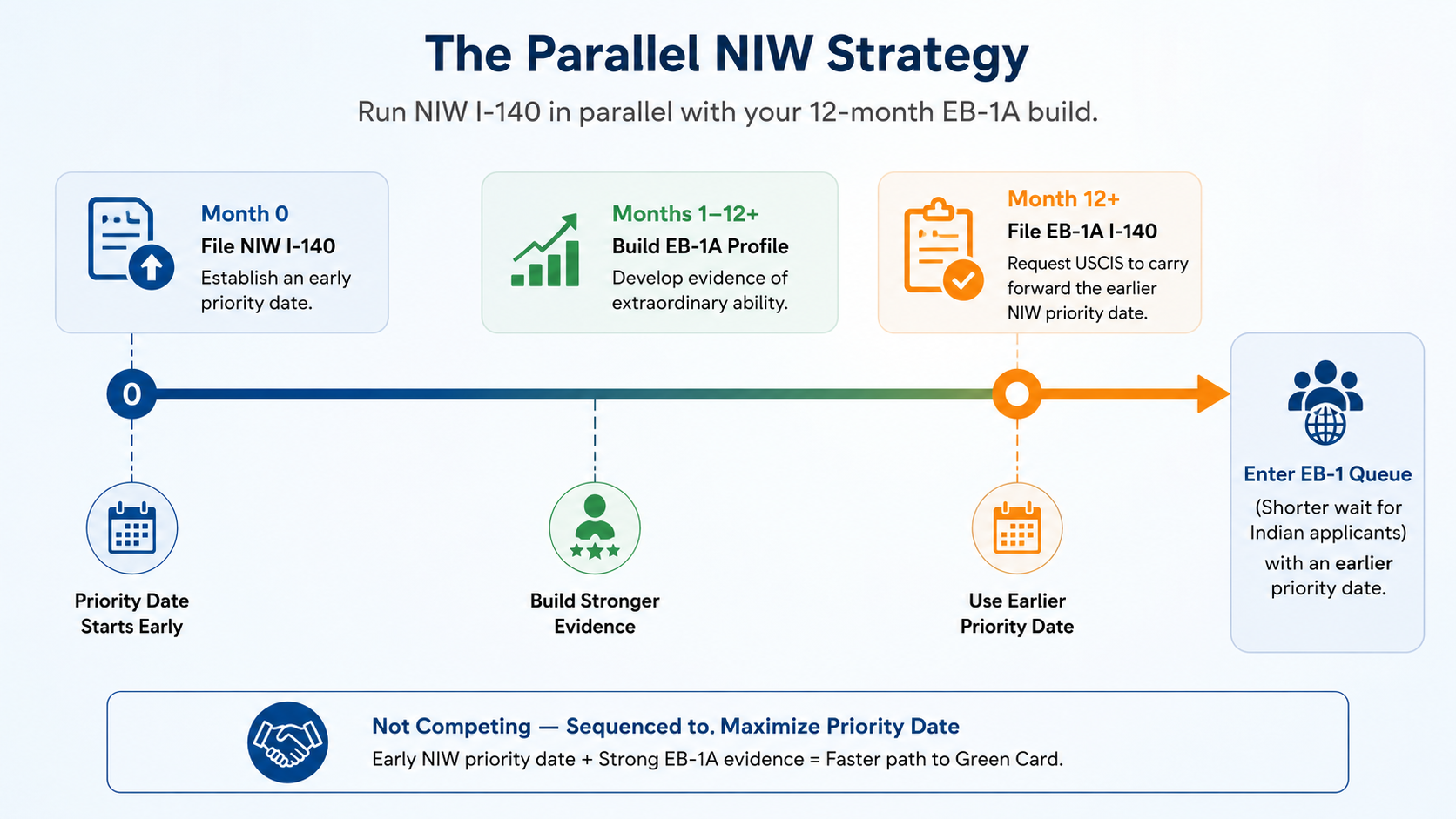
The 12-month EB-1A build should run in parallel with an NIW I-140 filing not after it.
File the NIW I-140 at the beginning of the build period. This establishes an early priority date immediately. While the EB-1A profile develops over the following 12–18 months, the NIW priority date is accumulating in the queue.
When the EB-1A record is credible typically after the 12-month build file the EB-1A and explicitly request that USCIS carry forward the earlier NIW priority date. You enter the EB-1 queue (which for Indian applicants is several years shorter than the EB-2 queue) with a date that is 12–18 months earlier than if you had waited to file NIW until after the EB-1A build was complete.
The two petitions are not competing they are sequenced to maximize priority date position while building the stronger evidence base.
Frequently Asked Questions
Can you build an EB-1A profile from scratch in 12 months?
For most mid-career professionals in senior positions, yes. The fastest criteria judging and salary documentation can show meaningful progress within 3–6 months. Media presence and expert publications typically require 4–8 months. Critical role evidence often exists and requires documentation rather than creation. A systematic 12-month effort can produce a credible filing-ready package where one did not previously exist.
Should I start the build before or after filing NIW?
File NIW first or simultaneously. The NIW I-140 captures a priority date immediately; the EB-1A build runs in parallel. Waiting to file NIW until the EB-1A is ready costs 12–18 months of priority date position, which for backlogged-country applicants can represent years of additional wait at the other end.
What is the easiest criterion to build, and why?
Judging (Criterion 4) is the most deliberately buildable for most professionals. It can be initiated in the first week of the build process, it creates independent documented evidence within 3–6 months, and the outreach process is straightforward. It is also genuinely valuable professionally participating in peer review keeps practitioners current with the field's frontier research.
How many peer reviews do I need for a credible judging history?
There is no regulatory minimum, but practice suggests that 15–25 completed reviews across two to three credible indexed journals over 12–18 months creates a history that is substantive rather than nominal. Quality matters as much as volume reviews for high-impact journals in the specific subfield carry more weight than equivalent volume for minor publications.
How do I approach a journal editorial board without it feeling presumptuous?
Directly and specifically. Editors are perpetually recruiting credentialed reviewers, especially in specialized subfields. A specific, brief email identifying the reviewer's relevant expertise and expressing interest in supporting the journal's review process is a normal professional communication. It is not presumptuous. The response rate for credentialed professionals approaching journals in their specific area is generally high.
What if I reach month 9 and a planned criterion isn't developing?
Reassess and pivot to an alternative criterion. The most common contingency: media coverage is taking longer than expected. Alternative path: redirect effort to expanding judging volume and quality (more reviews for better journals, or pursue editorial board membership at a journal where you've already reviewed). Two strong criteria plus one medium criterion is better than three medium criteria.
How do I brief a letter writer without it feeling like I'm writing their letter for them?
The briefing packet provides factual inputs specific contributions, supporting data, the legal framework not language or conclusions. The writer draws their own assessment from the inputs. What the packet does is ensure the writer has the specific, documented examples they need to write a substantive letter, rather than relying on general recollections. The difference between "I have found [Name] to be an exceptional researcher" and "In 2023, [Name]'s federated learning protocol was implemented by our research group after we benchmarked it against three alternatives I can explain specifically why we chose it" is the difference between a letter that summarizes and a letter that establishes field-level recognition.
How do I know my letter writers are genuinely independent?
Independence means no current professional or financial relationship that could appear to bias the letter. Former colleagues from a previous employer are more independent than current colleagues. Academics at other institutions who cite your work are more independent than collaborators. Government program officers in your area are highly independent. A person who benefits directly or indirectly from your success a business partner, an investor, a direct supervisor is not independent for EB-1A purposes.
What if my strongest evidence is mostly from one employer?
This is a common situation and not disqualifying, but it is a signal to prioritize external recognition-building before filing. One strong independent piece of evidence per criterion significantly changes the character of the overall case. The advisory role, judging, and media outreach activities in months 4–9 are specifically designed to create evidence that is not employer-generated.
When is the petition not ready, even after 12 months?
If the filing readiness test produces a "competent senior professional" verdict rather than an "extraordinary standing" verdict, it is not ready. The most common cause is that the criteria are technically satisfied but the evidence lacks the independence and specificity that final merits requires. The typical fix is not more evidence it is one or two better letters from more independent sources who can contextualize the criteria evidence in field terms.