
EB-2 NIW for Non-STEM Professionals: The Honest Truth in 2026
Last Updated on August 8, 2026 by Amelia
EB-2 NIW for non-STEM professionals is a pathway that raises an important question for applicants in business, finance, education, public policy, the arts, and other non-laboratory fields: can a non-STEM professional actually win an EB-2 National Interest Waiver, or is the pathway effectively closed to anyone without a research record? The honest answer is more nuanced than either extreme. EB-2 NIW non-STEM 2026 cases are filed and approved every adjudication cycle, but the strategic playbook for these petitions is meaningfully different from what works in STEM filings, and most non-STEM denials trace back to applying a STEM-style strategy to a non-research career.
This guide walks through what actually drives approvals for non-STEM applicants, where the real challenges lie, and how to build a petition that addresses the distinct evidentiary structure these cases require.
The STEM Bias: What’s Real and What’s a Myth
A few facts are worth stating clearly before anything else. USCIS does give certain weight to STEM endeavors, particularly those aligned with federally designated priority sectors. The 2026 priority list covering areas like post quantum cryptography, biomanufacturing, edge computing, and clean energy storage is heavily STEM tilted, and applicants whose work touches those areas have a structural advantage in arguing national importance.
But none of this means the Dhanasar framework excludes non-STEM applicants. The framework is field-neutral by its terms. Non-STEM petitions face a different evidentiary landscape not a closed door.
Myth: NIW is only for scientists and engineers.
Reality: This is regularly disproven by approvals across business, finance, education, public health policy, the arts, and other non-laboratory fields.
Myth: You need a PhD to file an NIW.
Reality: A PhD is one way to meet the EB-2 advanced degree requirement, not the only one. Master’s degrees, qualifying combinations of education and exceptional ability, and bachelor’s-plus-experience pathways all work.
Myth: Without academic publications, you can’t qualify.
Reality: Publications are one evidentiary path. For non-STEM applicants, they often aren’t the strongest one documented adoption, federal priority alignment, and cross organizational influence often carry more weight.
The strategic implication: non-STEM cases require a different evidentiary architecture, not a weaker one.
What USCIS Actually Evaluates
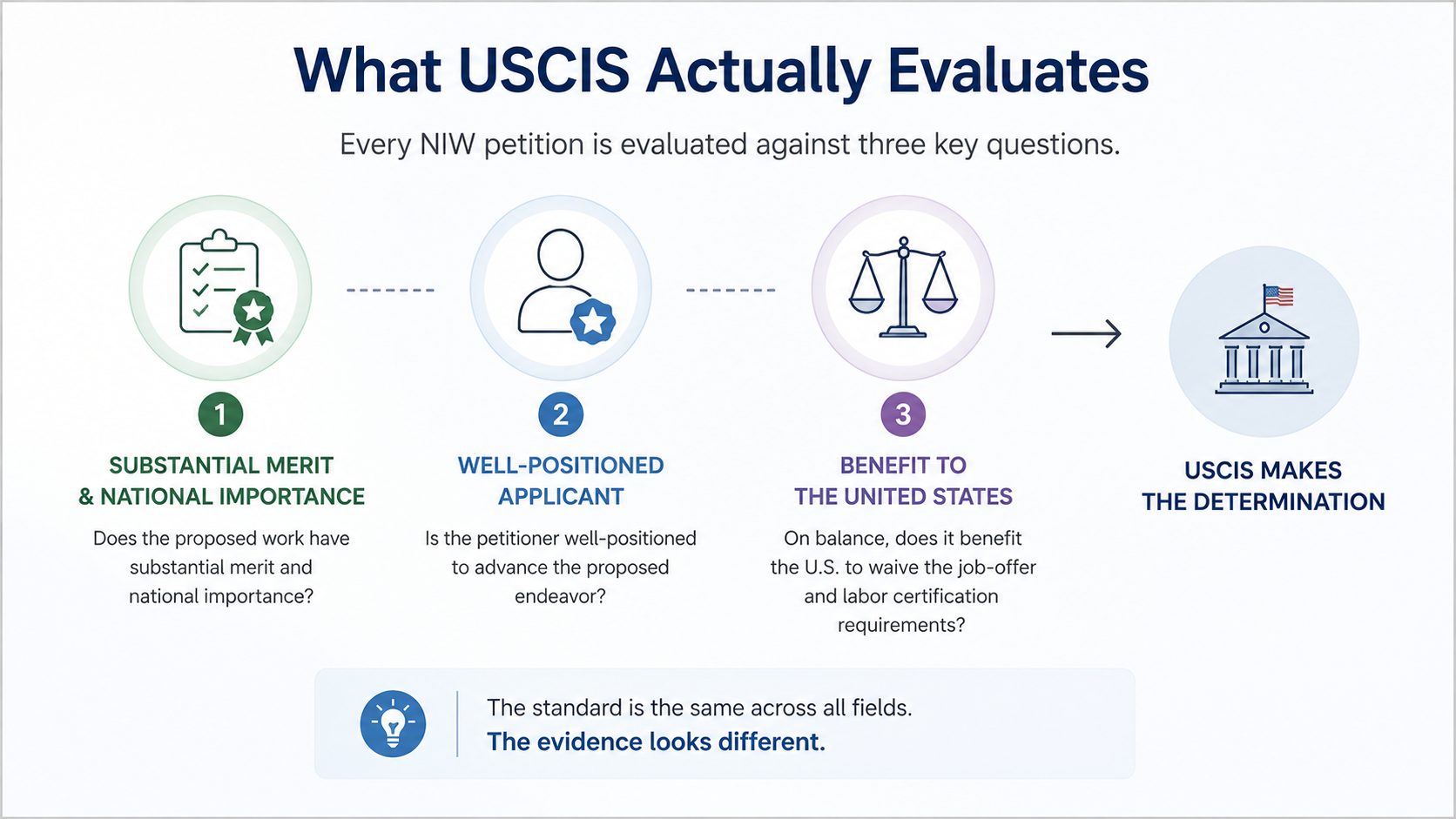
Independent of field, every NIW petition is evaluated against three questions: does the proposed work have substantial merit and national importance, is the petitioner well positioned to advance it, and on balance does it benefit the United States to waive the job offer and labor certification requirements?
Where non-STEM cases differ is how each question is answered. A semiconductor researcher proves national importance by tying their work to industrial policy and supply chain resilience. A finance professional proves it by tying their work to financial system stability, consumer protection priorities, or critical economic infrastructure. The standard is the same. The evidence looks different.
For non-STEM applicants, the most strategic shift is moving from credential centered framing to impact centered framing. STEM filings often lead with credentials (degree, citations, h-index) and let impact follow. Strong non-STEM filings lead with impact measurable influence on practice, policy, or industry and use credentials to support it.
Non-STEM Fields That Regularly Qualify
The fields below appear consistently in approved non-STEM filings. The patterns differ from one another, but each demonstrates how non-laboratory work can be framed to satisfy Dhanasar.
Finance and economic systems. Professionals working on financial system integrity, consumer protection frameworks, banking infrastructure, or systemic risk management can anchor their endeavor to federally documented priorities Treasury, Federal Reserve, CFPB, OCC, or SEC guidance documents. Strong cases tie individual contributions to specific risk areas the federal financial regulators have publicly identified.
Education policy and workforce development. Education professionals advancing curriculum standards, teacher preparation models, or workforce readiness programs can anchor petitions to Department of Education strategic priorities or Department of Labor workforce frameworks. Approved cases in this space typically involve evidence of adoption programs piloted across districts, frameworks cited in state policy, or methodologies referenced by national education organizations.
Public health policy and population health. Non-clinical public health work epidemiology, health systems design, public health communication, behavioral health policy can anchor strongly to CDC, HHS, or White House public health agendas. The federal substance use response strategy, maternal health initiatives, and pandemic preparedness frameworks each provide concrete reference points.
Business strategy in regulated or critical industries. Business professionals working in industries the U.S. government has identified as critical energy, defense, financial services, healthcare, supply chain, agriculture can demonstrate national importance through the regulated nature of the sector and the systemic effects of their work. The case strengthens when the work addresses bottlenecks or vulnerabilities federal agencies have publicly identified.
Entrepreneurship in non-STEM domains. Founders in services, logistics, social enterprise, fintech, edtech, and healthtech operations can pursue NIW where their venture addresses a recognized national problem. Acceptance into accelerator programs, U.S. venture capital validation, federal contracts, or measurable U.S. job creation all serve as evidence.
Law, legal scholarship, and regulatory work. Legal professionals contributing to regulatory frameworks, compliance systems for critical sectors, or specialized legal scholarship influencing federal practice can build credible NIW cases. The evidence often centers on adoption of legal frameworks, citation in regulatory commentary, or influence on industry compliance practices.
Arts, humanities, and cultural leadership. This is the most variable category and the one that most often gets misframed. The framing that does not work: “I will continue creating my art.” The framing that does: “To advance public cultural infrastructure through programs scalable across U.S. institutions, addressing priorities articulated by the National Endowment for the Arts or Department of State cultural exchange initiatives.” Cultural diplomacy, museum education, public humanities programming, and arts administration each have credible federal anchors.
Building the National Importance Argument Without a Lab
For non-STEM applicants, Prong 1 is usually where cases live or die. The argument has to be built deliberately rather than inferred from a research portfolio.
A useful structure:
Identify the federal priority anchor. Before drafting the endeavor, identify the federal agency, strategy document, statute, or initiative that recognizes your area of work as a national priority. This is not a name drop exercise the document needs to be real, current, and substantively connected to your work. Without an anchor, Prong 1 becomes an argument the petitioner has to win from scratch.
Frame the work as a response to a documented problem. Federal priorities exist because federal agencies have identified problems. Position your endeavor as a contribution to solving one of those problems. “To strengthen U.S. financial system resilience by developing risk modeling frameworks adopted across regional banks, addressing the systemic vulnerabilities flagged in recent FDIC and OCC guidance” is a structurally complete argument. “To continue my work in finance” is not.
Show portability. A defining feature of non-STEM Prong 1 success is showing that the work, methods, or frameworks travel beyond the petitioner’s current organization. Adoption across institutions, jurisdictions, or industry segments is the evidentiary spine.
Quantify reach where possible. Even in qualitative fields, some quantification helps: number of institutions adopting a methodology, populations affected by a policy framework, dollar value of regulatory impact, scale of measurable behavior change. Officers respond to specificity.
How to Find a Federal Anchor When No Obvious One Exists
A common stuck point in non-STEM petitions: the applicant’s field doesn’t map cleanly onto a single federal agency or initiative. The fix is rarely to invent a connection it is to look beyond the first obvious place.
A workable process:
- Start with the problem your work solves, not your field label. A human resources executive working on workforce development is not really “in HR” for petition purposes they are working on labor market participation, which connects to Department of Labor priorities, Department of Education workforce strategies, and economic competitiveness frameworks.
- Look at adjacent agencies and cross-cutting initiatives. Many federal priorities span multiple agencies. A consumer protection issue may touch CFPB, FTC, and Treasury. A school nutrition issue may touch USDA, HHS, and Department of Education. The endeavor can anchor to the cluster of priorities rather than a single document.
- Use White House cross agency strategies as bridges. Initiatives like the National Strategy on Hunger, Nutrition, and Health, the National Strategy on Suicide Prevention, or various executive orders on economic competitiveness intentionally cut across fields and provide federal anchors for work that doesn’t fit a single agency.
- Reference Congressional or GAO reports. Government Accountability Office reports and Congressional Research Service publications often document national-level problems in non-STEM domains financial regulation, social services, education outcomes, judicial administration where executive branch strategy documents are thinner.
- Use state level federal priority frameworks when applicable. For work in fields where federal authority is distributed (education, public health, criminal justice), state level implementations of federal frameworks can serve as anchors when paired with the underlying federal initiative.
The principle: federal priority alignment isn’t about finding the perfect agency. It’s about credibly placing your work inside the structure of documented national interests, using whatever combination of agency strategies, legislative frameworks, and cross cutting initiatives makes that connection most accurate.
A Worked Example: Reframing a Weak Endeavor
The shift from a weak non-STEM endeavor to a strong one is often a matter of reframing the same underlying work not changing what the petitioner actually does.
Background. A finance professional with twelve years of experience in consumer credit, currently leading risk modeling at a regional bank, considering an NIW filing.
Weak framing (initial draft):
“To continue my work in credit risk management at a U.S. financial institution, leveraging my expertise in statistical modeling and consumer lending to support the bank’s operations and growth.”
This version fails in predictable ways. It reads as a job description. The benefit accrues to one employer. There is no national-importance argument, no federal anchor, no portability evidence. An officer cannot evaluate it under Prong 1.
Strong framing (revised):
“To strengthen U.S. consumer credit system resilience by developing risk modeling frameworks that reduce discriminatory lending outcomes and improve credit access predictability for underserved populations addressing the algorithmic fairness and credit access concerns flagged in recent CFPB and OCC guidance. The methodology is structured for adoption by regional and community banks across the United States, with measurable effects on lending equity and default-prediction accuracy.”
The work is identical. The frame is fundamentally different. The revised version:
- States the endeavor as a contribution to a national level problem, not a continuation of employment
- Anchors explicitly to documented federal priorities (CFPB and OCC guidance)
- Establishes portability adoption by other institutions, not just the current employer
- Identifies measurable impact metrics (lending equity, prediction accuracy)
- Carries a public interest dimension that strengthens the third prong balancing analysis
The underlying work, credentials, and experience are unchanged. What changed is the lens from “what I do at my job” to “what my work contributes to the country.” This reframing is the single most consequential exercise in a non-STEM NIW filing.
Evidence That Carries Weight in Non-STEM Cases
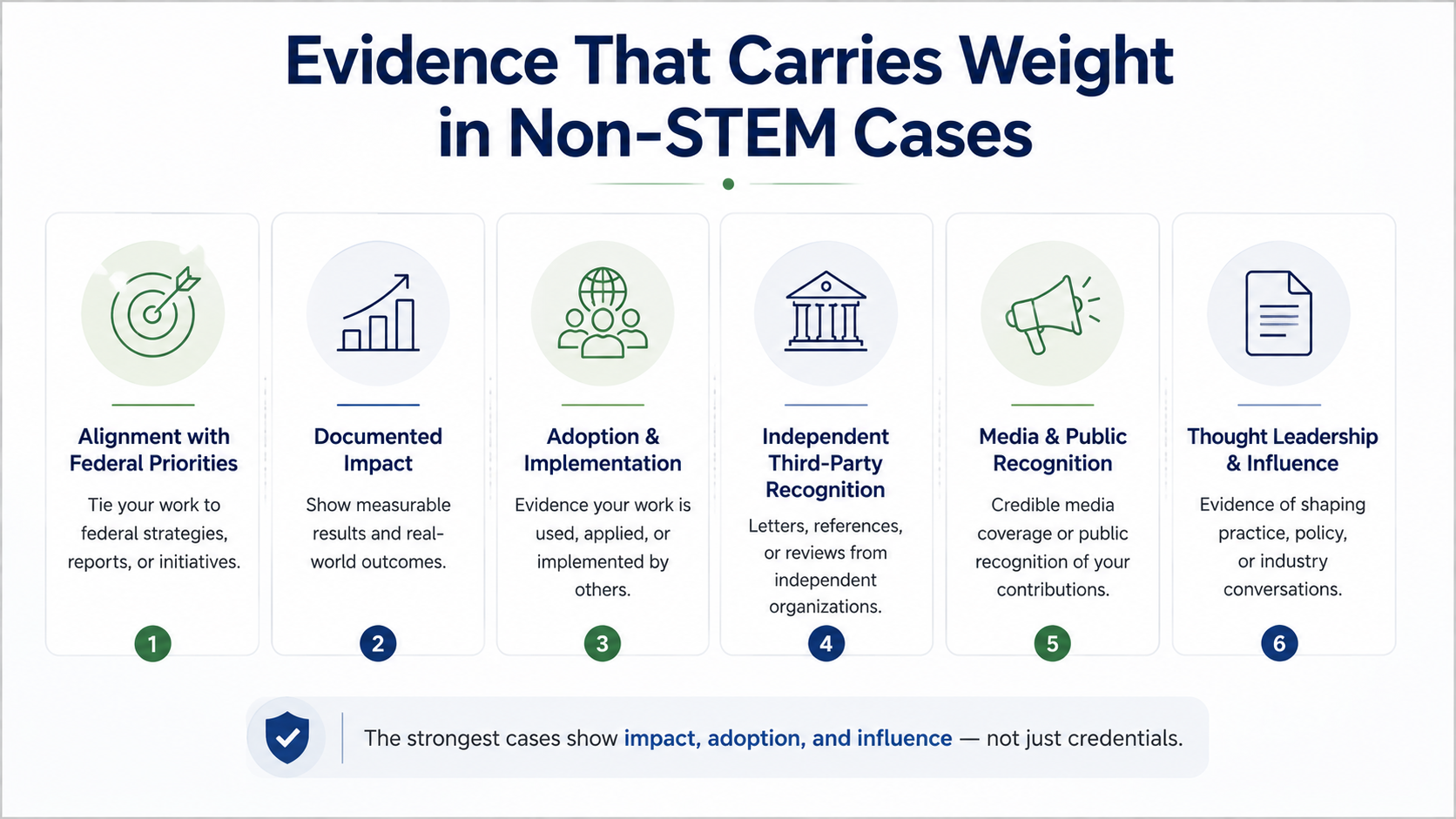
The evidence menu for non-STEM filings is wider than many applicants realize. The strongest petitions draw from several categories rather than relying on any single one.
- Documentation of adoption and influence records showing that your work, frameworks, methodologies, or recommendations have been adopted by other organizations, jurisdictions, or institutions. Often the most credible evidence for non-STEM applicants.
- Federal, state, or municipal recognition government contracts, citations in regulatory commentary, references in agency reports, appointment to advisory bodies, or invitations to participate in policy development processes.
- Industry leadership signals election to boards of major industry organizations, leadership roles in standard-setting bodies, invited keynote addresses at industry conferences, or peer recognition through professional awards.
- Media and trade press coverage substantive coverage in major business, trade, or policy publications. Not advertising style mentions, but reporting that treats the petitioner as a subject matter authority on a topic of national significance.
- Quantified business or social outcomes for business and entrepreneurial endeavors, demonstrable financial scale, employment impact, market reach, or systemic effects of the work.
- Expert recognition from outside the petitioner’s organization independent experts in the field who can speak to the petitioner’s contributions and their influence beyond a single employer.
- Speaking and editorial influence authored editorials in major outlets, invited expert testimony, regulatory comments cited in final rulemaking, or contributions to widely used industry standards or frameworks.
Evidence that typically carries less weight than applicants expect: standard employer issued performance recognition, internal promotions, ordinary client testimonials, or credentials that simply confirm qualifications without demonstrating distinct impact.
Not sure where your record stands? Get a free immigration profile audit from Immignis and find out which evidence categories your case is already strong in and where it needs reinforcement before filing.
Recommendation Letters for Non-STEM NIW Cases
In STEM cases, recommendation letters often come from co-authors, citing scholars, or senior researchers in the same subfield. Non-STEM applicants typically do not have an analogous pool. Building a credible letter strategy requires a different approach.
Look for cross organizational standing. The most valuable letter writers are independent experts people who can credibly speak to the petitioner’s influence without being colleagues, clients, or employees. Industry leaders at peer organizations, senior government officials in regulatory roles, board chairs of relevant professional bodies, and respected academics studying the petitioner’s field all qualify.
Prioritize specific examples over generic praise. The weakest letters describe the petitioner as “exceptional” or “outstanding” without anchoring those characterizations to specific work. The strongest letters describe particular contributions frameworks adopted, problems solved, methodologies replicated and explain why each one mattered at a level beyond the petitioner’s immediate organization.
Bridge the petitioner’s work to federal priorities. For non-STEM cases, expert letters that explicitly connect the petitioner’s contributions to documented federal interests carry disproportionate weight. A letter that says “this work addresses the data portability concerns flagged in recent CFPB guidance” does substantially more for Prong 1 than a letter that says “this work is important.”
Vary the letter writers’ perspectives. A petition with five letters from peer-level industry contacts reads as a coordinated chorus. A petition with letters from a regulatory official, an industry leader, an academic researcher, a senior executive at a peer organization, and a recognized policy expert reads as cross validated influence.
Real Challenges Non-STEM Applicants Face
Several challenges appear consistently in non-STEM filings and deserve direct acknowledgment.
The “ordinary employment” problem. A common denial pattern is the officer’s conclusion that the work, however valuable to an employer, is the kind of role a U.S. worker could fill making the labor certification waiver inappropriate. Overcoming this requires framing the work as fundamentally different from standard professional employment: novel approaches, demonstrated industry level influence, or contributions tied to specific national priorities.
Lack of academic-style metrics. Without citations, h-indices, or patent counts, non-STEM applicants must build a more constructed evidence narrative. This requires more deliberate documentation work than STEM filings typically need.
Difficulty identifying federal anchors. Some non-STEM fields do not map neatly onto a specific agency or statutory framework. In these cases, the burden is on the petitioner to identify a credible federal interest connection often through a combination of multiple agency priorities rather than a single dominant one.
Officers unfamiliar with the field. A petition reviewer who has adjudicated hundreds of biotech cases may take longer to engage with a financial regulatory case or a public humanities case. The petition has to teach the reviewer the field clearly, concisely, and persuasively before making the legal argument.
How to Strengthen a Profile Before Filing
For non-STEM applicants whose current record is thin, the question is whether to file now or build first. The honest answer is usually a combination: file when the case is credible, but invest deliberately in profile-building when timing allows.
Specific profile building moves that meaningfully improve non-STEM cases:
- Publish in respected industry or policy outlets. Trade journals, major policy publications, and substantive platforms with verifiable readership all contribute.
- Seek invited speaking roles. Industry conferences, policy convenings, and webinars hosted by credible organizations create documentable influence.
- Pursue formal advisory positions. Membership on industry boards, regulatory advisory committees, or non-profit boards adds external validation.
- Document adoption. When organizations adopt your frameworks, methodologies, or recommendations, create written records letters, citations, case studies that can serve as evidence later.
- Cultivate cross-organizational relationships. The recommendation letters that matter most years from now come from relationships built today across organizational lines.
These are not artificial credential-building exercises if approached substantively. They are the natural pattern of someone building actual influence in their field which is what the NIW evidentiary standard is ultimately measuring.
Common Misconceptions
Myth: My work has to be globally important.
Reality: National importance is the standard, not global importance. Work that benefits the United States at a national level economically, socially, or in critical sectors meets the bar.
Myth: I need a federal grant to qualify.
Reality: Federal grants are strong evidence but not required. Many approved non-STEM cases lack federal funding entirely. The standard is national importance of the work, not federal sponsorship of it.
Myth: My field needs to be on the priority sector list.
Reality: The 2026 priority sectors strengthen petitions whose work aligns with them. They do not exclude other fields from establishing national importance through documented agency priorities, sector frameworks, or systemic relevance.
Myth: If I can’t be filed as STEM, I should give up.
Reality: Reframing matters more than category. A finance professional working on financial-system stability is, in the practical sense, working on critical economic infrastructure a recognized federal priority even if the technical “STEM” designation does not apply.
Frequently Asked Questions
Can non-STEM professionals qualify for an EB-2 NIW?
Yes. The Dhanasar framework is field-neutral. Non-STEM applicants in business, finance, education, public policy, the arts, and other fields are regularly approved when their proposed endeavor satisfies the substantial merit and national importance standard with appropriate evidence.
What non-STEM fields most commonly qualify?
Finance and economic systems, education policy, public health policy (non-clinical), business strategy in regulated industries, entrepreneurship in non-STEM domains, legal and regulatory work, and arts and cultural leadership are the most common.
Is NIW harder for non-STEM applicants?
Not categorically. The evidentiary landscape is different and often requires more deliberate construction. STEM fields more easily map to recognized national priorities, but non-STEM cases succeed regularly when built around documented federal interests and demonstrated impact beyond the petitioner’s employer.
Do I need a PhD to file as a non-STEM NIW applicant?
No. A PhD is one way to meet the EB-2 advanced degree requirement, but it is not the only one. A U.S. master’s degree, or a bachelor’s plus five years of progressive professional experience, qualifies. The exceptional ability alternative provides another route.
What evidence works best in non-STEM NIW cases?
Documentation of adoption and influence frameworks, methodologies, or work used by organizations beyond the petitioner. Government recognition, industry leadership signals, substantive media coverage, quantified business or social outcomes, and independent expert recognition all add weight.
How do I show national importance without research publications?
By identifying a documented federal priority your work addresses, demonstrating that the impact of your work travels beyond a single organization, and providing evidence adoption, citation, replication, policy influence that the work has measurable reach at a level above the local.
Should I wait to build my profile before filing?
It depends on the current state of the record. A credible case should be filed when the evidence supports it. A weak case benefits from deliberate profile-building before filing, particularly in publishing, speaking, advisory work, and documented adoption of the petitioner’s contributions.
Can entrepreneurs in non-STEM fields qualify?
Yes. Non-STEM founders in services, fintech, edtech, healthtech operations, and social enterprise are filing successful NIW cases. The argument typically rests on the venture’s contribution to a recognized national problem, demonstrated traction, U.S. job creation, and validation through accelerators, investors, or contracts.
What is the most common reason non-STEM NIW petitions fail?
Framing the endeavor as ordinary employment that benefits a single employer rather than as work with portable national level impact. Officers cannot waive the labor certification requirement for work that looks like a routine job.
Are non-STEM approval rates lower than STEM approval rates?
Approval rates vary by field, evidence quality, and case structure rather than by STEM versus non-STEM designation. Well-constructed non-STEM cases with strong portability evidence and federal-priority alignment do not face a categorical disadvantage at adjudication.
If you are evaluating whether your non-STEM background supports a credible NIW filing, the most efficient first step is a structured profile review. Book a NIW strategy consultation for non-STEM professionals with Immignis to assess your record against current adjudication standards and identify the evidence framework most likely to succeed for your specific field.


Comment
EB-2 NIW Advanced Degree Requirement: The Essential PhD Truth
August 27, 2026 - 4:59 am[…] places a petitioner inside the EB-2 category it does not address whether the NIW will be granted. A Ph.D. holder in engineering who files an NIW petition has satisfied the degree requirement. If they have not […]